




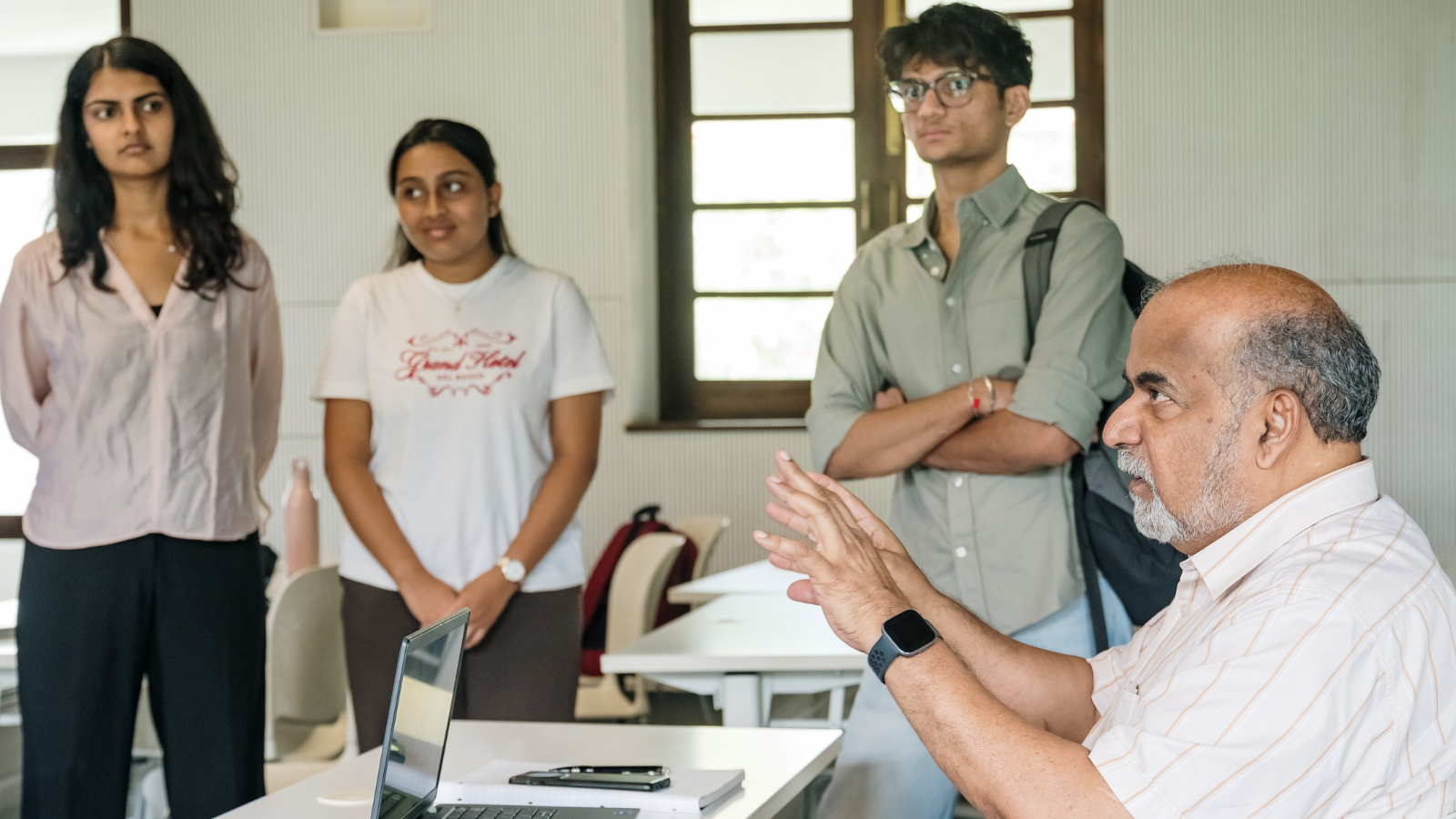
In a classroom, a professor explains an idea in many ways until you all get it. In a boardroom, the industry mentor says it only once, and then you are expected to start working with it. The next week, the mentor may change his mind, and you need to adapt quickly to the new idea. Welcome to the real world! Satish Deshpande, Professor of Practice at Ahmedabad University’s Amrut Mody School of Management, places MBA students in that ‘boardroom’ simulation for a year and mentors them through it.
Picture the first meeting as Professor Deshpande describes it. Students walk in for a briefing, may mistake the client mentor for a professor, start taking notes, and then hope for more clarification! Then within days the priorities may change. “Things are changing on a day-to-day basis,” he explains. Getting adapted to it before delivering value is part of why, in his experience, fresh graduates often need a year or two of training before a company finds them useful.
The Focused and Integrated Experiential Learning and Development (FIELD) Project embeds a year of real-world company work into the MBA. His aim is to get students industry-ready sooner. “If we can measure the skills of the students at the start of the project, those the industry needs, and if they grow significantly by the end of the project”, he says, “that would be the real success of this program.” Professor Deshpande calls this project “very unique.” Elsewhere, he says that experiential learning is not connected to live events at the company. As a visiting lecturer at many institutes, he has found that very few last more than two or three months. “Almost never do you own the project.” In the FIELD Project, students “have to actually go in the field, test hypotheses and implement decisions for the company.”
In his doctoral work, Professor Deshpande studied the hidden costs of syndication, a practice in which private equity investors team up to share strengths and risks. Examining how those costs affect performance, he describes slower decision-making as one downside of teamwork: “decision-making slows down considerably” in syndicated firms. FIELD Project teams meet the same pull of different views. Before any project is offered, students form their own teams, with an emphasis on mixing backgrounds. “First and foremost,” he says, “they have to learn to stay together.”
Then he has to break a myth. Students arrive sure of their lane: I am good at marketing, and I shall only do a marketing project. “There is nothing like a marketing project,” Professor Deshpande tells them. “Every project is accounts, finance, human relations, logistics, marketing, operations, strategy and supply chain.” They don’t believe him at first. As the project goes on, they do, because you cannot implement a change for a company, he says, until you understand all parts of it.
Professor Deshpande has lived that. He spent about 20 years in operations, including running a manufacturing company, then made about 40 investments across dozens of industries as a private-equity manager, which meant buying stakes in companies and monitoring them at board level. Vendor selection and management, hiring talent, incentivising salespeople, designing KPIs and monitoring them with MIS, studying competition, setting targets and communicating company strategy and vision: he has done it all from the inside, and he shows students how they connect with each other.
Mentoring is Professor Deshpande's job in the FIELD Project, and it is what he cares about most. His conviction comes from an internship study he read. The student’s drive explained less than a third of success. Mentors supplied the rest, through empathy and, above all, wanting the student to succeed. A mentor who watches a B or C grade team effort limits his own effort accordingly, he says. A mentor who keeps an “emotional distance” can see the project through, but may not bring out the best in the team. He sees the other result every year: some students deliver above-level performance. “They were encouraged to do well because someone believed in them.”
Back in that boardroom, the mentor will share his thoughts of that day, and he may change his mind the next day or next week. A FIELD Project student will spend more than a few days and weeks, a whole year in the boardroom experiencing these changes; reflecting and analysing them and then acting on them. They are now ready to join the corporate world.
“The whole idea of an MBA programme,” Professor Deshpande says, “is that the students are able to deliver value to the business, to their own or to the one that hired them, the day they join it.”
Students and researchers interested in this work can reach Professor Satish Deshpande through the faculty page at Ahmedabad University.