6 October 2026
Student-Led Research Wins International Recognition for Addressing Core Challenges in Medical AI at MICCAI 2026
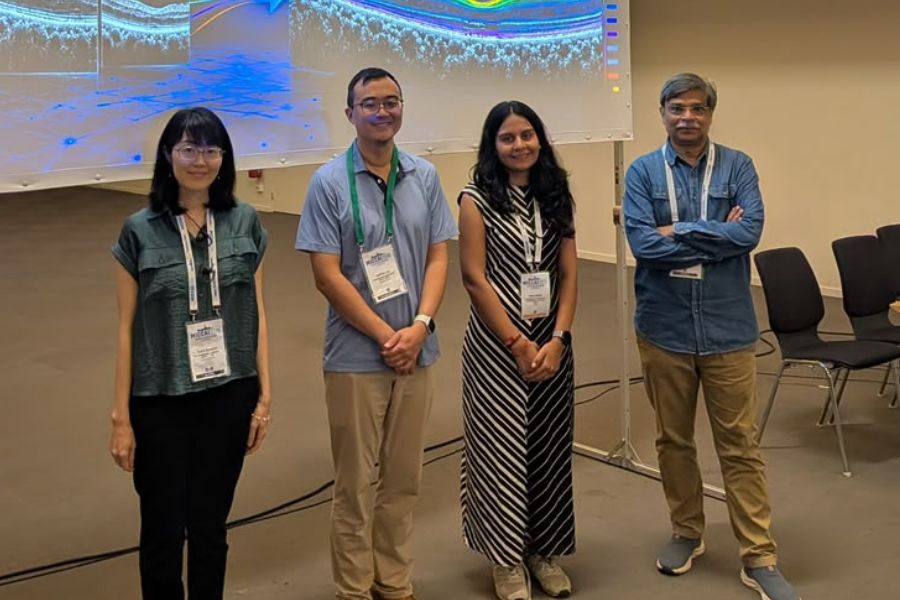
Can an AI model trace an image back to its underlying physics, generalise across unfamiliar scanners, or truly reason about a diagnosis? At MICCAI 2026, the Medical Image Computing and Computer-Assisted Intervention conference, held in France, Ahmedabad University's students, alumni, and faculty did not just compete. They used each benchmark to pursue a genuine, open question in medical imaging. Their work earned a major competition victory, a top-five placement, and four peer-reviewed papers at the conference.
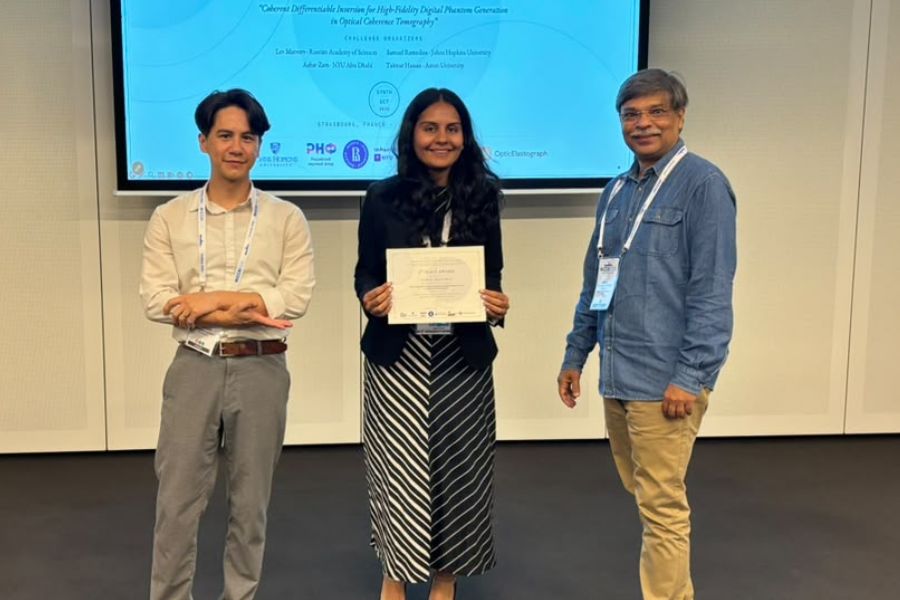
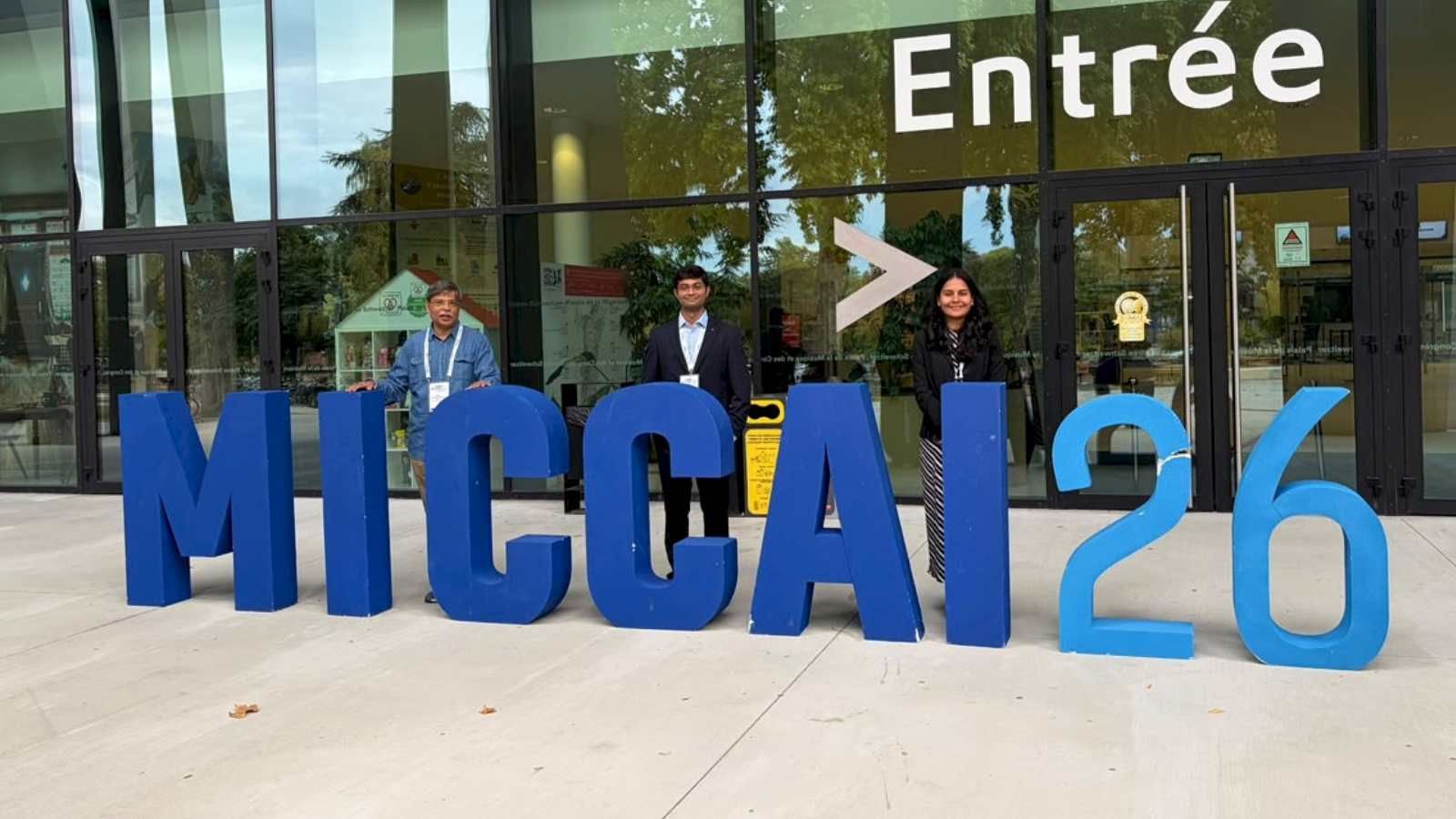
Representing Ahmedabad University were Ura Modi, BTech Class of 2027, and alumnus Harman Jani, Junior Research Fellow on a University Challenge Grant brain tumour segmentation project, under the guidance of Professors Mehul Raval and Jayendra Bhalodiya. Ura secured first place among 12 international teams in the SynthOCT Challenge.
What began in an undergraduate computer vision course led Ura to solve a fundamental question in medical imaging: how to trace an Optical Coherence Tomography (OCT) scan back to its physical source. After standard AI models hit a performance wall in the SynthOCT challenge, Modi broke through by building a physics-grounded, differentiable copy of the scanner to reverse-engineer the tissue scatterers that created the image. The winning approach also earned her a paper in the Springer LNCS proceedings and an oral presentation.
In clinical practice, AI models often fail when applied to imaging equipment they weren't trained on. Addressing this gap, the team competed in the DA-OCT challenge to build scanner-agnostic algorithms for Optical Coherence Tomography. Standing out among 107 international teams and 461 submissions, their top-five result earned them invitations to co-author the official challenge paper and submit a full research extension to the Translational Vision Science & Technology journal.
Beyond accuracy scores, medical AI must demonstrate genuine clinical reasoning rather than simply outputting correct-looking answers based on pattern matching. Addressing this challenge, the MedReason project evaluated how multimodal AI systems process visual and textual data together. The team's insights were accepted for publication in the MICCAI 2026 Springer LNCS proceedings, and they were selected to co-author the official global challenge summary.
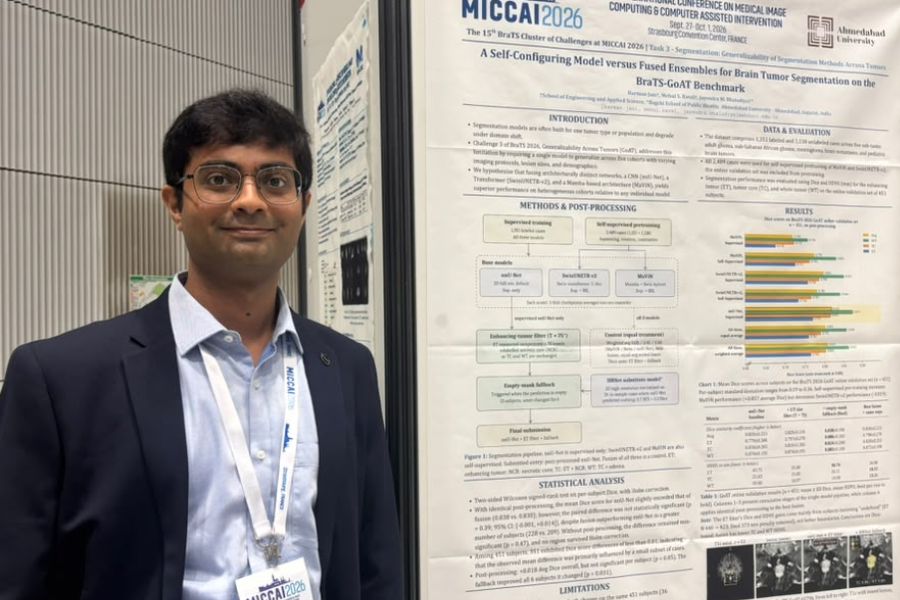
BraTS-GoAT, short for Brain Tumour Segmentation – Generalisability Across Tumour types, and part of the BraTS 2026 series, was a benchmark designed to test how well different methods generalise across tumour types. Here, Harman presented a paper co-authored with Professor Jayendra Bhalodiya, examining a central question in the field: does an ensemble of models really beat a single, self-configuring one? Their paper, "A Self-Configuring Model versus Fused Ensembles for Brain Tumor Segmentation on the BraTS-GoAT Benchmark," took on a deceptively simple assumption in the field: that combining multiple models into an ensemble reliably improves results.
The team studied when ensembles genuinely help, and when a single, carefully configured model is hard to beat. The work was presented in a benchmark that attracts top researchers worldwide, including NVIDIA, Google, Oxford, Cambridge, MIT, Stanford, IITs, IISc, and many more. The accepted paper ranked among the top 2 per cent of submissions from registered participants.
Reflecting on the deeper purpose behind the achievement, Ura says, "Behind every result is a simple quest: to understand a hard problem a little better than yesterday." At Ahmedabad University, students pursue such questions in an environment shaped by rigorous inquiry, close mentorship, and access to advanced research infrastructure, including Stepwell, the University's High-Performance Computing (HPC) facility. Together, these enable students to tackle complex computational problems, learn from challenging experiments, and push the boundaries of their fields.