15 September 2025
BTech Student Studies Aerodynamics of Crop-Damaging Whiteflies at Tel Aviv University
How can aerodynamics and fluid mechanics principles explain the mysteries of whiteflies' flight, an agricultural pest that damages crops across many countries? Understanding their flight pattern can help scientists design better strategies to control their spread. Contributing to this understanding better is Ahmedabad University student Ayan Patel, BTech Class of 2026, who leverages mechanical engineering tools to answer biological questions.
Ayan studied how whiteflies, which are just 1-2 millimetres in size, can fly relatively longer distances from what is expected based on conventional steady-state aerodynamics. Ayan spent his summer at Tel Aviv University as a research intern in the Biomechanics of Animal Locomotion Laboratory, School of Zoology.
He aimed to identify the patterns and frequencies of their flight in different regions and conditions to predict when and where whiteflies are most active. This could potentially provide insights for agricultural researchers to develop targeted interventions.
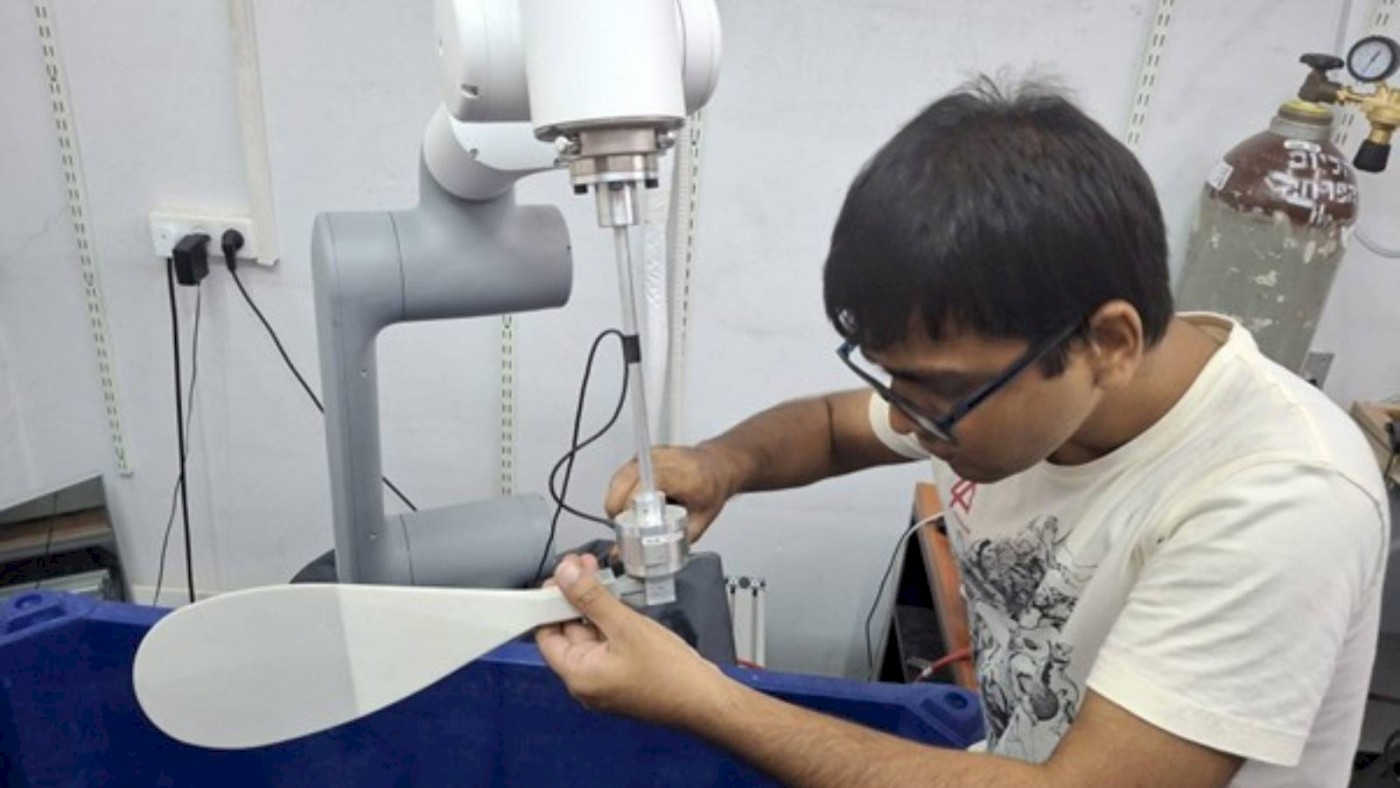
Ayan used computational simulations (CFD – Computational Fluid Dynamics) and built a scaled-up model of the insect's wing, which allowed him to study the fluid-structure interaction around the whitefly wing. He adjusted variables such as fluid viscosity, wing chord length, and mass to ensure that the physical conditions of the experiment mimicked the real environmental factors during the insect flight.
He tested how the wings can traverse through a fluidic medium using a robotic arm, measuring the variation of lift and drag forces on the wing at various angles of attack (AoA) via a force transducer. The study also revealed that miniature insects rely heavily on unsteady flow phenomena like vortex shedding and wake formation, which help them conserve energy during flight.
Beyond agriculture, he also studied the technological applications of research. These biomechanics can inspire the design of micro aerial vehicles and flapping-wing robots, which could be used in surveillance, environmental monitoring, or disaster relief operations which demand high maneuverability in cluttered environments.
When asked about his acceptance into the competitive summer research programme, Ayan emphasised his foundation at Ahmedabad University. "The skills I acquired, especially through the Undergraduate Research Programme (UGRP) under Professor Anamika Maurya, were a real differentiator," he noted.
He also highlighted his technical advantage, "Learning advanced commercial simulation software like COMSOL Multiphysics and ANSYS Workbench at the undergraduate level gave me a strong edge. Many students often encounter these tools directly during their post-graduate studies or in the industry."
The combination of hands-on research experience and technical expertise in computational modelling and fluid dynamics simulation became the key to his acceptance. His additional Teaching Assistant experience at Ahmedabad University and prior corporate internships further strengthened his application.
"Real-world challenges are never confined to a single domain. They demand insights from multiple perspectives. I learned this at Ahmedabad University and could apply it in real life during my summer research in Israel. Working with people from disciplines beyond my own, including biologists, zoologists, and researchers from different countries, helped me develop practical problem-solving approaches," said Ayan.
"At the University, I studied visual arts, humanities, and biology beyond my core mechanical engineering courses. This foundational understanding of other disciplines became an icebreaker for collaboration and helped me grasp certain biological concepts more easily. It also allowed me to see how mechanical engineering can find purpose in fields like biology, a mindset that made all the difference during my research," Ayan concluded.
Through this project, Ayan bridged biology and mechanical engineering, showing how studying nature's smallest flyers can lead to innovations with applications in zoology and the development of bioinspired flying robots.