



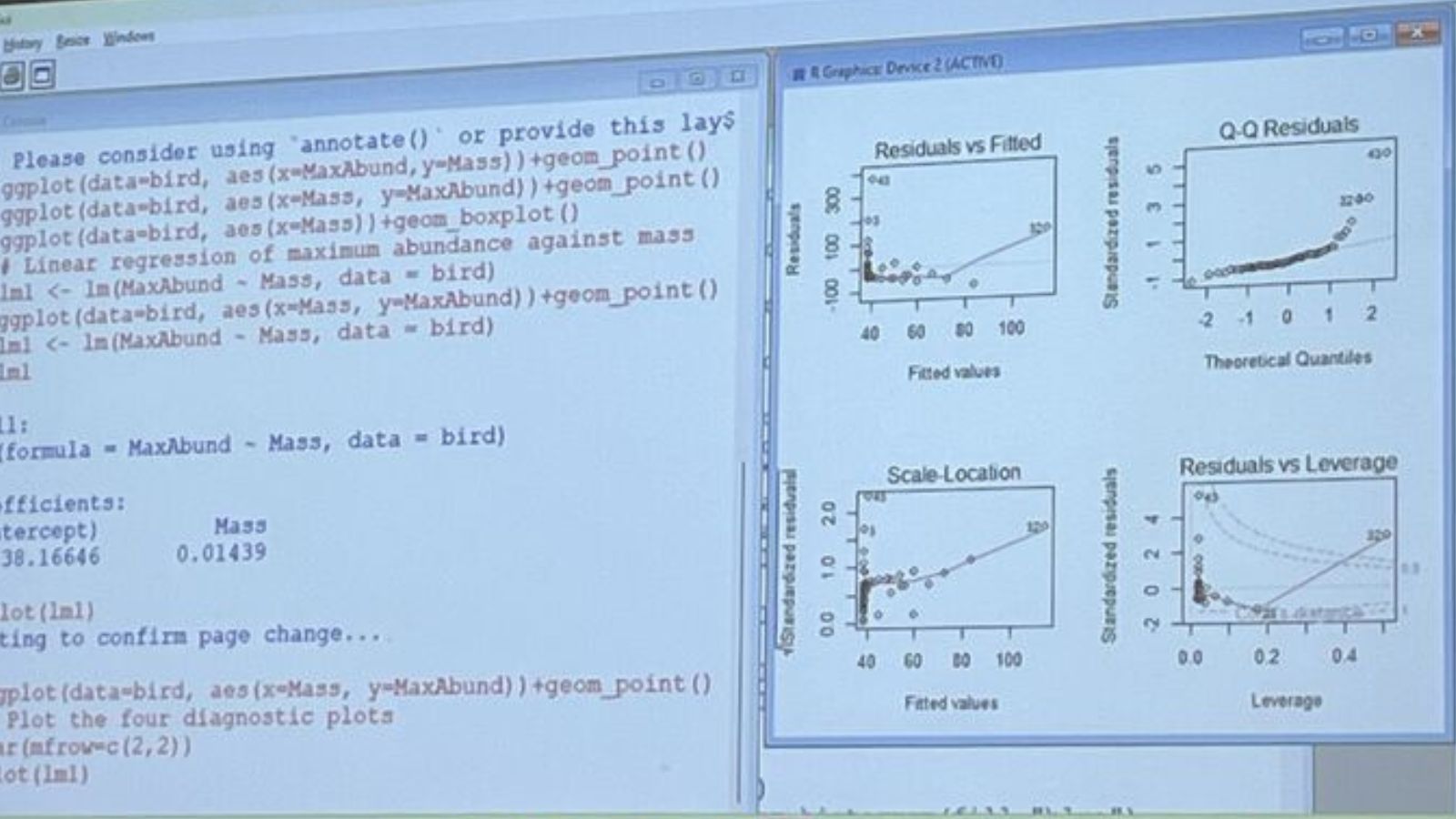
In today's data-driven world, data has emerged as one of the most valuable assets. With this shift, data analysis and visualisation tools have become indispensable, making proficiency in these areas a must-have for modern learners aiming to evolve into future-ready professionals. In line with this vision, Ahmedabad University professors Chetkar Jha, Keita Omi, and Neelanjan Sircar conducted a dedicated R Programming workshop exclusively for varsity students.
Designed to enhance students' data analysis and visualisation capabilities, the workshop introduced participants to the fundamentals of R programming, facilitated hands-on exercises using real-world datasets, explored powerful data visualisation techniques, and offered practical guidance on developing efficient data workflows.
What is R Programme?
R, a robust open-source programming language and software environment, is tailored explicitly for statistical computing and data visualisation. A preferred tool across disciplines such as data science, finance, and academia, its ability to handle complex statistical models and produce compelling visuals makes R an essential skill in the data science toolkit.
Empowering Learners
Nivedita Shah, an Economics major, offered a careful breakdown of the workshop, which was divided into two focused sessions. "The first session, led by Professor Neelanjan Sircar, began with an overview of R and its ecosystem. We started by understanding the basics of R programming," said Nivedita. "We learned to navigate the R environment, explored core concepts such as vectors, and practiced essential functions like mean(), max(), min(), and conditional statements using if-else. We also worked with the dplyr package to clean, filter, and summarise data. This foundation really helped us get comfortable with R," she concluded.
The second session was split between Professors Chetkar Jha and Neelanjan Sircar. The first half, led by Professor Jha, focused on data visualisation and manipulation. Students learned to create and interpret histograms, QQ plots, and residual versus fitted plots—key tools for understanding data distributions and evaluating model performance. The second half, again led by Professor Sircar, steered participants through deeper data analysis practices, including filtering datasets, calculating descriptive statistics, and performing cross-tabulations to extract meaningful insights.
For Sarah Singh, a student majoring in Finance and Economics, the workshop was an ideal introduction to the field. "This hands-on workshop was the perfect starting point," she shared. "From exploring and cleaning data to visualising it using R, everything was structured in a beginner-friendly and interactive way that made learning seamless and engaging."
Parmita Mahant, a Psychology major just beginning her journey into data analysis, also found the experience immensely valuable. The clarity of instruction and approachable pace helped Parmita familiarise herself with the different components of R programming. "I learned how to create and work with vectors, sort and arrange data, and apply logical operators," she said. "I'm deeply grateful to the professors for making the workshop so accessible—even for someone like me, with no prior exposure to R."
The workshop highlights Ahmedabad University's commitment to equipping students with industry-relevant skills through interdisciplinary learning experiences. With initiatives like these, the University continues to nurture analytical thinkers capable of tackling complex real-world challenges.