



An Ahmedabad University professor uses borrowed tools from hydrology to ask whether markets are really as irrational as we think.
Every few years, a bubble swells and bursts, and the same question returns: if markets are so smart, how did this happen? Professor Vinodh Madhavan, Programme Chair of the Master of Science in Quantitative Finance at Amrut Mody School of Management, has spent about 15 years asking a different question. Is the flaw in the markets, or in how we measure them?
His answer begins with a river. British hydrologist H. E. Hurst, studying the Nile, faced a trade-off. A reservoir that is too small runs dry in a long drought. One that is too high costs far more than it needs to. The task was to find the sweet spot: just big enough to store the surplus of wet years and see people through the dry ones. To find it, Hurst studied decades of river flow data and noticed that it has a kind of memory. A wet year tends to be followed by another, and a dry one by more of the same. He built a measure for it, now called the Hurst exponent.
Mathematician Benoit Mandelbrot later applied the idea to prices, including cotton prices, and argued that markets have long memory, too. If past prices shape future prices, the market can, in principle, be beaten. Others countered that this “memory” is a statistical illusion. “There is always this intellectual tension,” Professor Madhavan says.
He works between the two camps. One school, Efficient Market Hypothesis, holds that markets are always efficient; the other, behaviour economics, holds that they never are. Madhavan favours the adaptive market hypothesis, proposed by Andrew Lo, which borrows from evolutionary biology.
In nature, species survive by adapting. An animal perfectly suited to one habitat can struggle when the climate shifts, and those that adjust are the ones that endure. Madhavan favours the adaptive market hypothesis, which holds that markets behave in much the same way. Investors learn by trial and error, and a winning strategy spreads until too many people copy it and it stops working.
When the environment changes, through new rules, new kinds of investors, or new technology, old habits stop paying off, and the market goes through a brief period of disruption before it adapts again. So markets are mostly “efficient”, meaning prices already reflect what is known and are hard to beat, with short bursts of inefficiency in between. The question is no longer “efficient or not?” but “how efficient, and when?”
His latest study asks whether the inefficiency earlier researchers found is real. Those studies used tests that look for patterns in market prices, and any pattern was taken as a sign the market was inefficient. Professor Madhavan argues many were false alarms: prices naturally swing more in some periods than others, and the tests mistook that for a pattern. For 19 G20 countries, he removed those swings first and made the tests harder to trigger by accident. In 14 of the 19 markets, clear inefficiency no longer showed up. “You see what you wanted to see because of the way you went about searching for it,” he says.
It isn’t a clean verdict. Tidying the data this way can also hide real patterns, so the five markets still showing traces are a minimum. Even so, it matters: without the fix, the tests cried “pattern” even when there was none. Markets are not perfect, he says, but “they are not as inefficient as we make them out to be.” Whatever opportunities to ‘beat the market’ remain are fleeting, lasting mere nanoseconds, the territory of algorithmic traders rather than bubble-spotting investors.
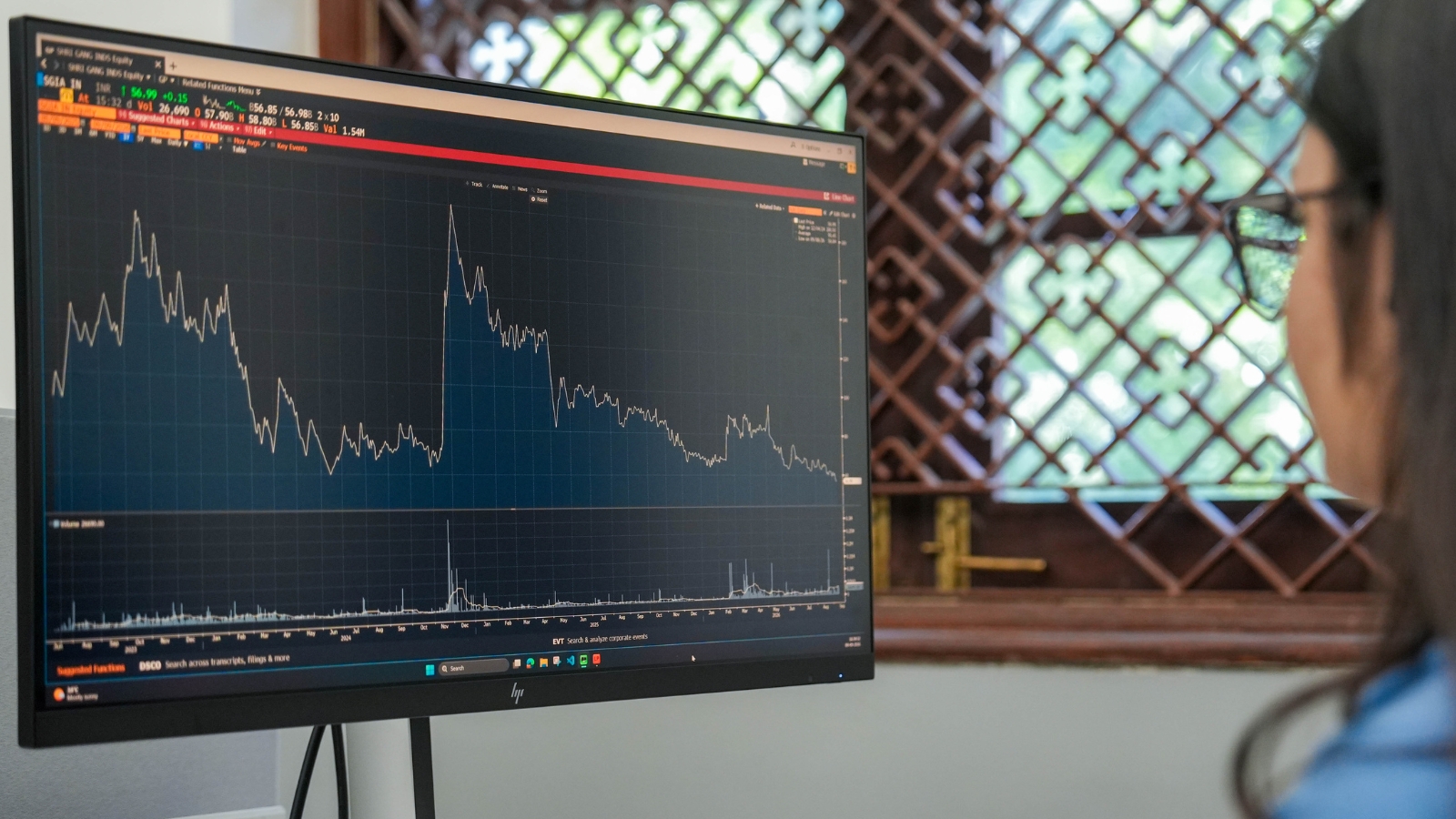
So what of the bubbles and crashes? They are real, he says, but not the full picture of efficiency. Ideas like his were once a hard sell to mainstream finance journals, though he sees that changing. And the tools for testing them have never been better. He sees AI as an opportunity rather than a threat, and at Ahmedabad University, the machinery is on campus: Bloomberg Lab (which gives students and researchers access to real-time market data) and a high-performance computing (HPC) cluster. A researcher can describe an idea to an AI tool, get a working program back and test it on the cluster. What once took three to four months now takes hours. “The opportunity is enormous,” he says.
Students and researchers interested in this work can reach Professor Vinodh Madhavan through the faculty page at Ahmedabad University