
Turning Waste to Wealth: CO2 Conversion and Lithium Ion Battery
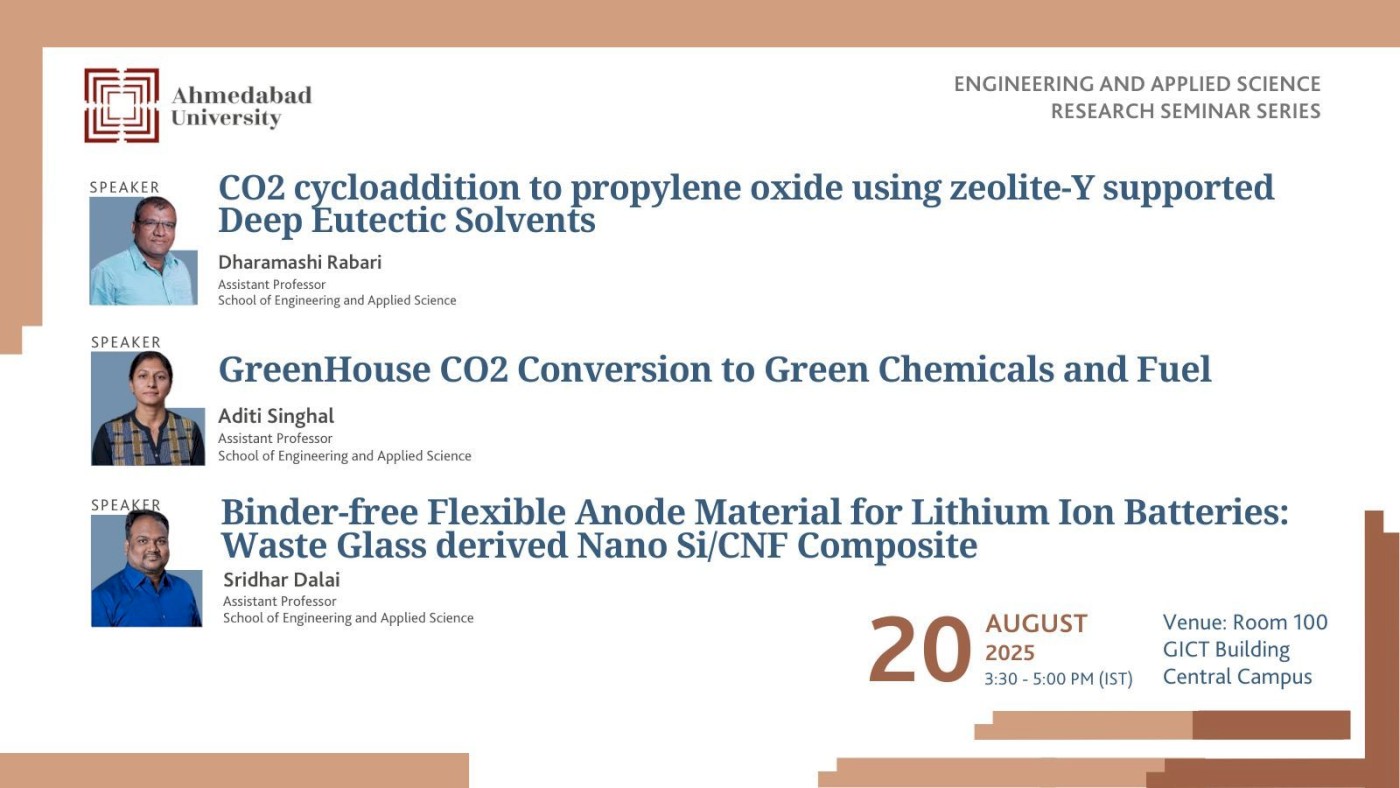
GreenHouse CO2 Conversion to Green Chemicals and Fuels
Aditi Singhal, Assistant Professor, School of Engineering and Applied Science
Electrochemical reduction of CO2 effectively combats environmental degradation and promotes sustainable economic growth. The study aims to convert industrial CO2 emissions into valuable products like Methane and Isopropyl Alcohol using a new class of Copper catalysts. The research will analyse the catalysts' individual and combined effects to produce new knowledge on electrocatalytic activity and offer practical, applicable research findings. The project enhances the understanding of the CO2 electroreduction process.
CO2 cycloaddition to propylene oxide using zeolite-Y supported Deep Eutectic Solvents
Dharamashi Rabari, Assistant Professor, School of Engineering and Applied Science
This study used deep eutectic solvents (DESs) supported on zeolite-Y as catalysts to convert CO2 into valuable products. The research focused on the cycloaddition of CO2 to propylene oxide to synthesise propylene carbonate. The project used both experimental and theoretical approaches. Researchers experimented in an autoclave, varying the hydrogen bond donors in the DES (urea, ethylene glycol, or glycerol) and analysing the resulting product. They also performed computational work using Density Functional Theory (DFT) to study the interaction of CO2 with the DES molecules.
Binder-free Flexible Anode Material for Lithium Ion Batteries: Waste Glass derived Nano Si/CNF Composite
Sridhar Dalai, Assistant Professor, School of Engineering and Applied Science
The research explores using silicon (Si) derived from waste laboratory glassware as a high-capacity anode material for Li-ion batteries. Silicon offers a theoretical capacity 10 times greater than conventional graphite but suffers from pulverisation during cycling. A composite material was created to address this by embedding the waste-derived Si in a carbon nanofiber (CNF) matrix. The Si/CNF composite leveraged the strengths of both materials: carbon's electronic conductivity and silicon's high lithium storage capacity. This combination resulted in a stable cycling performance superior to conventional graphite anodes.
Date: Wednesday, August 20, 2025
Time: 3:30 - 5:00 PM IST
Venue: Room 100, School of Engineering and Applied Science, Central Campus


