
Wednesday
15
October 2025
2:30 - 3:30 PM IST
Location
Room 202, School of Arts and Sciences
Central Campus
Share
From Seeing to Believing: Making and Using Images
Arts and Sciences Research Seminar Series
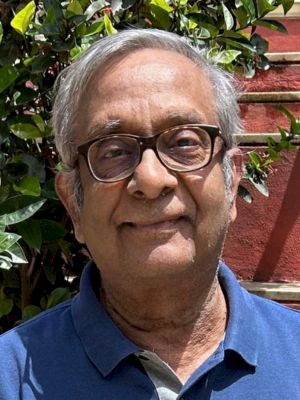
Rajaram Nityananda
Professor
ICTS Bangalore
Speaker
The distinction between object and image goes back to Plato’s cave. Today, only a fortunate few do not have a collection of MRI images and CT scans, on the basis of which major decisions have to be made. Both techniques won Nobel prizes, and use Fourier transform principles, which also won Nobel prizes in astronomy and crystallography. An added ingredient is the use not just of the data but ‘a priori’ information about the object being imaged, taking us into long standing controversies of statistical inference. Even before these are settled, AI bursts on the scene, swallowing and digesting all the images available and promising/threatening to annihilate all the techniques that we knew and loved.
Speaker
Rajaram Nityananda
Rajaram Nityananda studied physics at the Vivekananda College and IIT Madras, and did his PhD with Professor S. Ramaseshan at the National Aeronautical Laboratory, Bangalore in 1975. He joined the Raman Research Institute in 1975, where he worked for nearly 25 years. He served as Director of the National Centre for Radio Astrophysics (NCRA-TIFR) between 2000-2010. This was followed by stints at TIFR Hyderabad and IISER Pune, and at Azim Premji University (2014-21). He is currently affiliated with ICTS Bangalore. He is a Fellow of the three Indian Science Academies and has served as editor of Pramana, Journal of Astrophysics and Astronomy, and Resonance. He has a keen interest in teaching basic physics and communicating physics and astronomy to a general audience.


