
• About Ahmedabad
  • Stepwell
  • Student Affairs
  • Alumni and Advancement
  • Collaborate With Us
  • Media
  • Academics
    • Schools & Centres
      • Amrut Mody School of Management
      • Bagchi School of Public Health
      • School of Arts and Sciences
      • School of Engineering and Applied Science
      • Undergraduate College
      • Graduate School
      • Ahmedabad Design Lab
      • Centre for Heritage Management
      • Centre for Learning Futures
      • Global Centre for Environment and Energy
      • International Centre for Space and Cosmology
      • Sahyog: Centre for Promoting Health
      • Stepwell Centre for Asian Futures
      • The Climate Institute
      • The Institute of Manufacturing and Economy
      • VentureStudio
    • Programmes
      • Undergraduate Programmes
      • Graduate Programmes
        • Masters Programmes
        • Doctoral Programmes
      • Continuing & Executive Education
    • Learning Initiatives
    • Libraries
    • Interdisciplinary Learning
    • Academic Calendar
  • Admission
    • Undergraduate Admission
    • Graduate Admission
      • Masters Admission
      • Doctoral Admission
    • Fees & Financial Aid
  • Faculty
    • Amrut Mody School of Management
    • Bagchi School of Public Health
    • School of Arts and Sciences
    • School of Engineering and Applied Science
    • Centre for Heritage Management
    • Centre for Learning Futures
    • Global Centre for Environment and Energy
    • International Centre for Space and Cosmology
    • Stepwell Centre for Asian Futures
    • The Institute of Manufacturing and Economy
    • VentureStudio
  • Research
  • About Ahmedabad
  • Stepwell
  • Office of the Dean of Students
  • Alumni and Advancement
  • Collaborate With Us
  • Media
  • Academics
    Schools & Centres Programmes Learning Initiatives Libraries Interdisciplinary Learning Academic Calendar
  • Admission
    Undergraduate Admission Graduate Admission Doctoral Admission Fees & Financial Aid
  • Faculty
  • Research

9 June 2025

How Process Friction in Healthcare impacts Patient Care?
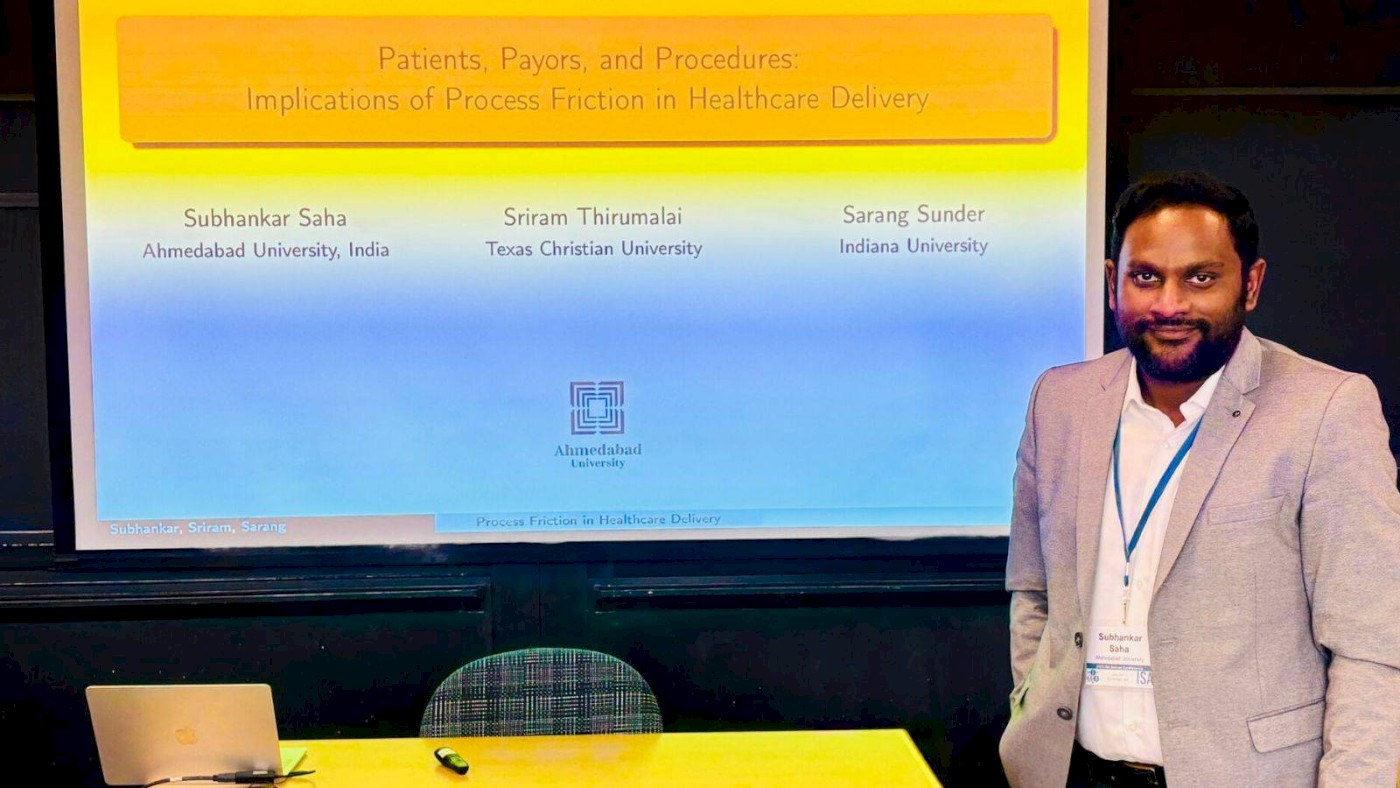
Subhankar Saha

Clinical decisions, such as procedural choices, must be driven solely by patients’ medical needs. But what if all clinical factors are identical and only the type of insurance changes? Does insurance coverage shape the care patients receive?

Subhankar Saha, Assistant Professor at Ahmedabad University’s Amrut Mody School of Management​​​​​​, explores this critical question in his recent research, presented at the 2025 Industry Studies Association Annual Conference at MIT. His paper, Patients, Payors, and Procedures: Implications of Process Friction in Healthcare Delivery, examines how administrative requirements for insurance types shape medical decision-making within the US healthcare system.

Professor Saha investigates this issue in the context of changes to Medicare reimbursement policies, which remained unchanged for private health insurance. Medicare is a U.S. federal health insurance program for individuals aged 65 and older. It accounts for 21 per cent of national healthcare spending and 13 per cent of the federal budget. He examines how these policy differences affected the number of procedures prescribed to patients requiring cardiac care.

Private insurance often requires prior authorisation before certain procedures can be performed, leading to delays and added administrative burdens- referred to in the study as "process frictions." Medicare, by comparison, operates with fewer such constraints, resulting in lower process friction. As a result, patients covered by Medicare were prescribed more procedures than those with private insurance.

However, policy changes in 2011 and 2012 introduced stricter approval processes for Medicare, effectively increasing its process friction. Professor Saha’s research found that once these changes took effect, the number of procedures prescribed to Medicare patients declined, reducing the gap between procedures prescribed for Medicare and privately insured patients.

While the new regulations suggest potential cost savings and efficiencies, the broader implications of research suggest that clinical decisions are susceptible to bias. Moreover, for policymakers, the findings call for carefully assessing how financial incentives and procedural hurdles can unintentionally bias care delivery. For hospital administrators, the research suggests the importance of identifying and reducing internal process friction to avoid delays in treatment. And for patients and families, the study encourages active engagement in medical decisions, asking questions to navigate better and manage their own care.

Professor Saha’s work contributes to a broader understanding of the complex dynamics between payors, providers, and patients by documenting how administrative structures influence treatment, calling for a more holistic approach to healthcare reform.

Read the full paper here

Related News

Parag Patel on Steering Committee of Association to Advance Collegiate Schools of Business (AACSB) International

Kartikeya Tanna (BCom' 04) Traces Smriti Irani's Journey to Winning Amethi in Debut Book

Parisha Patel at University of Valladolid, Spain

Semester Exchange Programme at the University of Valladolid, Spain under the Erasmus Programme

Ahmedabad University

Navrangpura, Ahmedabad 380009
Gujarat, India

info@ahduni.edu.in
+91.79.61911000/200/201

  • About Ahmedabad
  • Our Purpose
  • University Leadership
  • Board of Management
  • Board of Governors
  • Schools & Centres
  • Research
  • Programmes
  • Admission
  • Tenders and Vendors
  • Resources
  • Careers
  • Accreditations and Compliance
  • IQAC
  • Campus Visit
  • Contact
  • Privacy Policy

Auris

COPYRIGHT AHMEDABAD UNIVERSITY 2026

CONNECT WITH US

Download Brochure

Please enter information in the form below. The download will start automatically on submission of the form.

Download Brochure

Please enter information in the form below. The download will start automatically on submission of the form.