
6 November 2026
A Rare Duck Natural Hybrid Adds a New Record to Gujarat’s Biodiversity Documentation
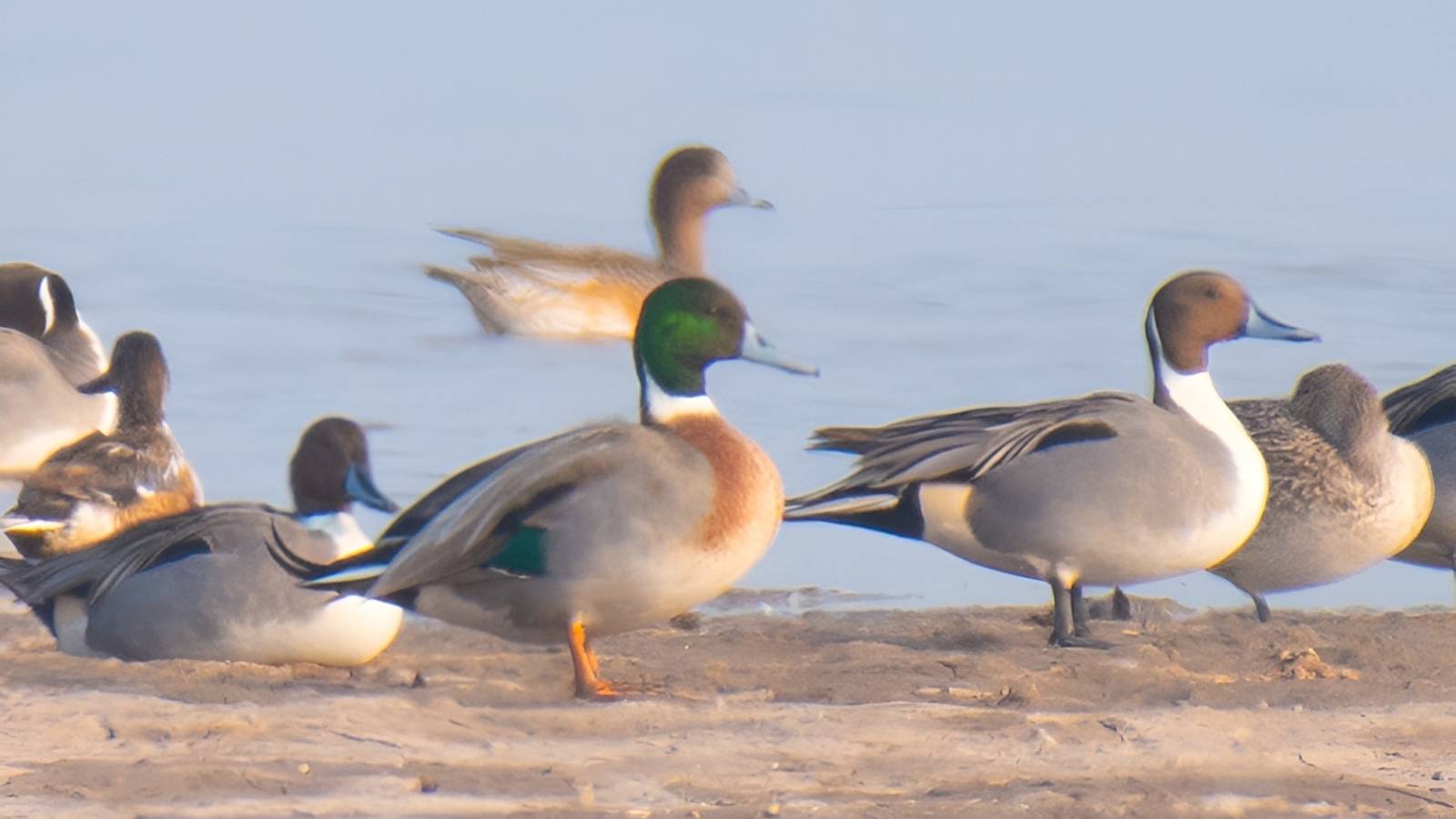
Adding to Gujarat's biodiversity, a bird displaying characteristics of two migratory duck species has been documented for the first time in the state. Observed at the wetlands of Mendha Creek in January 2026, the bird was provisionally identified as a natural hybrid of the Mallard (Anas platyrhynchos) and Northern Pintail (Anas acuta).
The bird showed a mix of features from both species. It had the Mallard's iridescent green head but a more elongated shape, like that of the Northern Pintail. Its breast was chestnut brown, blending into pale grey, finely patterned sides. Its tail was longer than a Mallard's but shorter than a typical Northern Pintail's. Its bill was dark grey to bluish, unlike the bright yellow bill of an adult male Mallard.
Together, these features supported its provisional identification as a Mallard–Northern Pintail natural hybrid. Combining the names of the two parent species, the researchers have locally proposed the Gujarati name Neelshir Singpar for the natural hybrid. They, however, note that genetic analysis would be necessary to conclusively confirm the identification.
The observation also highlights the importance of sustained efforts to document bird diversity. Every January, Bird Race Gujarat brings together teams from more than 30 districts, representing different professional backgrounds and age groups. Participants identify bird species and contribute systematic observations, helping build awareness of the state's avian diversity.
The finding has been published as a scientific note in the Journal of the Bombay Natural History Society (JBNHS), a journal with a 140-year history of documenting natural history and biodiversity. The note was co-authored by Krishna Biswas, Nisarg Modi, Gogan N. Madam and Professor Jayendra Bhalodiya of Ahmedabad University’s School of Engineering and Applied Science.
By documenting an unusual bird sighting and adding it to the scientific record, the research contributes to understanding of Gujarat's avian diversity, underscoring how systematic field observations, photographic documentation, and collaboration between birdwatchers and researchers can advance biodiversity research. Further observations and genetic analysis could help establish the identity and possible origin of this natural hybrid.