28 October 2025
A Doctoral Student's Research Proposes Equitable Developmental Transitions Through a Climate Justice Lens; Wins Global Recognition
Gujarat aims to become a $3.5 trillion economy while achieving Net Zero emissions target by 2047. Amid these competing priorities, Ahmedabad University doctoral student Arunava Mandal asks a critical question: What will be the impact of these competing developmental and climate goals on the state’s most vulnerable groups, including the marginalised communities and women? His research, “Assessing Distributional Impacts of Balancing Developmental Aspirations and a Net-Zero Target in a Developing Nation,” examines how rapid decarbonisation without social safeguards can deepen existing inequities and lead to a developmental pathway that is unsustainable.
Arunava initially followed a traditional path, studying engineering, and then management, followed by a 5-year stint in the industry. “But fate, as it often does, brought me back to where I truly belong” he says. His years in the development sector, working closely with women’s self-help groups and farmer-producer organisations, revealed the grim realities of climate change. “It was there that I saw climate change not as an abstract but a real problem”. That experience, he says, “changed everything.” It steered him towards research. “I realised that the intersection of climate change and social equity was where I wanted to dedicate myself.”
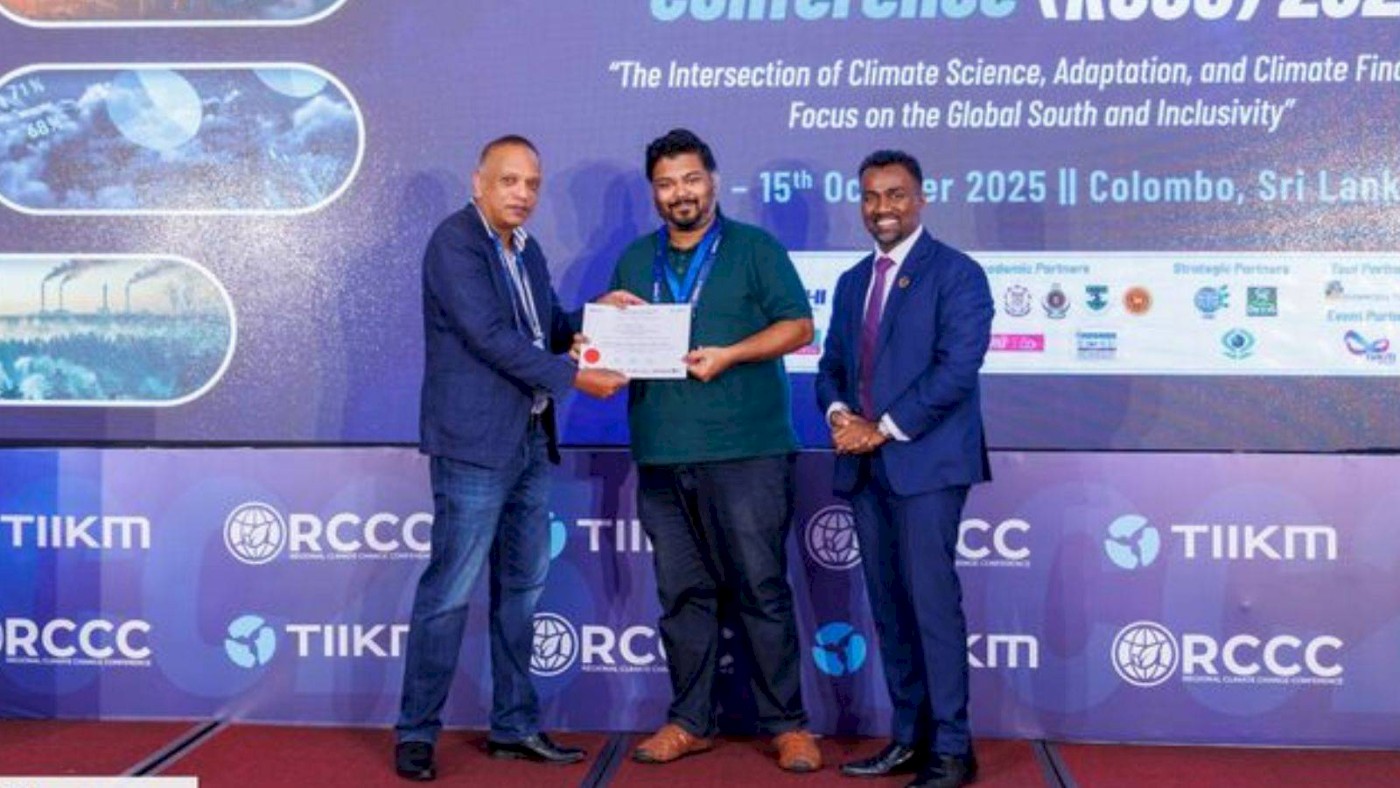
Presenting his findings at the Regional Climate Change Conference 2025, hosted by The International Institute of Knowledge Management (TIIKM) in Colombo, Sri Lanka, Arunava received the Best Presentation Award in the session on “Novel Regional/Local Climate Hazard and Impact Modelling Methods and Tools.” His award-winning presentation examined sub national climate and energy policies with the lens of climate justice and proposed a nexus-based framework, enabling the state to become just, inclusive, equitable and emissions neutral by 2047.
He also proposed a study to model and quantify the distributional impacts of climate policy led transitions, showing that the shift to cleaner energy will not affect everyone equally. Communities dependent on high-carbon industries may lose livelihoods as the economy transitions to renewables. Women and rural households, especially those reliant on biomass for cooking, face heightened risks of health challenges. Rapid urbanisation, a by-product of economic growth, continues to erode forests, wetlands and agricultural lands, forcing local populations to migrate. The study will go beyond theory and offers practical insights for Gujarat’s future climate action and renewable energy policies, helping identify where targeted support can protect vulnerable groups.
“I was drawn to the idea of studying distributional impacts to understand who gains and who loses in the process of climate policy induced transition,” he explains. “There’s very little research that examines these trade-offs at the subnational level within a developing nation. If we can understand how to incorporate just transition within a state’s developmental pathway, it might set off a chain reaction, encouraging similar studies across other developing nations.