


• About Ahmedabad
  • Stepwell
  • Student Affairs
  • Alumni and Advancement
  • Collaborate With Us
  • Media
  • Academics
    • Schools & Centres
      • Amrut Mody School of Management
      • Bagchi School of Public Health
      • School of Arts and Sciences
      • School of Engineering and Applied Science
      • Undergraduate College
      • Graduate School
      • Ahmedabad Design Lab
      • Centre for Heritage Management
      • Centre for Learning Futures
      • Global Centre for Environment and Energy
      • International Centre for Space and Cosmology
      • Sahyog: Centre for Promoting Health
      • Stepwell Centre for Asian Futures
      • The Climate Institute
      • The Institute of Manufacturing and Economy
      • VentureStudio
    • Programmes
      • Undergraduate Programmes
      • Graduate Programmes
        • Masters Programmes
        • Doctoral Programmes
      • Continuing & Executive Education
    • Learning Initiatives
    • Libraries
    • Interdisciplinary Learning
    • Academic Calendar
  • Admission
    • Undergraduate Admission
    • Graduate Admission
      • Masters Admission
      • Doctoral Admission
    • Fees & Financial Aid
  • Faculty
    • Amrut Mody School of Management
    • Bagchi School of Public Health
    • School of Arts and Sciences
    • School of Engineering and Applied Science
    • Centre for Heritage Management
    • Centre for Learning Futures
    • Global Centre for Environment and Energy
    • International Centre for Space and Cosmology
    • Stepwell Centre for Asian Futures
    • The Institute of Manufacturing and Economy
    • VentureStudio
  • Research
  • About Ahmedabad
  • Stepwell
  • Office of the Dean of Students
  • Alumni and Advancement
  • Collaborate With Us
  • Media
  • Academics
    Schools & Centres Programmes Learning Initiatives Libraries Interdisciplinary Learning Academic Calendar
  • Admission
    Undergraduate Admission Graduate Admission Doctoral Admission Fees & Financial Aid
  • Faculty
  • Research

Blog Detail Page

Featured

  • How a Chance Encounter Landed me an Internship with Forbes Marshall

    By Pranav Deora October 27, 2025
  • A Doctoral Programme Graduate’s Journey of Purpose and Impact

    October 13, 2025
  • Key Skills Recruiters Seek in Management Degrees Holders

    October 01, 2025
  • Workshop on R Programming: Equipping Future-ready Professionals with Data Analysis and Visualisation Tools

    May 20, 2025
  • Decoding the Universe: Recent Developments in LIGO and LISA

    By Meet Vyas July 17, 2024
  • My Journey from Nasik to Ahmedabad

    By Ayush Poddar September 05, 2023
  • University Residences, my Second Home

    By Itisha Rabari July 27, 2023
  • Student Mitrs and A Rollercoaster of Emotions

    By Riddhi Bhargava July 24, 2023
  • A Clinal Perspective on Species’ Response to Climate Change

    By Harshad Mayekar February 24, 2023
  • Raschakra - The Voice of A Woman

    By Mana Shah February 16, 2023
  • Exploring the Cosmos With Insights From Quantum Gravity

    By Oem Trivedi February 15, 2023
  • A Learning Experience at IIT Roorkee

    By Nandish Patel January 16, 2023
  • How do I select the ideal college for me?

    By Raghavan Rangarajan May 09, 2022

Categories

  • Ahmedabad Blogs
  • Arts and Humanities
  • Beyond Classrooms
  • Business and Commerce
  • Careers and Employability
  • Engineering
  • Personal Musings
  • Perspective
  • Social Sciences
  • Sciences

A TALE OF MY LOVE FOR LEISHMANIA

August 16, 2021

Sciences

5 minutes read
Souvik Sen Gupta

Souvik Sen Gupta

Biology is simple and complex at the same time. As a passionate practitioner of life science research, I always strive to target the simple questions around my research interest. The scope of life science research is vast- it involves study of unicellular and multicellular organisms, study of different diseases and also study of interactions between organisms and environment. At Ahmedabad University, I study the unicellular parasitic protozoa Leishmania donovani which is the causative agent of visceral leishmaniasis (Kala azar) worldwide. Kala azar is a deadly disease causing significant morbidity and mortality. The causative protozoa Leishmania donovani gets into our bloodstream through the bite of a sandfly (the vector of the disease) and goes inside the macrophages. These parasites cause eventual demise of the macrophages and colonize in the spleen. They eventually may cause death of the person affected if not treated in time. Among the different courses I teach, I also offer an elective course on Human Protozoan Parasites. In this course, I try to familiarize the young minds with the different protozoan parasites which cause some of the devastating diseases in the world. 

What does the term ‘parasite’ mean? In simplistic terms, any organism which invades any other organism, steals nutrition, takes refuge and cause a negative impact on the organism it has invaded may be termed as a parasite. My research interest spans around understanding one such parasite, Leishmania donovani in detail. I specifically am interested in unravelling the DNA repair and cell death pathways of this unicellular protozoan parasite so that we can have a better repertoire of drug targets to treat the deadly disease caused by Leishmania. Now, the obvious question is – why DNA repair and cell death pathways? 

Any organism, be it unicellular or multicellular, is constantly exposed to DNA damaging threat from the environment. Thus, all organisms should die due to the damage of the DNA from the environment. However, that does not occur due to the existence of DNA repair pathways. These pathways are constantly at work to eliminate any DNA damaging threat. On the other hand, the cell death pathways are also an important component in the biology of an organism. These pathways get activated when the organism is destined to die. When we talk about the parasite Leishmania, it is a foe about which we know very little. Probably that is the reason why this unicellular protozoan parasite causes significant morbidity and mortality worldwide. So, if we are able to know more about the organism, we will be better equipped to fight the war against these deadly parasites. Though these are harmful to the human race, I must mention here that throughout my research career, I have mostly tried to understand these parasites and now I feel that something is missing from my day to day life if I don’t visualize them under microscope. It’s because visualizing these fantastic unicellular protozoan parasites and seeing them swim around in the field of view under the microscope has become an obvious event in my regular life (I don’t think I can do without that!). Yes, as already mentioned, they are the enemies of human race but there is some uniqueness about these parasites which have allowed them to be able to infect humans throughout decades. They are incredibly smart and that is why it is essential to understand them in detail. I realize my passion for research at Ahmedabad University and also feel honoured to interact with some brilliant inquisitive minds. There is no limit for learning and I must say that I still love to learn in this fantastic academic environment. I conclude with the saying of Mahatma Gandhi – “Live as if you were to die tomorrow. Learn as if you were to live forever.” 

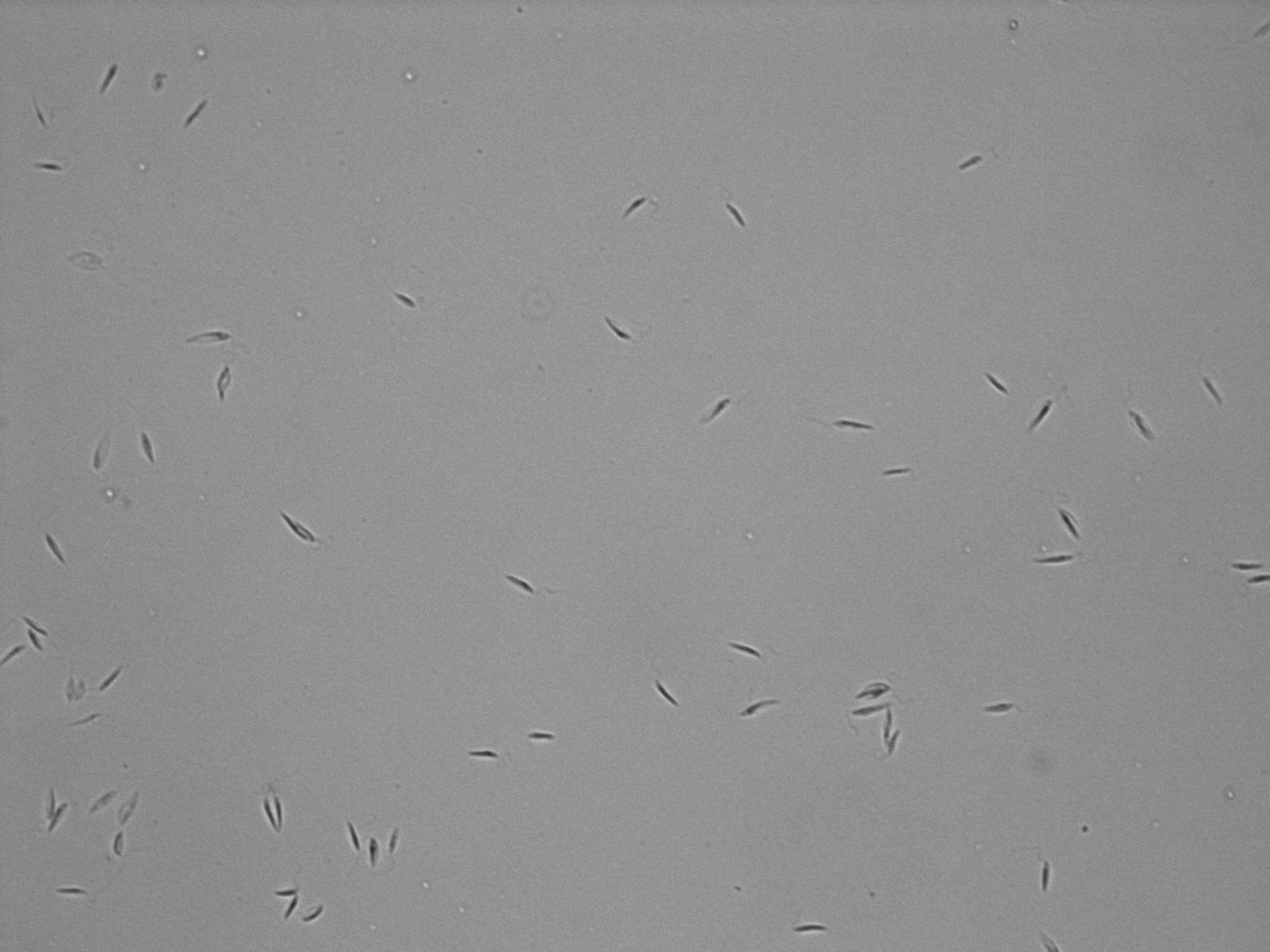
Fig.1 legend: Leishmania promastigotes visualized at 40X magnification on an inverted microscope
Day01

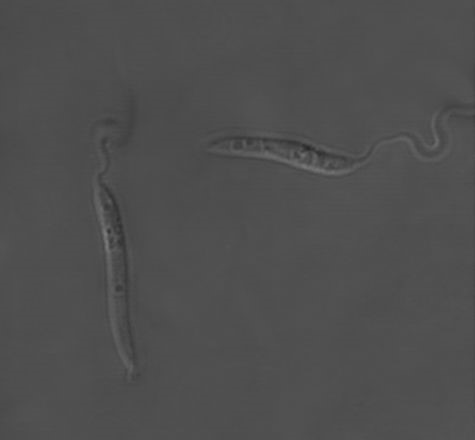
Fig.2 legend: Leishmania promastigotes visualized at 100X magnification on a confocal microscope
Day01


Author's Profile


Souvik Sen Gupta

Souvik Sen Gupta works as an Assistant Professor in Biological and Life Sciences at the School of Arts and Sciences, Ahmedabad University, Gujarat, India. He obtained his Master’s degree in Biotechnology from University of Calcutta and worked at CSIR-Indian Institute of Chemical Biology, Kolkata for his Doctorate. His research group works in the field of molecular parasitology and anti-leishmanial therapeutics.

Tags: LEISHMANIA, Parasites, diseases, DNA, Research, Life sciences, School of Arts and Sciences,

Share this article:


Photo Gallery

Ahmedabad University

Navrangpura, Ahmedabad 380009
Gujarat, India

info@ahduni.edu.in
+91.79.61911000/200/201

  • About Ahmedabad
  • Our Purpose
  • University Leadership
  • Board of Management
  • Board of Governors
  • Schools & Centres
  • Research
  • Programmes
  • Admission
  • Tenders and Vendors
  • Resources
  • Careers
  • Accreditations and Compliance
  • IQAC
  • Campus Visit
  • Contact
  • Privacy Policy

Auris

COPYRIGHT AHMEDABAD UNIVERSITY 2026

CONNECT WITH US

Download Brochure

Please enter information in the form below. The download will start automatically on submission of the form.

Download Brochure

Please enter information in the form below. The download will start automatically on submission of the form.