
21 September 2026
Where the River Flows, Empires Rise and Fall
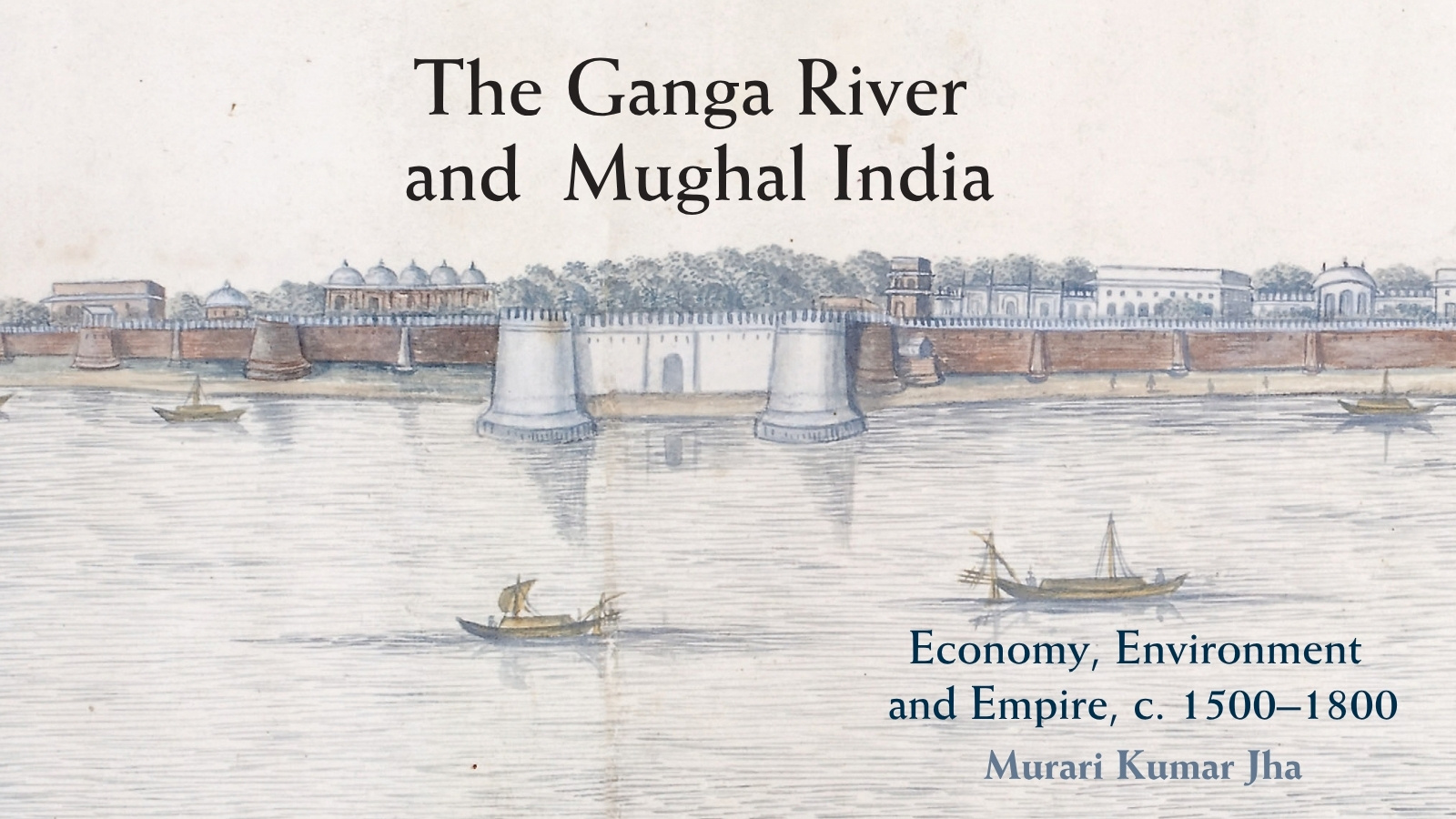
The decline of the Mughal Empire has long been understood as a political story centred within South Asia. In an interview, Assistant Professor Murari Jha of Ahmedabad University's School of Arts and Sciences discusses his forthcoming monograph, The Ganga and Mughal India: Economy, Environment and Empire, c. 1500–1800. Through an interdisciplinary lens, the book explores how landscape, ecology, geography, and long-distance networks shaped the trajectory of one of India's wealthiest empires.
The monograph has been awarded the prestigious Ludo and Rosane Rocher Foundation Book Subvention Grant and is scheduled for publication by Cambridge University Press, UK, later this year.
Below are excerpts from the interview with Professor Murari Jha.
Q. Your forthcoming monograph argues that the decline of the Mughal Empire can be understood through the lens of rivers, climate, and geography. What inspired this perspective?
Sometimes, history can be best understood by studying where the water flows next and how its scarcity can bring mighty empires to their knees. From the Mauryas to the Guptas, and later, the Mughals, India’s great empires have risen where the rivers ran deepest. Along the fertile banks of the Ganga and their tributaries, power found permanence. These waterways were not just geographical features; they were the answers to how agriculture, trade, and administration flourished in empires that followed the flow of the river.
The Mughals' imperial map mirrored the meandering course of the Ganga, from the semi-arid upper doab (the land between the Ganga and Yamuna rivers) through the alluvial plains to the more humid eastern Ganga Plain and Bengal Delta. Cities like Agra, Delhi, Patna, Rajmahal and Dhaka emerged to establish political control over the overland and riverine routes.
Q. What is the central argument of your book?
The book traces the decline of the Mughal Empire through two decisive shifts: climate and route.
When the monsoon rhythms faltered due to the increased frequency of El Niño episodes during the so-called Little Ice Age in the late seventeenth and eighteenth centuries, accompanied by a quickening pace of the eastward shift of the river course in the Delta, the Mughals’ centralised control of imperial logistics and transport infrastructure between northwestern India and Bengal began to slip away from Delhi and Agra.
Q. How did geography and climate shape the political and economic fortunes of different regions within the Mughal Empire?
The work contrasts the humid river valleys along the left banks of the Ganga in northern and eastern India with the semi-arid regions beyond, including the Deccan, western India, Punjab and Afghanistan. The humid plains produced grain, settled agrarian life and stability, while the drier frontiers facilitated mobility, transportation, pastoral economy, and, at times, rebellion. In semi-arid regions, rain failures disrupted pastoral activities, trade and livelihoods, forcing inhabitants to raid more prosperous agricultural areas in the humid zone to augment their resources.
In the eighteenth century, political momentum shifted from drier areas towards the humid Ganga Plain and the Bengal Delta. The Mughal grip was loosened not only by upheavals in the drier zones of the empire, but also by an environmental and logistical realignment that re-drew the map of power and wealth itself. Thanks to maritime and riverine trade, more wealth concentrated in coastal areas, which became the new sites of articulation of power.
Q. Your book identifies two major developments that explain the transformation of the eighteenth century. Could you elaborate on them?
Two interrelated developments linked to changing rainfall patterns and transportation networks underpin the book’s explanation of the eighteenth-century transformation.
First, increasingly arid climatic conditions destabilised the overland caravan routes connecting Bengal and Bihar with Kabul. Several alignments of route became impracticable due to unavailability of water and fodder, while mounting economic pressures in the arid zones fostered political instability and frequent raids by the Marathas, Rajputs, Jats, and Afghans. This made the caravan routes frequently unsafe and unpredictable.
Second, the Ganga transport corridor between Patna and Hugli gained unprecedented economic importance. The humid zone’s agricultural and manufactured goods enjoyed relatively unhindered access to overseas markets via maritime networks, generating substantial inflows of cash and capital. More merchants and capital moved from arid zones to urban centres located along the Ganga in eastern India.
Q. What impact did these changes have on the balance of political power within the Mughal Empire?
As economic opportunities weakened in the drier Mughal heartlands in Hindustan, eastern India emerged as a major centre of trade and commerce. The wealth generated through riverine and overseas trade strengthened regional political elites, enabling them to establish autonomous power bases at the expense of the Mughal Empire. Integration with Indian Ocean global trade networks and growing regional wealth thus pulled eastern India away from the Mughal Empire.
By the eighteenth century, the long-established pattern of state formation based on overland mobility had been replaced by one centred on maritime mobility. The English East India Company, and its Indian collaborators—the beneficiaries of the overseas export economy—sowed the seeds of the colonial empire on the banks of the Ganga, which eventually encompassed the entire Indian subcontinent by the nineteenth century.
Q. How does your research challenge conventional understandings of the decline of the Mughal Empire?
The monograph challenges the conventional view that the decline of the Mughal Empire was purely a political phenomenon centred in South Asia. Instead, it argues that global processes also significantly contributed to this decline.
Moreover, the monograph invites people to view history through an interdisciplinary lens, using landscape itself as an example of how climate, ecology, long-distance routes and geography can influence the fate of early modern empires. As the monograph reveals, the Mughal story does not end with the familiar narrative of imperial decline after Aurangzeb’s death in 1707; it flows onward with the Ganga, illuminating an era when global streams of silver nourished the world’s richest riverine economies before colonial rule transformed its fortunes.