19 August 2024
The Cultural Paradigm of Tangible and Intangible Heritage in India
It is imperative to discuss key issues such as sustainability, and the economics and business of heritage, among others, for examining various aspects of India’s tangible and intangible heritage. This was the key theme emerging from discussions at the Workshop on ‘Redefining Tangible and Intangible Cultural Heritage: Exploring Global Perspectives and Practices and their Lessons for India’, hosted by the Centre for Heritage Management (CHM) at Ahmedabad University in collaboration with Jadavpur University, Kolkata, and University of Liverpool.
Experts and scholars participating in the workshop deliberated on various ideas and constructs pertaining to oral traditions, performing arts, social practices, rituals, festivals, and traditional knowledge systems and practices prevalent in the country.
In her inaugural address, Professor Molly Kaushal , Director, CHM, said that the Centre offers a rare academic platform, combining management, on one hand, and heritage studies, on the other. Professor Pankaj Chandra , Vice Chancellor of Ahmedabad University, said that as a young institution, the University is building a unique cultural and educational environment, based on the concept of interdisciplinarity for addressing complex challenges. Professor Soumyen Bandhopadhyay, Architect and Architect Historian, University of Liverpool, suggested that India is in a fantastic position to question and debate the boundaries of tradition and heritage, and ways of making heritage resilient.
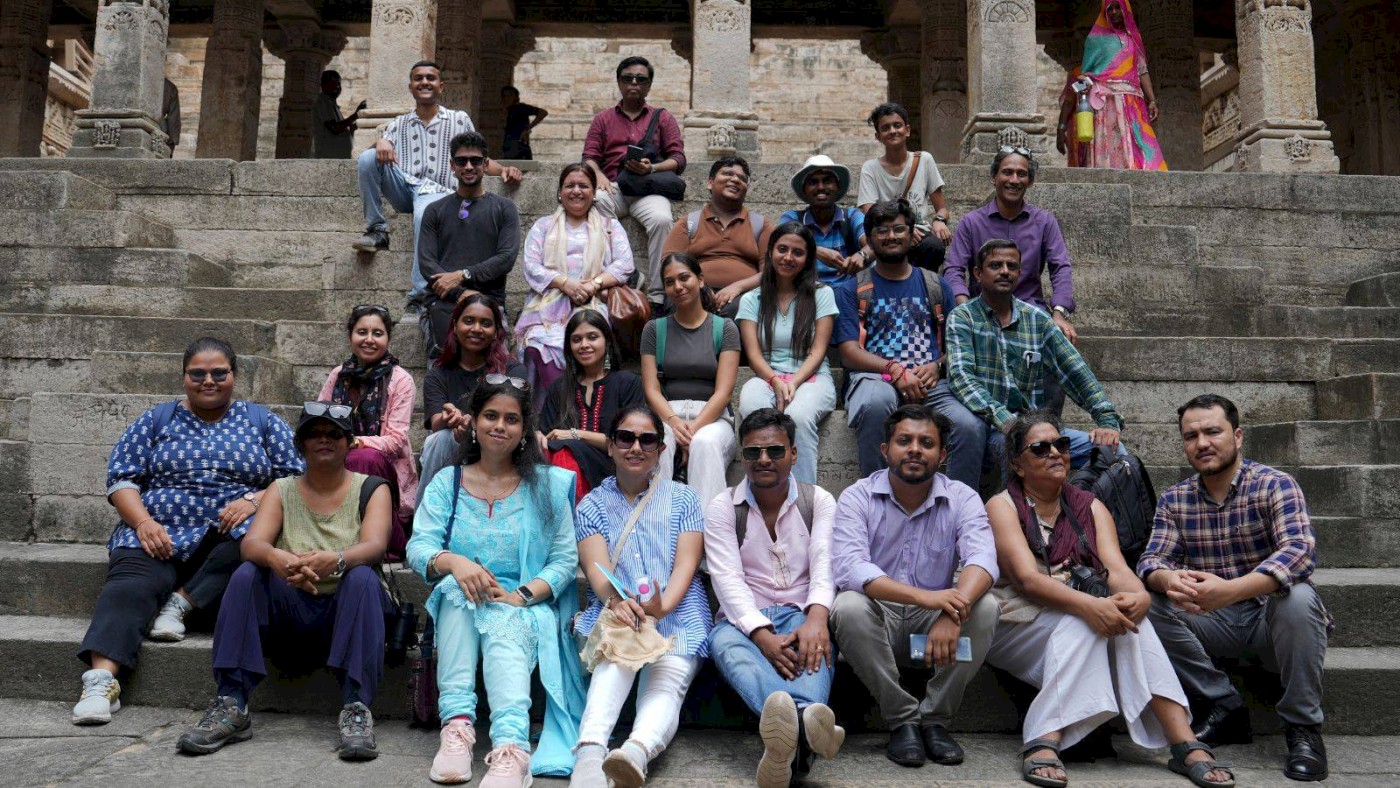
The participants in the Conference also visited a number of tourism sites in Ahmedabad during their field visit, including the Patan Patola Heritage Museum, where they witnessed artisans producing traditional items like an ikat Patola sari, as well as the Patan City Museum housing a wide range of sculptures and archaeological inscriptions. In addition, they took a trip to Rani ki Vav, a famed stepwell in Patan and a UNESCO heritage site, and the Modhera Sun Temple, dedicated to the solar deity Surya, which has now been designated as a protected monument by the Archaeological Survey of India.
During the concluding two days of the Conference, faculty and researchers from Ahmedabad University and other institutions focused on traditional crafts such as brick-making in Karnataka; the biodiversity of living heritage; the transformative practices in archaeology, with a view on empowering communities to ensure sustainability; various material approaches for preserving India’s tangible heritage, and practices for archiving indigenous cultural heritage. On the final day of the Conference, scholars presented their research on different aspects of India’s cultural heritage.