
• About Ahmedabad
  • Stepwell
  • Student Affairs
  • Alumni and Advancement
  • Collaborate With Us
  • Media
  • Academics
    • Schools & Centres
      • Amrut Mody School of Management
      • Bagchi School of Public Health
      • School of Arts and Sciences
      • School of Engineering and Applied Science
      • Undergraduate College
      • Graduate School
      • Ahmedabad Design Lab
      • Centre for Heritage Management
      • Centre for Learning Futures
      • Global Centre for Environment and Energy
      • International Centre for Space and Cosmology
      • Sahyog: Centre for Promoting Health
      • Stepwell Centre for Asian Futures
      • The Climate Institute
      • The Institute of Manufacturing and Economy
      • VentureStudio
    • Programmes
      • Undergraduate Programmes
      • Graduate Programmes
        • Masters Programmes
        • Doctoral Programmes
      • Continuing & Executive Education
    • Learning Initiatives
    • Libraries
    • Interdisciplinary Learning
    • Academic Calendar
  • Admission
    • Undergraduate Admission
    • Graduate Admission
      • Masters Admission
      • Doctoral Admission
    • Fees & Financial Aid
  • Faculty
    • Amrut Mody School of Management
    • Bagchi School of Public Health
    • School of Arts and Sciences
    • School of Engineering and Applied Science
    • Centre for Heritage Management
    • Centre for Learning Futures
    • Global Centre for Environment and Energy
    • International Centre for Space and Cosmology
    • Stepwell Centre for Asian Futures
    • The Institute of Manufacturing and Economy
    • VentureStudio
  • Research
  • About Ahmedabad
  • Stepwell
  • Office of the Dean of Students
  • Alumni and Advancement
  • Collaborate With Us
  • Media
  • Academics
    Schools & Centres Programmes Learning Initiatives Libraries Interdisciplinary Learning Academic Calendar
  • Admission
    Undergraduate Admission Graduate Admission Doctoral Admission Fees & Financial Aid
  • Faculty
  • Research

26 October 2026

Researchers Read the DNA of a Fly That Lives Only in the Cold Himalayas
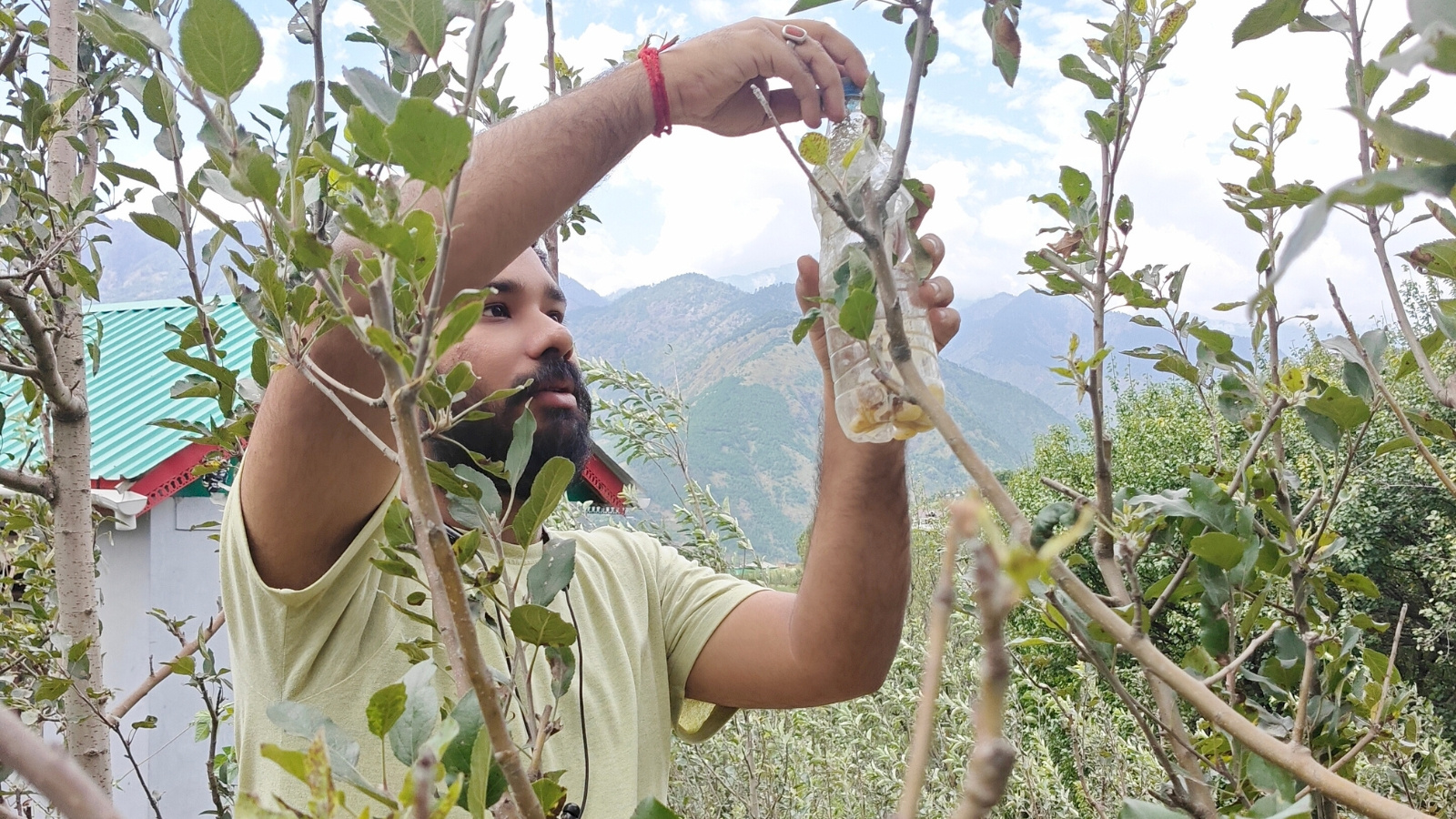
Avirup Chakraborty

Ahmedabad University researchers have sequenced the first genome of Drosophila nepalensis, a small mountain fly, and found hints that life in the cold may have narrowed its options.

The Himalayas are among the world’s biodiversity hotspots, home to thousands of species, many of which are found nowhere else. They are also warming at almost twice the global average rate. Animals that live only in the cold have one way out, which is uphill, and mountains only go so high.

Drosophila nepalensis is endemic to the Himalayas and has already begun moving to higher ground. Most fruit fly research has focused on widespread species like Drosophila melanogaster (which has a cosmopolitan distribution), so mountain specialists such as this one have been largely unstudied. Until now, nobody had read its DNA.

The study was conducted by Avirup Chakraborty, a doctoral student, at the Species, Climate Change, and Evolution Lab, led by Subhash Rajpurohit, an Associate Professor in the School of Arts and Sciences at Ahmedabad University. The team collected wild flies in the Himalayas, at an elevation of about 2,400 metres above sea level, and sequenced their DNA.

A genome is the full set of instructions an animal is built from. The team pieced together about 178 million letters of this fly’s DNA and identified roughly 10,500 genes. A standard completeness test identified 98 per cent of the genes expected in insects, making it a solid reference for other researchers. 

They also checked what temperature the fly prefers. Flies were placed in a narrow tube that ran from cool (14°C) to warm (32°C). D. nepalensis gathered at the cold end far more than two widespread relatives, the common fruit fly and D. ananassae.

The team compared the fly’s genes with those of five close relatives and found that certain gene groups had expanded in D. nepalensis. These included genes that make protein-cutting enzymes, genes that protect other proteins when cells are under stress, and genes that carry signals between nerve cells. At the same time, the genes that help package DNA inside cells had shrunk sharply. Together, the changes suggest the fly has reworked parts of its genetic machinery, which may help it live in the cold, high Himalayas. 

The work, published in G3: Genes | Genomes | Genetics, hints at a trade-off. Being built for a single narrow, cold habitat could leave the fly with fewer options when that environment changes. The authors offer this as an idea to test, not a result, and the new genome makes that testing possible. For a fly with only so much mountain left to climb, that knowledge matters. The new genome lets researchers start asking what these genes do and how much room the fly has to adapt as its home warms. 

Read the full study

Ahmedabad University

Navrangpura, Ahmedabad 380009
Gujarat, India

info@ahduni.edu.in
+91.79.61911000/200/201

  • About Ahmedabad
  • Our Purpose
  • University Leadership
  • Board of Management
  • Board of Governors
  • Schools & Centres
  • Research
  • Programmes
  • Admission
  • Tenders and Vendors
  • Resources
  • Careers
  • Accreditations and Compliance
  • IQAC
  • NIRF
  • Campus Visit
  • Contact
  • Privacy Policy

Auris

SUBSCRIBE TO OUR NEWSLETTER

COPYRIGHT AHMEDABAD UNIVERSITY 2026

CONNECT WITH US

Download Brochure

Please enter information in the form below. The download will start automatically on submission of the form.

Download Brochure

Please enter information in the form below. The download will start automatically on submission of the form.