14 April 2026
Research on Engineering Smart Networks for an Uneven India Wins ANRF Grant
In February 2026, India reached 1,013.03 million mobile broadband subscribers, with nearly half the population residing in rural areas, according to the Telecom Regulatory Authority of India. However, urban user density (142.32 per cent) far exceeds rural (59.46 per cent), highlighting the urgent need for smart, adaptive solutions to meet diverse service needs.
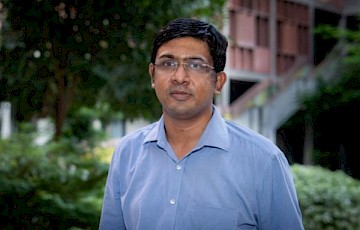
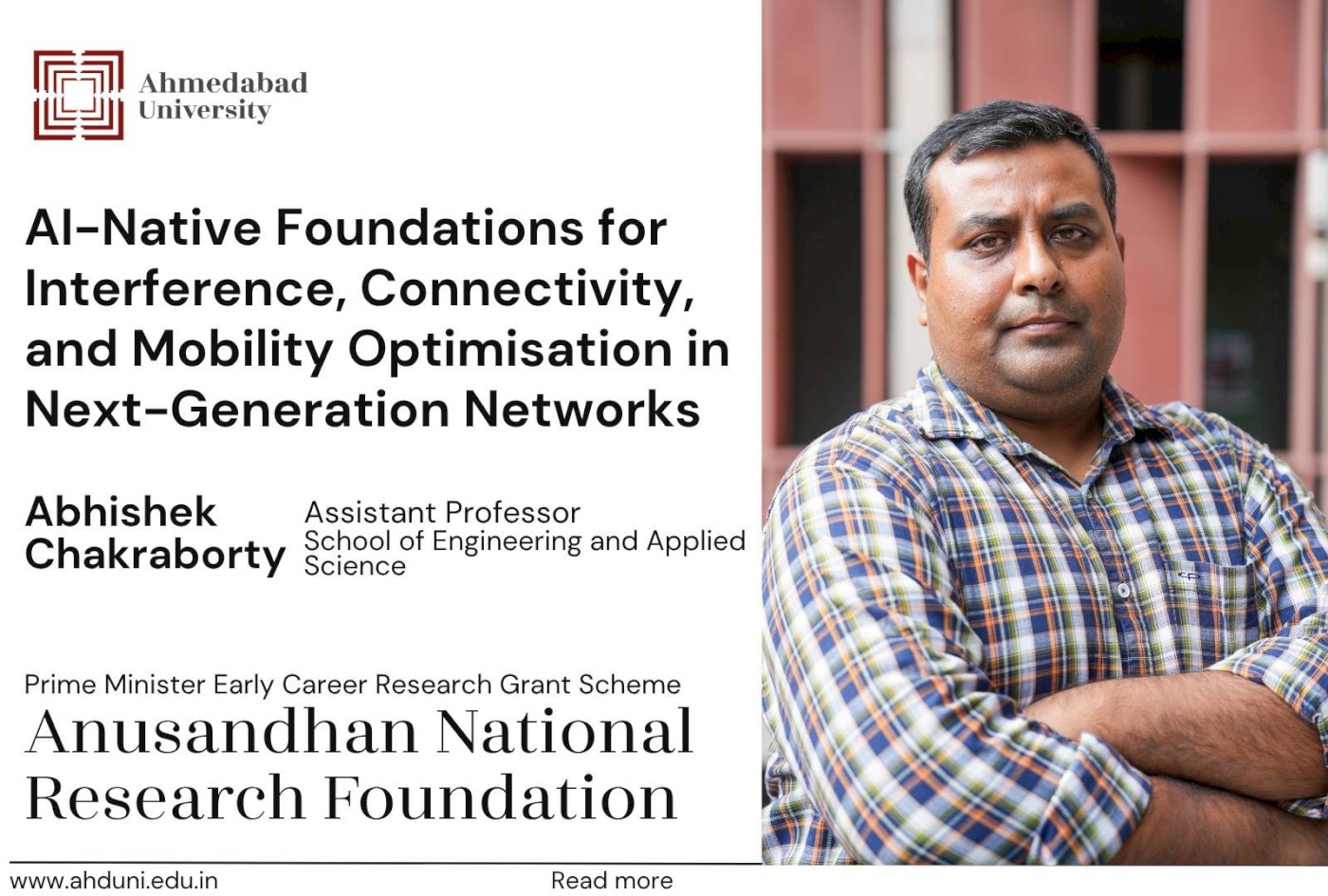
In response, Professor Abhishek Chakraborty from the School of Engineering and Applied Science at Ahmedabad University is developing new theoretical models, AI-native frameworks, and simulation prototypes to mitigate signal interference, improve network connectivity, and optimise user mobility.
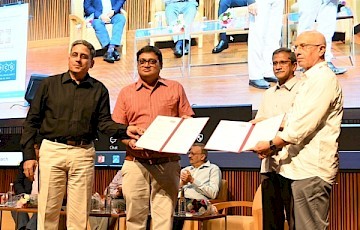
It is for this project, titled AI-Native Foundations for Interference, Connectivity, and Mobility Optimisation in Next-Generation Networks, that he was awarded the Anusandhan National Research Foundation Prime Minister Early Career Research Grant, a recognition that supports promising early-stage researchers addressing critical national challenges.
Through these efforts, Professor Chakraborty seeks to propose reliable digital access in underserved and rural areas, support Digital India, BharatNet, and the National Digital Communications Policy 2018, and thereby advance India’s connectivity and digital inclusion goals.
This work reflects Ahmedabad University’s growing emphasis on rigorous, socially relevant research. As Professor Chakraborty notes, “Ahmedabad University fosters a vibrant research culture by providing faculty with multiple internal grants to kickstart their research, and the Grant Office provides all administrative support needed. The ecosystem in Ahmedabad is highly interdisciplinary, which helps translate complex ideas into reality.” This enabling environment allows faculty to move from ideas to impact, reinforcing the University’s commitment to rigorous, interdisciplinary research that addresses real-world challenges.