16 April 2026
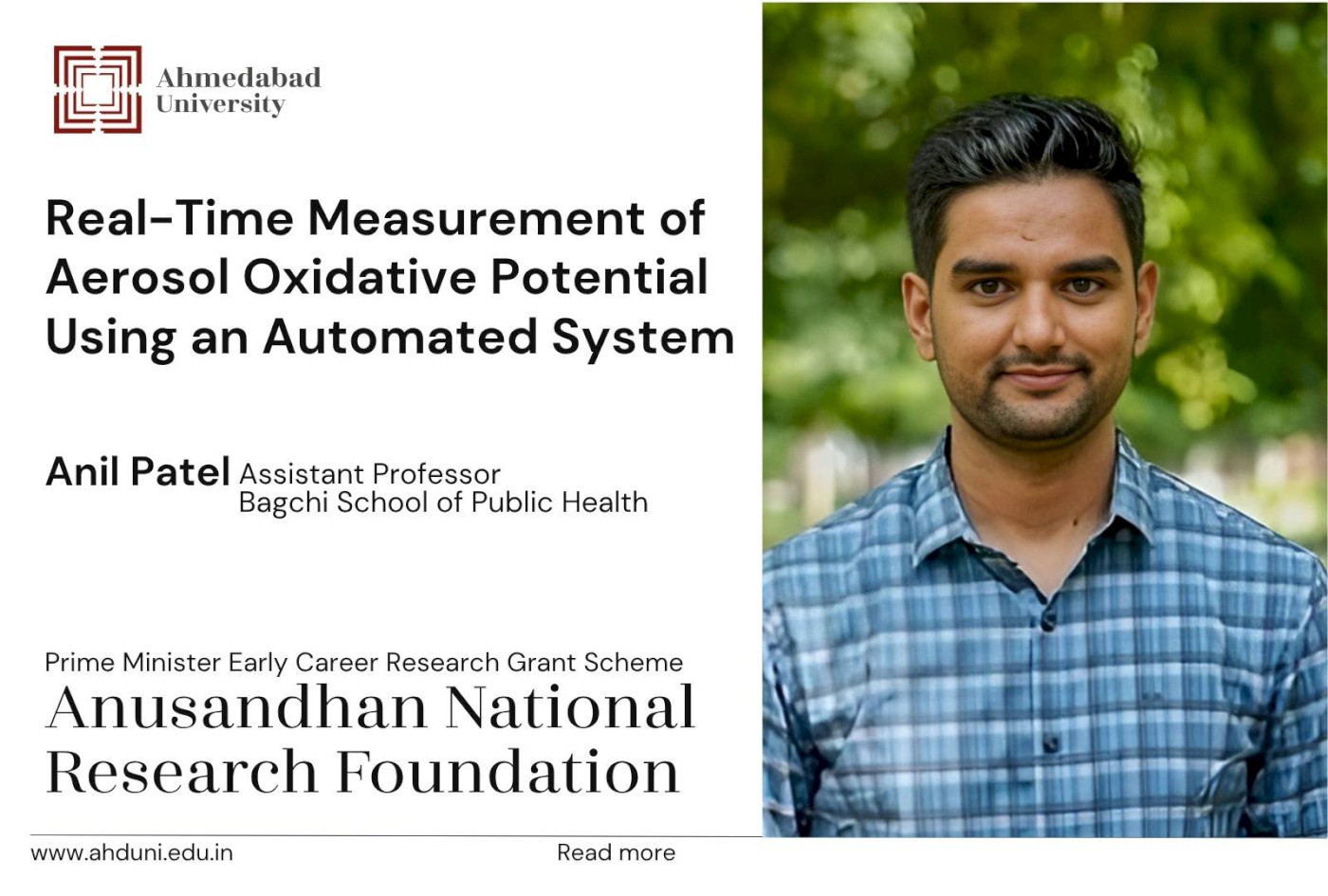
Professor Anil Patel Receives ANRF Grant for Real-Time Aerosols’ Oxidative Potential Research
Air pollution is often measured in terms of how much particulate matter is present in the air. But a more pressing question is whether that air is equally harmful at all times. For Professor Anil Patel, this shift in thinking has been shaped by years of research into how atmospheric aerosols interact with the human body. When inhaled, these particles can generate reactive oxygen species (ROS) in the respiratory system, a process widely considered a key mechanism behind pollution-related health effects.
Building on this work, and ongoing efforts to understand which aerosol components are most toxic and why, Professor Anil Patel of the Bagchi School of Public Health at Ahmedabad University is now leading a new project that moves from theory to measurement. Supported by a grant from the Anusandhan National Research Foundation Prime Minister Early Career Research Grant Scheme, the project focuses on aerosol oxidative potential (OP), a metric that captures the real-time toxicity of airborne particles.
Oxidative potential reflects the ability of airborne particles to induce oxidative stress in the human body, one of the key pathways through which air pollution affects health. Unlike conventional air quality measurements that simply track particle mass, OP provides a more direct indication of toxicity. However, it is rarely measured in real time. At present, most OP assessments rely on 12 to 24-hour integrated filter samples, which average out short-term fluctuations and miss rapid changes in air toxicity caused by traffic emissions, photochemical reactions, and shifting atmospheric conditions.
Professor Patel’s project aims to address this gap by developing an automated system capable of measuring aerosol oxidative potential in real time. This would allow researchers to capture the highly dynamic nature of air pollution as it changes hour by hour, rather than relying on daily averages that can obscure critical spikes in toxicity. By shifting from static to continuous monitoring, the research introduces a more precise and responsive way of understanding air quality.
The implications of this approach extend significantly beyond measurement. Real-time OP data can help identify when air pollution is most harmful and what drives those fluctuations, whether it is traffic density, weather patterns, or chemical reactions in the atmosphere. This creates a stronger scientific basis for linking pollution exposure to health outcomes and could ultimately inform more targeted public health responses. Over time, such systems could also support long-term monitoring frameworks that better reflect the complexity of air pollution in rapidly changing urban environments, particularly in countries like India.
Support from the ANRF enables the development of new scientific infrastructure within India, allowing researchers to build advanced measurement capabilities locally rather than relying on external systems. The project also reflects the interdisciplinary research environment at Ahmedabad University, where atmospheric science and public health intersect to address complex real-world challenges. As Professor Patel notes, “Ahmedabad University is an environment where good ideas are taken seriously and given the space to grow.”
By focusing on real-time toxicity rather than averaged pollution levels, the research represents a shift in how air quality is understood. It moves the conversation from how polluted the air is to how dangerous it is at any given moment, offering a more nuanced and health-relevant way of thinking about one of India’s most persistent environmental challenges.