
13 January 2026
Novel Quantum Digital Image Processing Research Earns Best Poster Award
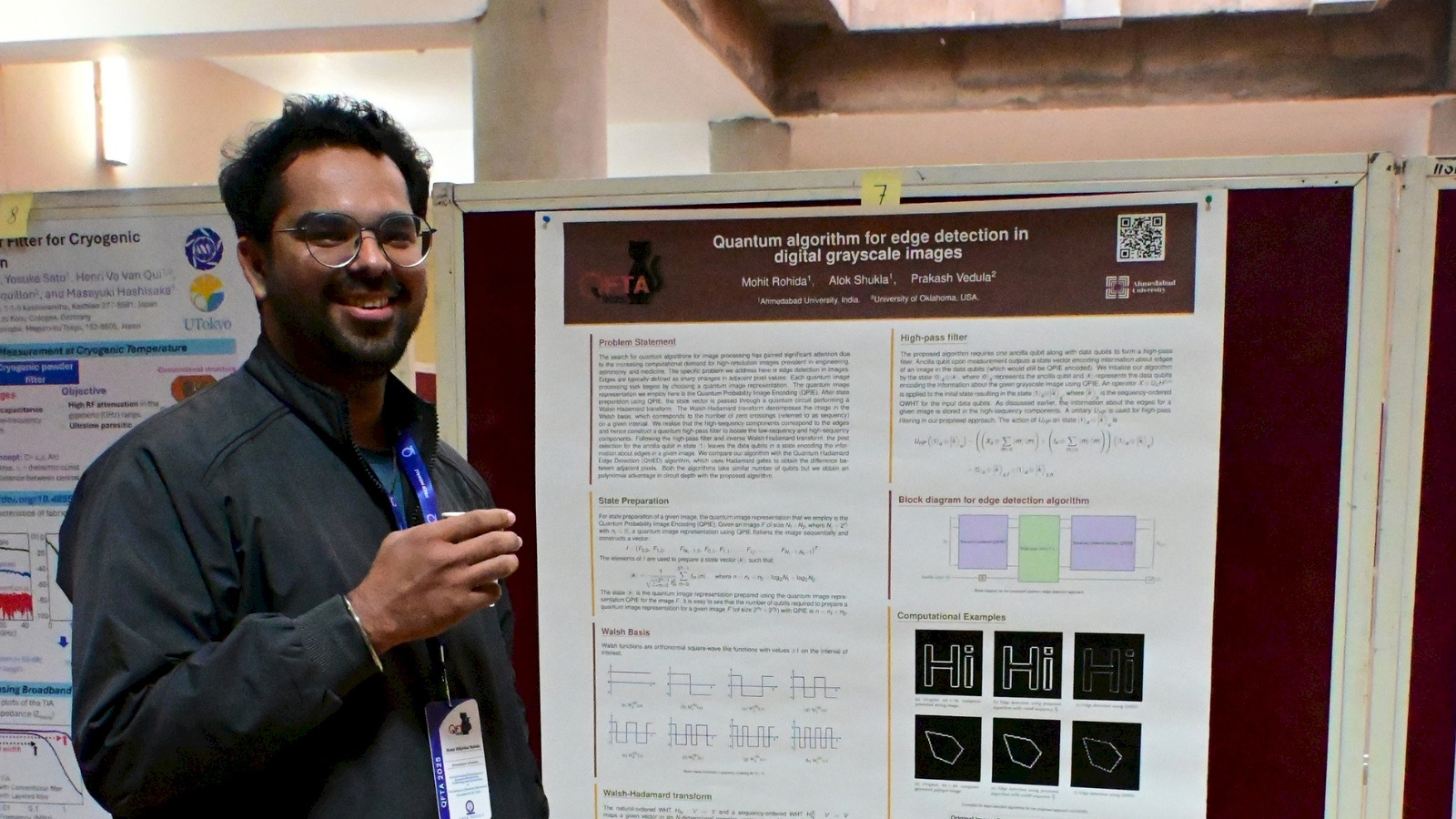
A digital image, a composition of a grid of pixels, is often rendered meaningful through edge detection, which provides these pixels with structure and enables computers to interpret them. Edge detection converts raw visual data into information that machines can analyse, interpret, and act upon. This is critical in numerous real-world applications, including medical diagnostics, satellite and astronomical imaging, and facial recognition, among many others, where it enables systems to interpret data with higher accuracy.
This inspired doctoral student Mohit Rohida to research the field in depth, exploring more efficient ways to detect edges using quantum computing. His work introduces a novel quantum algorithm built around the sequency-ordered Walsh-Hadamard transform, a mathematical tool that decomposes images into patterns where sudden changes, such as edges, emerge more clearly. By rethinking how these patterns are analysed, the approach aligns with the inherent structure of image data.
The defining feature of this method is its efficiency. Compared to existing quantum techniques, it requires fewer computational steps and simpler quantum circuits, making it faster and less complex to execute on quantum hardware. The algorithm also integrates a quantum high-pass filter that emphasises sharp transitions, allowing edges to be extracted with greater precision and clarity.
Tests on sample images showed that this approach outperforms earlier quantum edge-detection methods, highlighting its potential for practical use. This work was recently recognised with the Best Poster Presentation Award at the 3rd International Conference on Quantum Foundations, Technologies, and Applications (QFTA 2025), held at the Indian Institute of Science Education and Research (IISER) Mohali. The award-winning poster was based on a recent preprint developed in collaboration with Professor Alok Shukla of Ahmedabad University and Professor Prakash Vedula of the University of Oklahoma.