
28 August 2026
Manipur: Trust Deficit and the Path Towards Trust Building
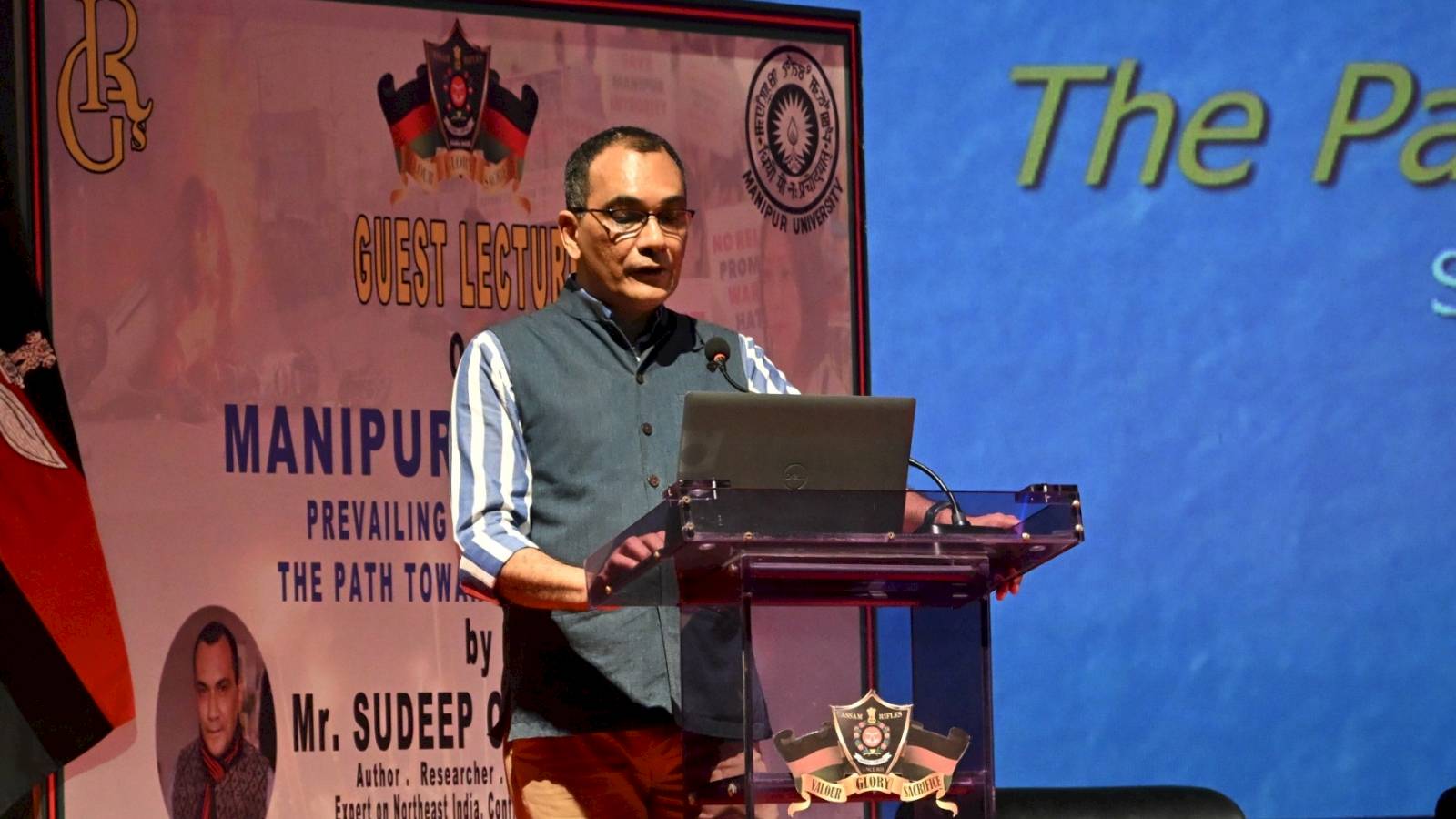
During a public lecture in the Imphal, the capital of troubled Manipur, one of India’s gateway states in the matrix of the ‘Look East’ policy and the subsequent ‘Act East’ policy that seeks to connect this far eastern region with Myanmar and other countries of Asean, Professor Sudeep Chakravarti proposed several steps to bridging the trust deficit among the state’s Meitei, Naga, and Kuki-Chin-Zo peoples. He was invited by Manipur University and Assam Rifles.
The process needs to be sequenced, suggested Professor Chakravarti, Executive Director of Stepwell Centre for Asian Futures. Security. Humanitarian recovery. Political dialogue. Justice and truth alongside reconciliation. And, finally, a new institutional compact for co-existence among the three ethnic groups.
This ‘Framework for Security, Political Dialogue, Justice, Reconciliation and Shared Development for Manipur’ is necessary because the conflict in Manipur has moved beyond the stage of an ordinary law-and-order crisis. The violence that began in May 2023 deepened a three-sided dimension involving Meitei, Kuki-Chin-Zo, and Naga interests, while armed groups, border dynamics, Myanmar’s continuing instability, and competing political claims complicate any simple settlement.
He also suggested that it was time for a Manipur Peace and Reconciliation Compact built around the following pillars.
- An immediate and monitored reduction of violence.
- An inclusive political dialogue mechanism.
- Safe movement and humanitarian access across ethnic boundaries.
- A comprehensive return, rehabilitation, and restitution programme for displaced persons.
- A truth, justice, and reconciliation architecture.
- A negotiated framework for political and administrative grievances without redrawing boundaries as the first resort.
- A structured programme for disarmament, demobilisation, and rehabilitation.
- A long-term social and economic compact linking communities through education, trade, infrastructure, and shared institutions.
This Compact can create an encompassing Manipur Peace Council involving all ethnic groups and including civil society organisations—such as COCOMI, or the Coordinating Committee on Manipur Integrity, an influential Meitei civil society organisation—as well as political organisations—the United Naga Council and its counterparts, for instance. And women, youth, internally displaced persons, traditional institutions, independent constitutional and human-rights experts, and elected representatives.
No single organisation can, or should, suggested Professor Chakravarti, be treated as automatically representing an entire ethnic community. This is particularly important because representation itself has become contested.
The objective should not be ‘reconciliation’ in the narrow sense of asking communities to forgive one another. The immediate objective could be coexistence with security and dignity. Reconciliation, he suggested, can develop over time. Indeed, one finds with examples that abound in the subcontinent, that rehabilitation—difficult and complex as it may be—is often easier than reconciliation.
The principal mistake would be to treat Manipur as one conflict with one cause, Professor Chakravarti said. There are at least five interconnected conflicts.
The first is the Meitei–Kuki-Zo conflict, centred on competing perceptions of land, political representation, security, migration, tribal protection, historical grievance, and territorial control.
The second is the Naga question, which predates the current crisis. Naga political aspirations, the activities of NSCN(I-M), and the relationship between Naga-inhabited areas and Manipur’s territorial integrity are factors in Manipur’s political, historical, and emotional environment. Moreover, an analysis by the Manohar Parrikar Institute of Defence Studies and Analyses noted that Naga, Kuki, and Meitei insurgencies have each acquired political relevance through claims of community protection and self-determination. My own writing and that of several colleagues in Northeastern India have also recorded similar observations.
The third point: The insurgency-security conflict. Armed groups have operated for several decades in Manipur. The state consequently possesses an entrenched security architecture involving the Indian Army, Assam Rifles, Central Armed Police Forces, and Manipur Police.
Point four: Humanitarian conflict created by displacement. A person who has lost a house, farm, shop, village, or place of worship does not experience peace simply because a ceasefire is declared. Even so, while the absence of conflict is not peace, it does give us a foundation to build upon.
Point five: The conflict of narratives. Communities now possess competing accounts of who initiated the violence, who is responsible for atrocities, who is an indigenous inhabitant, who represents whom, and whether the conflict is primarily ethnic, territorial, constitutional, demographic, or security related.
A peace process that attempts to settle all five questions simultaneously will fail, Professor Chakravarti maintained. The approach is therefore about sequencing and then, calibration and revisiting of approaches when something does not work.
[For more, please click here. It contains an article in the September 2026 issue of FORCE Magazine]
For more information, please write to: asian.futures@ahduni.edu.in