6 June 2025
Catalysing Clean Energy Technologies
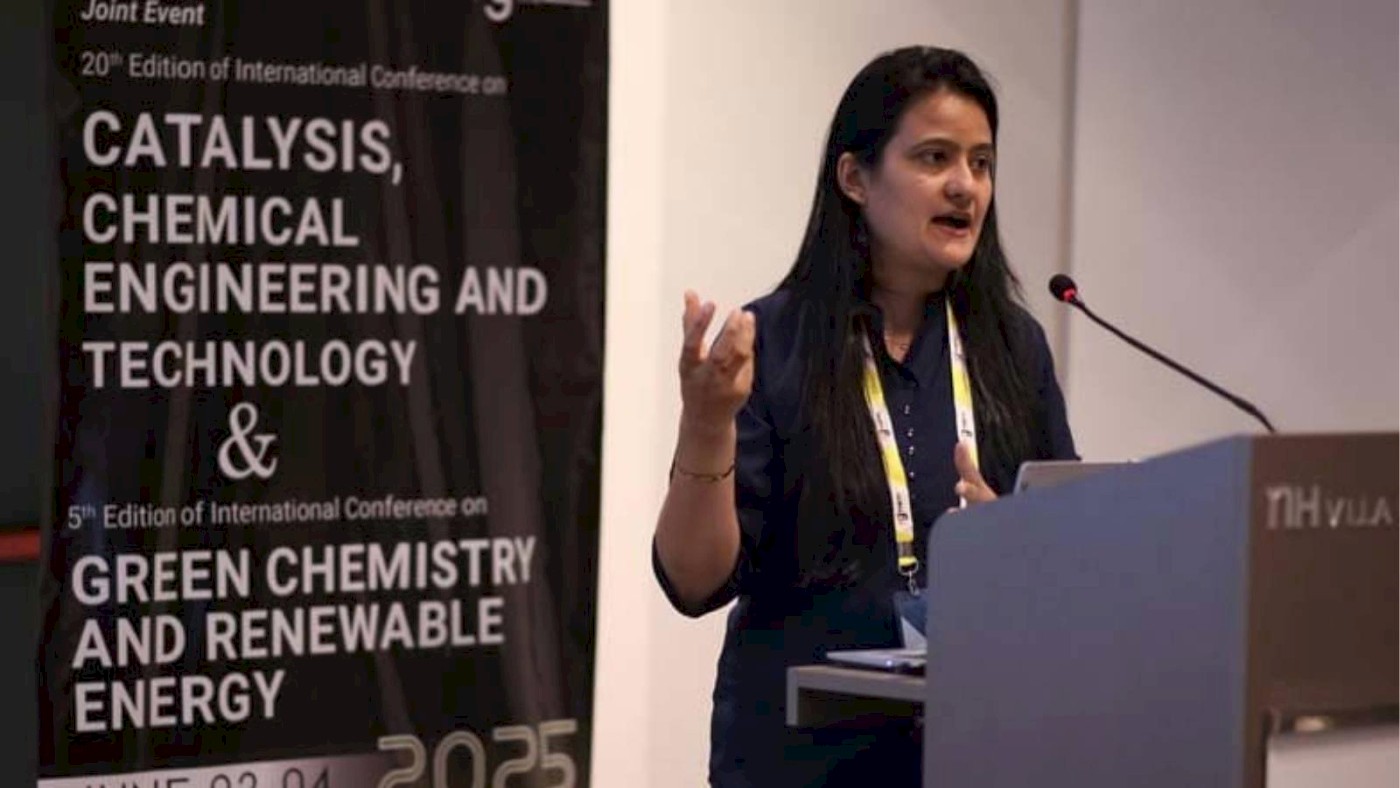
By strategically engineering the incorporation of platinum into nickel–iron oxide compounds and activating them via electrochemical reduction, Rajeshree Liya, a doctoral student under the supervision of Professor Aditi Singhal at Ahmedabad University's School of Engineering and Applied Science, has developed a cost-effective and highly efficient catalyst to enhance the Oxygen Evolution Reaction (OER). This advancement addresses the challenge in clean energy technologies: the inherently slow and energy-intensive nature of the OER.
The high overpotential and sluggish kinetics of the oxygen evolution reaction (OER) pose substantial challenges, making it the primary bottleneck in the overall efficiency of water-splitting processes. Consequently, the development of effective anodic catalysts for the OER is essential, particularly when compared to the relatively faster cathodic hydrogen evolution reaction (HER) in water electrolysis. This approach represents one of the most promising carbon-free strategies for integrating renewable energy into energy conversion, storage, and utilisation (ECSU) technologies.
Rajeshree's research work involves using nickel-iron oxides, which are abundant and inexpensive. The trick lies in how very less amounts of platinum (Pt) are incorporated and then activated through a pre-treatment process called electrochemical reduction activation (ERA).
The study investigated two methods of incorporating platinum (Pt) into these oxides, such as Pt-supported (Pt on the surface) and Pt-substituted (Pt integrated into the structure). After synthesising various samples with different Pt concentrations (0.25, 0.5, and 1 per cent), initial electrochemical tests showed that the Pt-modified compounds didn't outperform the base nickel-iron oxide.
However, ERA pre-treatment effectively reconstructs the material's surface, creating more active sites and oxygen vacancies essential for the reaction. The research found that the optimal approach varied depending on how platinum was introduced. A low concentration (0.25 per cent) of substituted Pt and a higher concentration (1 per cent) of supported Pt yielded the best results. This method offers a pathway to enhance the efficiency water splitting reaction by overcoming the OER bottleneck.
Rajeshree presented her work at the International Conference on Catalysis, Chemical Engineering, and Technology (CCT2025) in Rome, Italy. "This experience was incredibly enriching, both academically and personally," she stated, expressing gratitude for the Rasila Kadia Excellence in Research award from the University, which made her participation in the international conference possible. She also credited her supervisor, Professor Aditi Singhal from the School of Engineering and Applied Science, for her unwavering guidance and support throughout the research. Rajeshree looks forward to applying the insights gained to strengthen her academic contributions further.
Ahmedabad University is a research-driven institute where our doctoral programmes take centre stage in this vibrant ecosystem. Students pursue cutting-edge doctoral research across diverse fields, including management, engineering and applied science, biological and life sciences, physics, mathematical and computational sciences, epidemiology, and an interdisciplinary PhD in humanities and social sciences. Beyond engaging in impactful research, our doctoral students receive financial support, along with comprehensive support for international lab visits, conference participation, research contingency grants, and more. To pursue impactful research like Rajeshree and share it with the global community, explore our doctoral programmes and join our thriving research community.