5 November 2026
Beyond Degrees and Designations: Kulin Lalbhai on Building Businesses, Staying Curious and Shaping Your Own Path
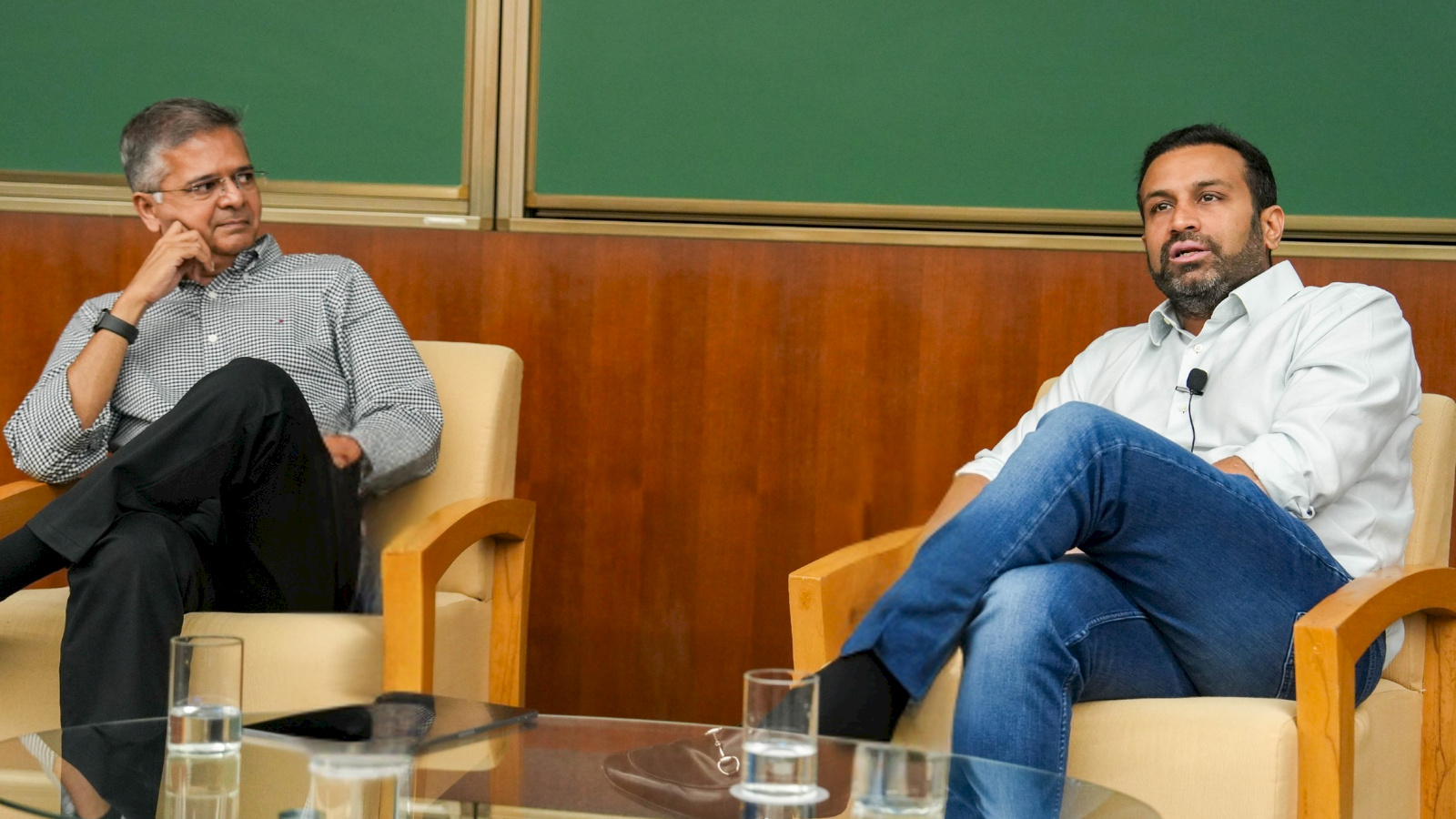
Kulin Lalbhai, Vice Chairman of Arvind Limited, sums up his advice at Ahmedabad University’s Leadership Series 2.0: students should keep learning, take ownership and combine perspectives.
Lalbhai says that a prestigious degree does not, by itself, prepare you for leadership. Drawing on his work in consumer businesses, digital ventures, and real estate, he urged students to build capability through independent experience, stay open to learning, and develop skills that help them adapt as technology reshapes work.
He leads Arvind's consumer and digital businesses, including fashion, real estate and emerging technology ventures. He holds a bachelor's degree in Electrical Engineering from Stanford University and an MBA from Harvard Business School, and he worked as a management consultant at McKinsey & Company before joining the group's leadership.
The event took place on 30 October, with Professor Parag Patel leading the insightful conversation.
Earn Responsibility by Learning to Build
Lalbhai drew a line between ownership and management, especially coming from family businesses. When he and his brother joined, their father held back leadership roles. He told them to build new ventures, assemble teams, absorb setbacks and learn how an idea becomes a working business.
That experience gave him the confidence to take on bigger roles. He then spent several years partnering with CEOs to scale businesses before moving into leadership himself.
He told students to look for opportunities to take ownership of outcomes independently, rather than to manage a single function within an established organisation.
Employers trust people who have delivered, regardless of their title.
Curiosity and Humility
Lalbhai said the biggest gain from Stanford and Harvard came from the people and ideas that challenged what he already believed. At Stanford he studied among exceptionally capable peers. He had done well academically before, and there he became an ordinary student in an extraordinary environment. He called that a lesson in humility.
He told students to use their education to see what is possible. He also doubted that specialised knowledge will stay a differentiator.
With information easy to find, he said, people who connect ideas, combine perspectives and apply knowledge in new ways will gain value.
So study across disciplines, seek out unfamiliar fields and practise working across domains.
Growth and Values Can Coexist
Lalbhai said a business can earn money and still hold to ethical practice. Arvind entered real estate with transparent financial transactions, even though that narrowed its customer base at first in a market where cash deals were common. The company kept its principles. As regulations and market practice changed, that choice became a competitive advantage.
In textiles, Arvind invested in zero liquid discharge technology, which lets it reuse 95% of the water used in production. Production costs rose at first. Over time, the environmental practices strengthened its position with global brands.
He sees profit and responsibility as compatible goals. Future managers and entrepreneurs must build long-term value by putting societal and environmental responsibility inside the business model.
Design Thinking: Creating Spaces That Inspire
Lalbhai spoke about design through Arvind Smart Spaces, the group's real estate business, where he serves as Chairman and Non-Executive Director. The company aims to create spaces that improve how people live, interact, and experience their surroundings, rather than simply developing properties.
He holds that good design belongs in every price range. Small choices matter: more natural light in a home, a welcoming entrance, safe green areas where children can play.
For students, the lesson is that an idea's value includes how it improves everyday life, as well as its technical and commercial merit.
Keep Your Options Open
Near the end, Lalbhai outlined three principles he would follow if he were starting his career today. Pursue something you enjoy. Push beyond your comfort zone while the stakes are low. Hold your career path loosely.
With AI and robotics changing industries and occupations, he stressed staying adaptable and open to opportunities that do not exist yet.
He urged students to use their university years to explore interests, build new capabilities and test their assumptions. If you are deciding what to do after graduation, you do not need to predict where the world is heading. You need the ability to respond to whatever comes next.
A university education prepares you for more than a first job. It gives you time to build the curiosity, humility, resilience and breadth of perspective for a career that means something to you.
Leadership Series 2.0, organised by Amrut Mody School of Management, is an initiative that brings accomplished leaders from business and other fields to campus for face-to-face conversations with students on the realities of leading in a fast-changing world.