11 March 2026
Ahmedabad University Hosts Global Collaborative for the Liberal Arts to Advance Humanistic Technological Innovation in the Age of AI
Seismic shifts in geopolitics and rapid technological advancements in the realm of artificial intelligence, automation, and data-driven systems are reconfiguring how expertise functions, how organisations are structured, and how professional pathways evolve. Universities must therefore examine whether their institutional design, pedagogy, and leadership priorities are aligned with the complexity students will encounter over decades of technological and geopolitical change.
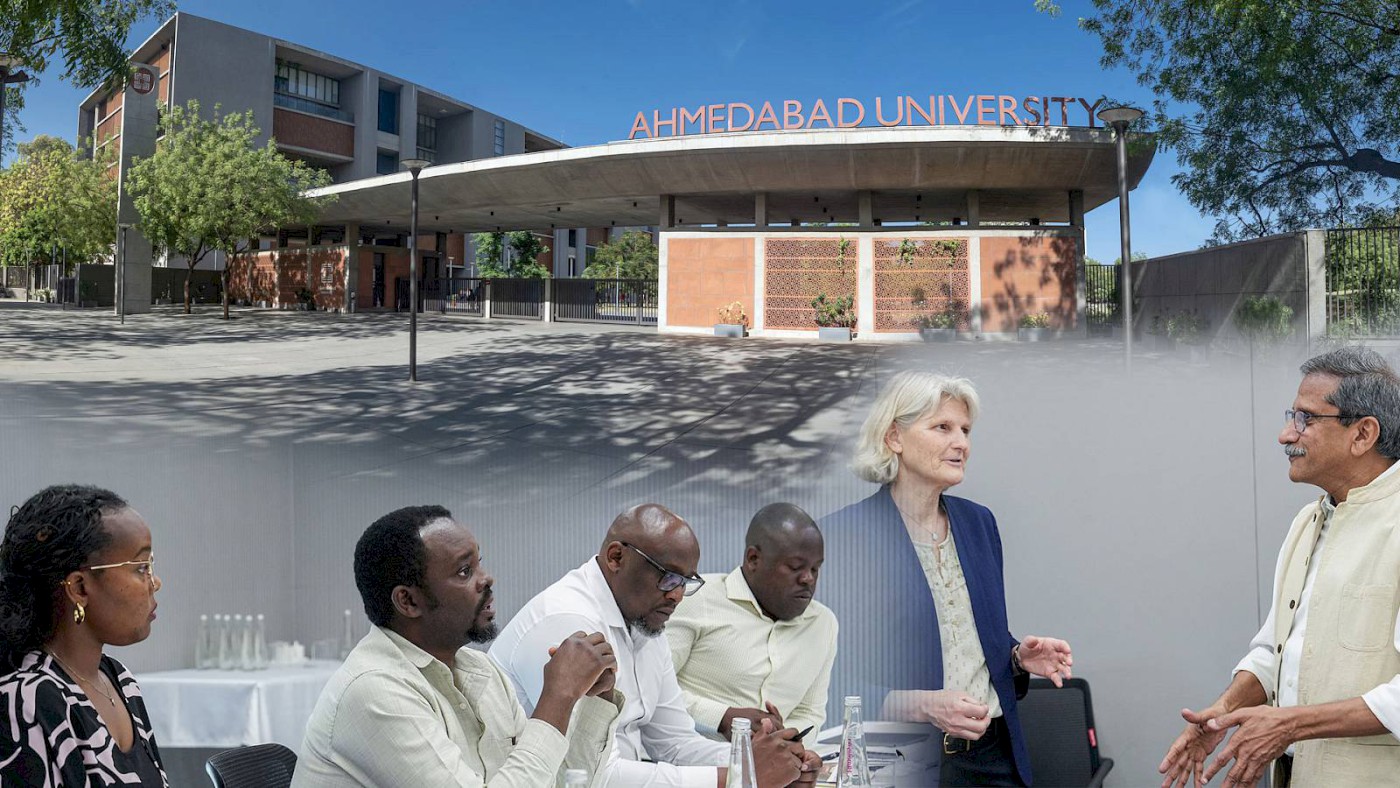
Ahmedabad University hosted leaders from Vassar College, University of Edinburgh, and University of Global Health Equity as part of the Global Collaborative for the Liberal Arts. The partnership brings together institutions committed to cultivating intellectual agility alongside technological competence through coordinated academic design and institutional reflection.
With institutions spread across continents, the Global Collaborative for the Liberal Arts fosters sustained comparative reflection on organisational culture, pedagogy, and educational outcomes within distinct higher education systems. This cross-continental structure allows curricular design and institutional strategy to be informed by varied political, economic, and technological environments, strengthening the capacity of each partner to undertake reform with shared insight and institutional clarity.
Professor Pankaj Chandra, Vice Chancellor of Ahmedabad University, said “Preparing students for the age of artificial intelligence requires more than adding technical modules. Institutions must cultivate intellectual agility as a defined outcome. Pedagogy, A concern for long term implications of any technology on society must enter the content as well as the pedagogy so that graduates are able to integrate technical knowledge with ethical reasoning and cross-disciplinary understanding.”
Sharing her insights about the urgent need for reimagining higher education, Professor Elizabeth Bradley, President of Vassar College, said “Technological systems are advancing at extraordinary speed and they’re already having a transformative impact on learning. Higher education institutions must ensure that ethical reasoning, contextual judgment, and interdisciplinary inquiry stay at the forefront. Humanistic technological change requires intentional educational design.”
The 2026 shared academic theme, Humanistic Technological Innovation, examines how artificial intelligence, financial technologies, digital health systems, and data infrastructures can expand access and inclusion while strengthening public institutions. Each partner institution contributes a distinct disciplinary perspective, including financial technology and inclusion, planetary health, narrative medicine, and technology ethics.
Underscoring the implementation focused approach of the Collaborative, Professor Philip Cotton, Vice Chancellor of the University of Global Health Equity, said, “An important academic initiative within the partnership is the Global Scholars Course, a jointly developed programme connecting students across four continents through shared readings, structured dialogue, and collaborative project design. The course culminates in an academic immersion in Kigali, Rwanda, where cross-institutional teams develop proposals addressing gaps in access and inclusion within technological ecosystems”.
Hosting the 2026 convening in Ahmedabad reflects the increasingly multipolar character of educational leadership. Institutions across Asia, Africa, Europe, and North America are contributing to the redesign of higher education in ways that recognise technological transformation while sustaining the centrality of human judgment.
Professor Peter Mathieson, Principal and Vice Chancellor of the University of Edinburgh, said, “Universities operate in very different national and social contexts, yet many of the challenges we face in the global context are very similar. Collaborations such as the Global Collaborative for the Liberal Arts create opportunities for institutions to learn from one another while bringing diverse perspectives to shared questions about technology, society, and the future of education.”
Through the Global Collaborative for the Liberal Arts, the four institutions are advancing a coordinated model of education designed to prepare graduates for responsible leadership in a century defined by artificial intelligence and sustained complexity.