27 May 2026
A Patented Green Approach to Industrial Wastewater Treatment and Pollution Control
Industrial wastewater treatment and pollution control methods have increasingly come under criticism for their environmental impact and reliance on toxic chemical processes. While Emulsion Liquid Membrane (ELM) technology is highly efficient in separating and recovering contaminants from aqueous solutions, conventional systems often fail to adequately address environmental and health risks associated with membrane technologies.
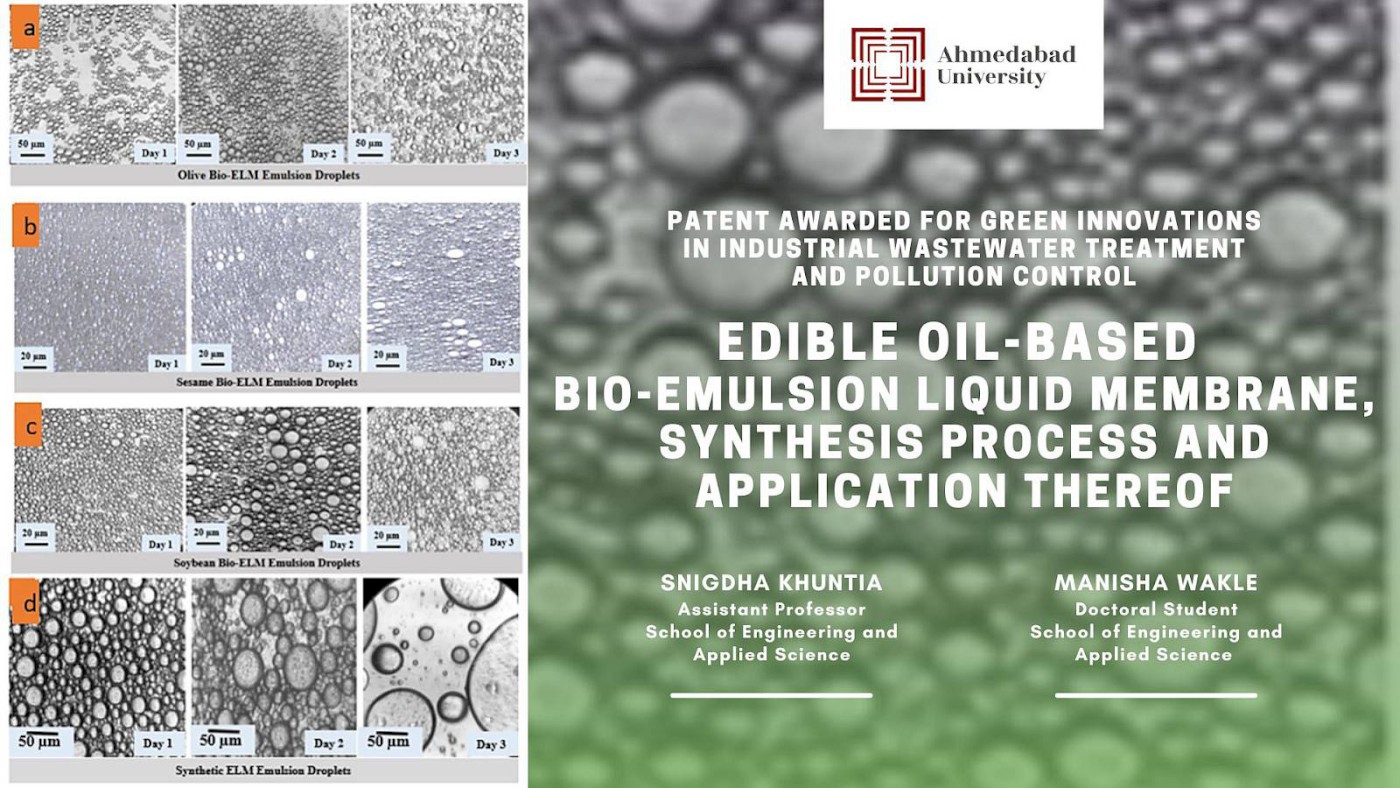
Professor Snigdha Khuntia from the School of Engineering and Applied Science and Manisha Wakle, who is pursuing her doctoral studies at Ahmedabad University under Professor Khuntia’s guidance, developed a novel Bio-Emulsion Liquid Membrane (Bio-ELM) system using edible oils such as sesame, soybean, and olive oil as bio-diluents in place of petroleum-derived materials. The innovation has been granted a patent by the Indian Patent Office.
The formulation achieves enhanced emulsion stability, reduced surfactant demand, and improved phase separation control, enabling efficient removal of contaminants from wastewater. The Bio-ELM demonstrated superior performance, with sesame oil exhibiting the longest stability duration and the smallest droplet size.
The process has been designed to operate under mild conditions, ensuring biocompatibility and environmental safety. Owing to its sustainable composition and cost-effective operation, the technology is well-suited for industrial wastewater treatment and resource recovery applications, marking a significant advancement toward green membrane processes.
Although ELM technology has emerged as an efficient separation solution, emulsion instability remains a major challenge. During extraction, emulsion droplets can break down, causing leakage of the internal stripping phase into the external aqueous phase. This instability reduces extraction efficiency, weakens membrane integrity, affects long-term operational performance, and limits scalability for industrial wastewater treatment.
Another major limitation of conventional ELM systems is their dependence on toxic and expensive chemical components, including hydrocarbon-based diluents, synthetic surfactants, ionic liquids, and carrier solvents. These materials increase operational costs while raising concerns related to environmental toxicity, non-biodegradability, and potential health hazards.
Furthermore, existing technologies have not sufficiently addressed the need for biodegradable membrane materials, eco-friendly synthesis methods, sustainable wastewater treatment systems, and low-cost alternatives suitable for large-scale industrial use. The invention, therefore, responds to the growing demand for a green Bio-ELM system capable of delivering enhanced stability, high extraction efficiency, cost-effectiveness, and environmental sustainability simultaneously.
Optimised edible oil formulations and surfactants enhance membrane stability by preventing emulsion breakdown, reducing leakage of the internal phase, improving extraction efficiency, and increasing operational reliability. A more stable membrane also enables better mass transfer, higher contaminant removal rates, and more selective extraction of pollutants from wastewater.
In addition, the use of biodegradable edible oils reduces toxicity, minimises environmental pollution, and decreases dependence on petroleum-derived chemicals, making the technology greener and safer for environmental applications. Replacing expensive hydrocarbon-based materials and ionic liquids with edible oils also lowers raw-material, membrane synthesis, and operational costs, thereby improving commercial feasibility and scalability. Reduced use of toxic chemicals further minimises health risks to workers, ecological damage from chemical disposal, and long-term environmental contamination. The invention contributes to sustainable wastewater treatment by supporting circular and green chemistry approaches, sustainable industrial practices, and eco-friendly pollution control technologies.