
Performing and Visual Arts
Research Interests: Histories of Printmaking Pedagogy in Post-independent India, Tracing Emergence of Subaltern Perspectives through Contemporary Art Practices, Examining How Marginalised Voices Reframe Material Traditions, Reshape Visual Languages and Influence the Wider Cultural Frameworks of Artistic Production
Profile
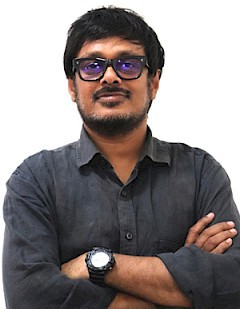
Professor Koustav Nag is an artist-scholar whose work spans printmaking, material studies, and contemporary art practices in South and East Asia. He holds a PhD from Assam University, where his research examined the intersections of traditional printmaking, cultural identity formation, and the pedagogical legacies of colonial art education.
With his teaching experience and a strong studio background, Professor Nag brings a reflective and research-driven approach to his pedagogy. He has guided students in understanding both the conceptual and material foundations of image-making, while encouraging a critical engagement with history, technique, and contemporary relevance.
His artistic practice includes installation and community-based projects presented nationally and internationally. Recent work with the Goethe-Institut New Delhi explored labour, visibility, and the social life of materials. Professor Nag has received several distinguished awards and fellowships, including support from the Japan Foundation Tokyo Wonder Site, the World Bank USA, the Ministry of Culture India, and the Lalit Kala Akademi.
Across his teaching and research, Professor Nag maintains a commitment to examining how traditional printmaking processes continue to shape artistic discourse today. His work reflects a steady belief in the value of historical knowledge, disciplined practice, and thoughtful inquiry.
Research
Professor Koustav Nag's research explores the historical, pedagogical, and cultural trajectories of printmaking in Asia, with a particular focus on India and Japan. One of his central research areas is "A Critical Study of Institutional Printmaking: Pedagogy and Practices in Post-Independent India”, where he examines how printmaking departments in major art institutions shaped artistic identity, curriculum design, and the transition from traditional techniques to contemporary approaches. This study also examines how institutional frameworks have influenced material choices, workshop culture, and the broader discourse on modern Indian art.
Professor Nag's doctoral research examined the arrival and adaptation of Japanese printmaking within the Santiniketan environment during Rabindranath Tagore's time, exploring cross-Asian artistic exchanges and their impact on early Asian modernism. He continues to expand this work by comparing contemporary printmaking practices in Japan and India, with a focus on image construction, material language, and studio methodology.
Professor Nag also works on subaltern representation and material culture in contemporary art. His See Through project reflects on the visibility of urban labourers through construction materials used as symbolic devices. Across all his research, he maintains a thoughtful commitment to understanding how tradition, pedagogy, and cultural memory shape the evolving field ofprintmaking.
Publications
- Research on Ownership and Emotional Understanding of AI-generated Art, Exploration 2024 of Research A Scientific Journey ISBN: 978-93-6135-162-4, Chapter -4, Page 39-50 (2024)
- Archaeology of Art Education in India:From Colonialism to Artificial Intelligence Chapter - 5 page - 56-66, ISBN: 978-91-989240-7-7, DOI-10.25215/9198924079 (2024)
- Sustainable printmaking: Changing Toxic to Non-Toxic Artist Practice and Ecological Harmony In society, Integrated Publication, Chapter -7, PP 65-74, Edition -1 Vol-2 ,ISBN;978-93-5834-085-3 (2023)
- Printmaking to Printing Technology Importancy of present time, Red’s Shine Publication, Vol -8 , Chapter -16, ISBN-978-91-89764-50-7, P-115 (2023)
- Praxis International Journal of Social Science and Literatur, ISSN: 2581-6675 Volume 6, Issue 4, April 2023. Page-39-47 (2023)
- Rabindra Bharati Journal of Philoshophy -Vol-XXIII, No. 07:2022, ISSN NO-0973-0087 (2022)
Teaching
- Printmaking: Relief, intaglio, lithography, serigraphy, and alternative printmaking processes, with emphasis on traditional and contemporary methods, workshop discipline, and modern applications.
- Drawing and Visual Studies: Foundations of visual language, observational skills, and conceptual development.
- Painting: Techniques, colour handling, and surface development.
- Sculpture: Exploration of form, structure, and diverse materials.
- Installation Art: Spatial awareness, site-responsive approaches, and material-led immersive practices.
- Community-Based Art Practice: Working in public spaces, collaborative art-making, and socially engaged processes.
- Studio Practice and Portfolio Development: Mentorship on building cohesive bodies of work, refining craft, and developing thoughtful material engagement.