
Faculty
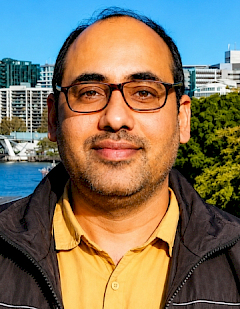
Ashish Kumar Upadhyay
Assistant Professor, Bagchi School of Public Health
PhD (International Institute for Population Sciences, Mumbai)
Research Interests: Biostatistics and Demographic Modelling, Small Area Estimation (SAE), Spatial Epidemiology and Geospatial Analytics, Gender and Health Equity, Maternal and Child Health, Non-communicable Disease Epidemiology (hypertension and diabetes), Health Policy and Systems Research
Profile
Professor Ashish Kumar Upadhyay served as a Research Scientist with the Centre on Gender Equity and Health, University of California, San Diego (UCSD), USA, based in India. He worked in the GENDER (project in collaboration with the International Institute for Population Sciences (IIPS), Mumbai, which develops gender-focused research using large-scale survey data from South Asia and Southeast Asia. Prior to this role, he served as Research Coordinator on the r4d: Inclusive Social Protection for Chronic Health Problems project at IIPS, undertaken in collaboration with the University of Lausanne, Switzerland, and the Erasmus School of Economics, the Netherlands, which examined socioeconomic and geographical inequality in health among older adults in India. He has also worked as Research Coordinator on an earlier phase of the GENDER Project at IIPS, in collaboration with UCSD. Professor Upadhyay holds a PhD in Population Studies from IIPS, Mumbai, an MPhil in Population Studies from IIPS, and an MSc in Statistics from Banaras Hindu University (BHU).
Research
Professor Upadhyay's research lies at the intersection of demography, biostatistics, and public health, with a particular focus on gender, maternal and child health, and non-communicable disease epidemiology in South Asia. As part of the GENDER Project, funded by the Bill & Melinda Gates Foundation, he conceptualises and supervises research on gender issues in India, and supports the development of gender-disaggregated data at the sub-national level. His earlier work on the r4d: Inclusive Social Protection for Chronic Health Problems project, funded by the Swiss National Science Foundation and the Swiss Agency for Development and Cooperation, examined socioeconomic and geographical inequalities in health among older adults in India.
The recurring methodological theme in his research is model-based Small Area Estimation (SAE), which he has applied to map son preference, women's work participation, women’s financial inclusion, and childhood stunting at the district level across India. He has also published extensively on hypertension and diabetes screening and control, intimate partner violence and contraceptive discontinuation, interpregnancy intervals and child health outcomes, and the socioeconomic and environmental determinants of child undernutrition and mortality, drawing on nationally representative surveys such as the National Family Health Survey (NFHS) and the Demographic and Health Surveys (DHS), Longitudinal Ageing Study in India (LASI) and Young Lives Study (YLS). His work combines quantitative public health and epidemiological methods, statistical and econometric modelling, spatial and geospatial analytics to health data.
Publications
- Srivastava S, Kumar K, McDougal L, Nambiar A, Upadhyay AK, Hay K, Raj A, Singh A (2026). Spatial Heterogeneity in Women's Financial Inclusion in India: An application of small area estimation. PLOS ONE, 21(4). https://doi.org/10.1371/journal.pone.0347585
- Upadhyay AK, Singh A, Singh A, Johnson FA, Kumar K, Tzavidis N, Padmadas SS (2025). Mapping son preference in India, 2002–2021: Spatial patterns and trends using model-based small area estimation. Demographic Research. 10.4054/DemRes.2025.53.28
- Pedgaonkar SP, Kumar K, Meitei WB, Kumar S, Upadhyay AK, Maurer J, Singh A (2025). Clustering of hypertension and clustering of diabetes within households across districts of India: A cross-sectional analysis using a nationally representative household survey. PLOS Global Public Health. https://doi.org/10.1371/journal.pgph.0004648
- Srivastava S, Kumar K, McDougal L, Upadhyay AK, Hay K, Singh A (2025). Mapping women's work in India: An application of small area estimation. PLOS ONE, 20(2). https://doi.org/10.1371/journal.pone.0317783
- Singh A, Kumar K, McDougal L, Chokhandre PK, Singh AK, Upadhyay AK, James KS, Raj A (2025). Patriarchy, fertility and excess female child mortality in India. Spatial Demography, 13(1). https://doi.org/10.1007/s40980-024-00133-z
- Singh A, Upadhyay AK (2024). Spatial patterns of son preference in India. Atlas of Gender and Health Inequalities in India, pp. 89–96. https://doi.org/10.1007/978-3-031-47847-5_8
- Mohanty SK, Upadhyay AK, Maiti S, Mishra RS, Kämpfen F, Maurer J, O'Donnell O (2023). Public health insurance coverage in India before and after PM-JAY: Repeated cross-sectional analysis of nationally representative survey data. BMJ Global Health, 8(8), e012725. https://doi.org/10.1136/bmjgh-2023-012725
- Mohanty SK, Abhilasha, Mishra RS, Upadhyay AK, O'Donnell O, Maurer J (2023). Sociodemographic and geographic inequalities in diagnosis and treatment of older adults' chronic conditions in India: A nationally representative population-based study. BMC Health Services Research. https://doi.org/10.1186/s12913-023-09318-6
- Singh A, Upadhyay AK, Kumar K, Singh A, Johnson FA, Padmadas SS (2022). Spatial heterogeneity in son preference across 640 districts in India: Application of model-based small area estimation techniques. Demographic Research. https://doi.org/10.4054/DemRes.2022.47.26
- Upadhyay AK, Kumar K, James KS, McDougal L, Raj A, Singh A (2022). Association between intimate partner violence and contraceptive use discontinuation in India. Studies in Family Planning. https://doi.org/10.1111/sifp.12184
- Kannaujiya AK, Kumar K, Upadhyay AK, McDougal L, Raj A, James KS, Singh A (2022). Interpregnancy interval and child health outcomes in India: Evidence from three recent rounds of the National Family Health Survey (NFHS). Maternal and Child Health Journal. https://doi.org/10.1007/s10995-022-03559-3
- Kannaujiya AK, Kumar K, Upadhyay AK, McDougal L, Raj A, James KS, Singh A (2021). Effect of preterm birth on early neonatal, late neonatal and postneonatal mortality in India. PLOS Global Public Health. https://doi.org/10.1371/journal.pgph.0000205
- Islam S, Upadhyay AK, Mohanty SK, Pedgaonkar SP, Maurer J, O'Donnell O (2022). Use of unclean cooking fuels and visual impairment among older adults in India: A nationally representative study. Environment International. https://doi.org/10.1016/j.envint.2022.107302
- Mohanty SK, Ambade M, Upadhyay AK, Mishra RS, Pedgaonkar SP, Kämpfen F, O'Donnell O, Maurer J (2022). Prevalence of pain and its treatment among older adults in India: A nationally representative study. Journal of Pain. 10.1097/j.pain.0000000000002705
- Mohanty SK, Upadhyay AK, Shekhar P, Kämpfen F, O'Donnell O, Maurer J (2021). Missed opportunities for hypertension screening in India: A cross-sectional study. Bulletin of the World Health Organization. https://doi.org/10.2471/BLT.21.287007
- Mohanty SK, Pedgaonkar SP, Upadhyay AK, Kämpfen F, Shekhar P, Mishra RS, Maurer J, O'Donnell O (2021). Awareness, treatment and control of hypertension in adults aged 45 years and over and their spouses in India. PLOS Medicine. https://doi.org/10.1371/journal.pmed.1003740
- Srivastava S, Chandra H, Singh SK, Upadhyay AK (2021). Mapping changes in district-level prevalence of childhood stunting in India, 1998–2016: An application of small area estimation techniques. SSM – Population Health. https://doi.org/10.1016/j.ssmph.2021.100748
- Upadhyay AK, Singh A (2020). Are Indian girls really better nourished than Indian boys? Evidence from the National Family Health Survey (NFHS), 1992–2016. Clinical Epidemiology and Global Health. https://doi.org/10.1016/j.cegh.2020.09.007
- Srivastava S, Upadhyay AK (2020). A success story of reduction in childhood stunting and underweight in India: Analysis of pooled data from three rounds of the Demographic and Health Surveys (DHS), 1998–2016. Journal of Biosocial Science. https://doi.org/10.1017/S002193202000070X
- Kannaujiya AK, Kumar K, Upadhyay AK, McDougal L, Raj A, Singh A (2020). Short interpregnancy interval and low birth weight births in India: Evidence from the National Family Health Survey (NFHS) 2015–16. SSM – Population Health. https://doi.org/10.1016/j.ssmph.2020.100700
- Srivastava S, Fledderjohann J, Upadhyay AK (2020). Explaining socioeconomic inequalities in immunisation coverage in India: New insights from the fourth National Family Health Survey (2015–16). BMC Pediatrics. https://doi.org/10.1186/s12887-020-02196-5
- Upadhyay AK, Srivastava S, Mishra V (2020). Does use of solid fuels for cooking contribute to childhood stunting? A longitudinal data analysis from low- and middle-income countries. Journal of Biosocial Science. https://doi.org/10.1017/S0021932020000097
- Singh S, Srivastava S, Upadhyay AK (2019). Socioeconomic inequality in malnutrition among children in India: An analysis of 640 districts from the National Family Health Survey (2015–16). International Journal for Equity in Health. https://doi.org/10.1186/s12939-019-1093-0
- Upadhyay AK, Singh A, Singh A (2019). Association between unintended births and risk of postpartum depression: Evidence from Ethiopia, India, Peru and Vietnam. SSM – Population Health. https://doi.org/10.1016/j.ssmph.2019.100495
- Upadhyay AK, Singh A, Srivastava S (2019). New evidence on the impact of the quality of prenatal care on neonatal and infant mortality in India. Journal of Biosocial Science. https://doi.org/10.1017/S0021932019000543
- Upadhyay AK, Srivastava S (2017). Association between Haemophilus influenzae type b (Hib) vaccination and child anthropometric outcomes in Andhra Pradesh (India): Evidence from the Young Lives Study. Journal of Public Health. https://doi.org/10.1007/s10389-017-0824-1
- Upadhyay AK, Srivastava S, Paul C (2017). Consequences of forced migration during early childhood on cognitive well-being in later childhood in Andhra Pradesh, India. International Journal of Population Studies.
- Singh A, Upadhyay AK, Singh A, Kumar K (2017). The association between unintended births and poor child development in India: Evidence from a longitudinal study. Studies in Family Planning. http://www.jstor.org/stable/26384497
- Upadhyay AK, Srivastava S (2015). Effect of pregnancy intention, postnatal depressive symptoms and social support on early childhood stunting: Findings from India. BMC Pregnancy and Childbirth. https://doi.org/10.1186/s12884-016-0909-9
- Singh A, Upadhyay AK, Kumar K (2016). Birth size, stunting and recovery from stunting in Andhra Pradesh, India: Evidence from the Young Lives Study. Maternal and Child Health Journal. https://doi.org/10.1007/s10995-016-2132-8
- Upadhyay AK, Singh A, Kumar K, Singh A (2015). Impact of indoor air pollution from the use of solid fuels on the incidence of life-threatening respiratory illnesses in children in India. BMC Public Health. https://doi.org/10.1186/s12889-015-1631-7
Conference (National and International)
- Upadhyay, AK (2025, July 13–18). Sex differential in hypertension awareness, treatment and control in India. International Population Conference (IPC), Brisbane, Australia.
- Upadhyay AK (2019, April 10-13). Socioeconomic inequality in health at later ages: An artefact of mortality selection. Population Association of America (PAA) Annual Meeting, Austin, Texas, USA.
- Upadhyay AK (2019, April 10-13). Ageing in the context of cohort evolution and mortality selection in India. Population Association of America (PAA) Annual Meeting, Austin, Texas, USA.
- Upadhyay AK (2018, November 12-15). Association between unintended birth and risk of postpartum depression: Evidence from Ethiopia, India, Peru and Vietnam. International Conference on Family Planning (ICFP), Kigali, Rwanda.
- Upadhyay AK (2018 July 11-14). Consequences of forced migration during early childhood on child development in India: Evidence from longitudinal studies. Asian Population Association (APA) Conference, Shanghai, China.
- Upadhyay, A. K. (2017, August 11). Effect of maternal employment during the first year of a child's life on development at the age of eight years: Evidence from a longitudinal study. Global Need for Formal Child Care Conference, McGill University, Montreal, Canada.
- Upadhyay AK (2017). Socioeconomic inequalities in health at later ages: An artefact of mortality selection. International Union for the Scientific Study of Population (IUSSP) International Population Conference 2017, Cape Town, South Africa.
- Upadhyay AK, Srivastava S (2016). Consequences of household forced displacement during early childhood on cognitive well-being during later childhood: A longitudinal data analysis from India. Young Researchers' Conference on Impact and Challenges of Demographic Changes, Paris, France.
- Upadhyay AK (2015 July 27-30). Effect of public health spending on childhood undernutrition: Evidence from 104 Demographic and Health Surveys from 34 developing countries. Asian Population Association (APA) Conference, Kuala Lumpur, Malaysia.
- Upadhyay AK and Srivastava S (2015 April 30 – May 2). Association between economic growth and infant mortality: Evidence from 132 Demographic and Health Surveys from 36 developing countries. Population Association of America (PAA) Annual Meeting, San Diego, California, USA.