
Wednesday
04
November 2026
4:00 - 6:00 PM IST
Location
Room 201, School of Arts and Sciences
Central Campus
Share
The Umbrella called Bustard
Arts and Sciences Lecture Series
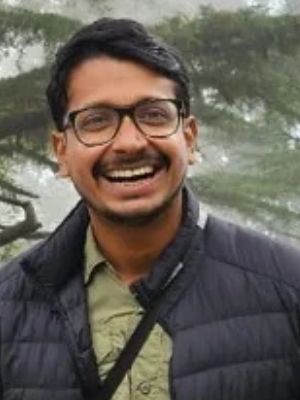
Sutirtha Dutta
Scientist
Wildlife Institute of India
Dehradun
Speaker
Nature conservation has moved along two seemingly dichotomous paths of landscape vs focal species approaches. Although surrogate species’ conservation can benefit associated taxa, the mechanism of shared benefits is rarely examined. India’s Open Natural Ecosystems (ONEs) - vital for biodiversity and pastoral livelihoods, yet historically marginalised - are receiving renewed conservation attention, much of it focusing on the Critically Endangered Great Indian Bustard (GIB). This offers an opportunity to evaluate its umbrella effect. The GIB’s population and distribution have declined by 90% over five decades, due to historical hunting and habitat loss. Recovery efforts are addressing the vulnerability of its small population and threats in the wild. Conservation breeding, using eggs collected from the wild, has exceeded predicted survival benchmarks and enabled rewilding, earlier than anticipated. Concurrently, research integrating surveys, telemetry and field observations have identified vulnerable demographic stages, mortality agents, habitat requirements and space use, informing in-situ management. We identified three pathways by which GIB conservation can benefit associated taxa of India’s ONEs.
- Habitat restoration: A network of fenced closures has been established in Desert National Park, to secure breeding habitats for GIB from unregulated agriculture and grazing.
- Threat mitigation: Surveys indicate habitat displacement and mortality of GIB, along with the Laggar Falcon, Egyptian Vulture, and Tawny Eagle, due to energy infrastructure. The Hon’ble Supreme Court Judgement curtailing new energy infrastructure within the Priority GIB Area of ~15,000 sq km will reduce this additive mortality of these threatened taxa.
- Resource mobilisation: Successful conservation breeding of GIB in Rajasthan has strengthened efforts to recover ‘doomed’ populations, mobilising resources for restoring degraded habitats.
Together, these findings demonstrate how umbrella conservation can deliver broader biodiversity gains across India’s ONEs. However, the vastness of these landscapes, competing stakeholder interests, open-access regimes, and longstanding systemic neglect pose challenges to the recovery of this ancient ecosystem.
Speaker
Sutirtha Dutta
I am an applied ecologist, interested in a wide range of questions on distribution, dynamics, behaviour and their conservation applications for endangered animal populations. I grew up in Kolkata, where I completed my Bachelors in Zoology from Presidency College (2004). As part of my Masters in Forestry from Forest Research Institute, Dehradun (2006), I studied the natural history of spiny-tailed lizard in Kutch for my dissertation that piqued my curiosity in grassland ecology. After a brief stint in Bombay Natural History Society, where I worked on wetland birds, I joined the Wildlife Institute of India as a researcher, to study, among other things, the Great Indian Bustard (2007). I completed my PhD on its ecology and conservation under the guidance of my mentors Dr Yadvendradev Jhala and Dr Asad Rahmani (2012). Then, I joined the Wildlife Institute of India as a Scientist (2017).
Here, I have continued and expanded my work on grasslands and bustards. I have been instrumental in developing the national conservation action plan for India’s bustards (2013) and lead the Bustard Recovery Program - an integrated approach of scientific research, conservation breeding and habitat management for recovering the Critically Endangered Great Indian Bustard and Lesser Florican. My current research focuses on wildlife population responses to anthropogenic habitat changes through the lens of demography, movements, habitat-relationships and behaviour of grassland fauna. I also engage widely with research scholars from other socio-ecological systems to address their questions using quantitative analytical tools. At my Institute, I teach population ecology, quantitative methods, study design and conservation biology to Masters students and trainees from Indian Forest Services.