Wednesday
18
November 2026
4:00 PM IST
Location
Room 008, Amrut Mody School of Management
Central Campus
Share
Elephant Knowledge in Precolonial Assam: Exploring the Interface of Heritage and Ecological Consciousness in Hastividyarnava
Expert Talk
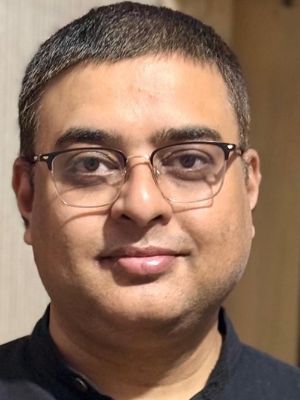
Dhurjjati Sarma
Assistant Professor
Department of Modern Indian Languages and Literary Studies
Gauhati University
Speaker
The Hastividyarnava (Saka 1656, AD 1734) is an illustrated treatise on elephant lore, and is notable among the illustrated Assamese manuscripts epitomising the joint engagement between literature and visual arts in medieval and early modern Assam. The text was composed by Sukumar Barkath, and the illustrations were carried out by Dilbar and Dosai, two skilled artists hailing from the Mughal capital, under the orders of the Ahom king Siva Singha (AD 1714–1744) and his queen Ambika Devi. The paper endeavours to analyse Hastividyarnava as a knowledge text embodying significant information on the central role of elephants vis-à-vis the activities of the royal court and also the use of specifically prescribed medicinal herbs and concoctions for treating various diseases afflicting the elephant. As a text drawing on the prevalent wisdom accrued from mythology, folklore, and Sanskrit gajashastras, the Hastividyarnava could be seen as a valuable ‘heritage document’ of the eighteenth century through its emphasis on traditional knowledge system and prescriptive activities for ensuring the well-being and longevity of elephants under the close supervision of the Ahom kings. The study will also incorporate insights pertaining to the movement of elephants through trade and migration routes from the precolonial to the modern period, with due focus on the ‘embodied heritage’ manifested through the figure of the animal traversing the undulating plains and hills of Assam. A few folksongs resonant of the traditional elephant lore of the region will also be discussed with a view to understand how elephant knowledge—mediated through the oral, written, and performative—formed part of the larger ecological engagement of the specific communities functioning as mahouts (riders) and phandis (trainers) of elephants.
Speaker
Dhurjjati Sarma
Dhurjjati Sarma is an Assistant Professor in the Department of Modern Indian Languages and Literary Studies, Gauhati University, Assam. He is also an Associate at the UGC Inter-University Centre for Humanities and Social Sciences (IUC), Indian Institute of Advanced Study, Shimla. He was educated at the University of Delhi and the English and Foreign Languages University, Shillong Campus. He was a Production Editor at SAGE Publications, New Delhi, and a Research Fellow in North East India Studies at the Indira Gandhi National Centre for the Arts (IGNCA), New Delhi. He is broadly working on various aspects of literary historiography, translation studies and practices, and the interface between literature and other arts. His articles and book reviews have appeared in journals like South Asia: Journal of South Asian Studies, National Identities, Urdu Studies, GUINEIS Journal, Language and Language Teaching, Indian Literature, English Forum, Indica Today, Rupkatha Journal on Interdisciplinary Studies in Humanities, Dibrugarh University Journal of English Studies (DUJES), Space and Culture India, and Margins: A Journal of Literature and Culture. He has chapters in edited books published by Peter Lang, Orient BlackSwan, Springer Nature, Sahitya Akademi, Routledge, and Palgrave Macmillan. He is the Assistant Editor of the Delhi Journal of Comparative Studies, published by the Delhi Comparatists, and was also the Guest Editor of the transcript: An e-Journal of Literary and Cultural Studies, published by the Department of English, Bodoland University, India, for two years. He has delivered lectures and participated in workshops at various academic institutions in India and abroad, including Central Institute of Indian Languages (Mysore), University of Calcutta, University of Delhi, NCERT (New Delhi), NIT Silchar, IIT-Bombay, Bangalore University, ICCR Moscow, Moscow State Linguistic University, and the Centre for South Asia and Himalayan Studies, Aubervilliers, France. He translates between Assamese, English, and Hindi, and his notable works include the Assamese translation of G.N. Devy’s Mahabharata: The Epic and the Nation and the Hindi translation of the PLSI Assam Volume.