16 April 2026
How Can Natural Ecosystems Inspire New Computing Systems
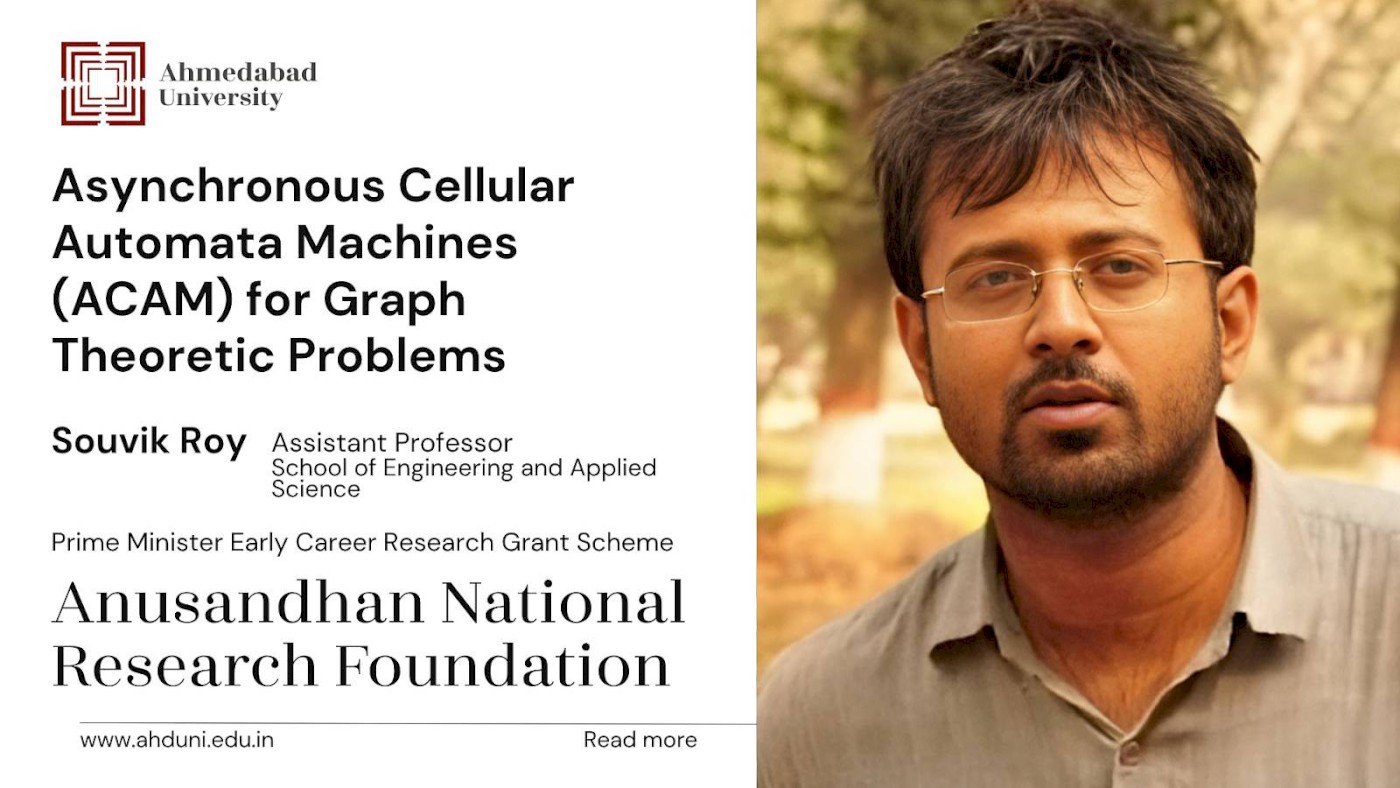
What’s common in the growth of living organisms, the movement of bird flocks, ant colonies, and forest fires? These complex systems, though appearing coordinated, function without a single controller. There is no central authority directing every action, yet order emerges through interaction. It is this tendency in nature that inspired Professor Souvik Roy’s research, leading him to ask: what if intelligence could emerge from disorder? What if randomness itself could solve problems?
These questions form the crux of Professor Souvik Roy’s research at the School of Engineering and Applied Science, where he explores computing systems inspired by the decentralised intelligence found in the natural world. His work seeks to understand whether decentralised principles can reshape how humans build computational models.
He draws inspiration from Alan Turing’s work on morphogenesis, where Turing explored how biological patterns emerge from simple interactions and random disturbances. He argues that this same logic may hold valuable lessons for computation. This idea of decentralised coordination informs Professor Roy’s computational models.
He works with cellular automata, mathematical systems made up of many small units, or cells, that interact locally according to rules. Each cell acts like a tiny computer. Individually, these units are simple, but collectively they can produce sophisticated behaviour. Yet even classical cellular automata, he notes, retain traces of centralisation.
Many such models assume that all cells update according to a global clock, that every unit follows the same rule, and that communication happens only with immediate neighbours. His research challenges these assumptions by introducing noise or randomness into these systems.
In most engineering frameworks, noise is treated as a problem to be eliminated. However, Professor Roy investigates whether noise can instead become productive. Can randomness help systems coordinate more efficiently? Can uncertainty solve problems that rigid, deterministic systems struggle with? Can controlled disorder create resilience?
To explore this, he applies noise-driven models to longstanding computational problems such as global synchronisation, leader election, density classification, where distributed agents determine the majority state and parity problems.
One of the practical goals of this research is to identify systems that remain stable even when disrupted. He studies which decentralised models can absorb noise while continuing to function. Such robustness could prove critical in future technologies. Beyond theory, the work also points towards new hardware possibilities. Because cellular automata are built from many simple units rather than a single highly complex processor, they may one day support low-cost and scalable computing architectures. Instead of relying solely on increasingly powerful centralised machines, future systems could consist of vast numbers of modest components working collectively.
To extend this line of inquiry, Professor Roy’s work has moved beyond the classroom and laboratory into international collaboration. He is engaged in a research partnership between Ahmedabad University and the French Inria Institute for Computer Science (Mocqua team), focusing on questions of asynchronous systems and computation.
This work holds broad relevance for modelling complex systems, understanding distributed computation, and designing robust technological frameworks. Building on earlier joint work on asynchronous cellular automata published in Theoretical Computer Science, the collaboration has been further supported by the Scientific High-Level Visiting Fellowship (SSHN 25) of the French Institute in India (IFI).
Building on this momentum, he was recently awarded the Prime Minister Early Career Research Grant from the Anusandhan National Research Foundation (ANRF), which now supports the continuation and expansion of this research. The grant, he notes, is not a starting point but an extension of questions he has been working on for years.
Reflecting on the broader research landscape, Professor Roy points to both its challenges and possibilities within India. “This is a very restricted field,” he says. “Not many people work in it, because it is difficult and not immediately market driven. But that is also why it is important. It allows us to explore ideas that may become useful much later, even if they do not have immediate applications.”