2 April 2026
Engineering Student’s Sustainable Cooling Innovation Wins Hackathon at IIT Gandhinagar
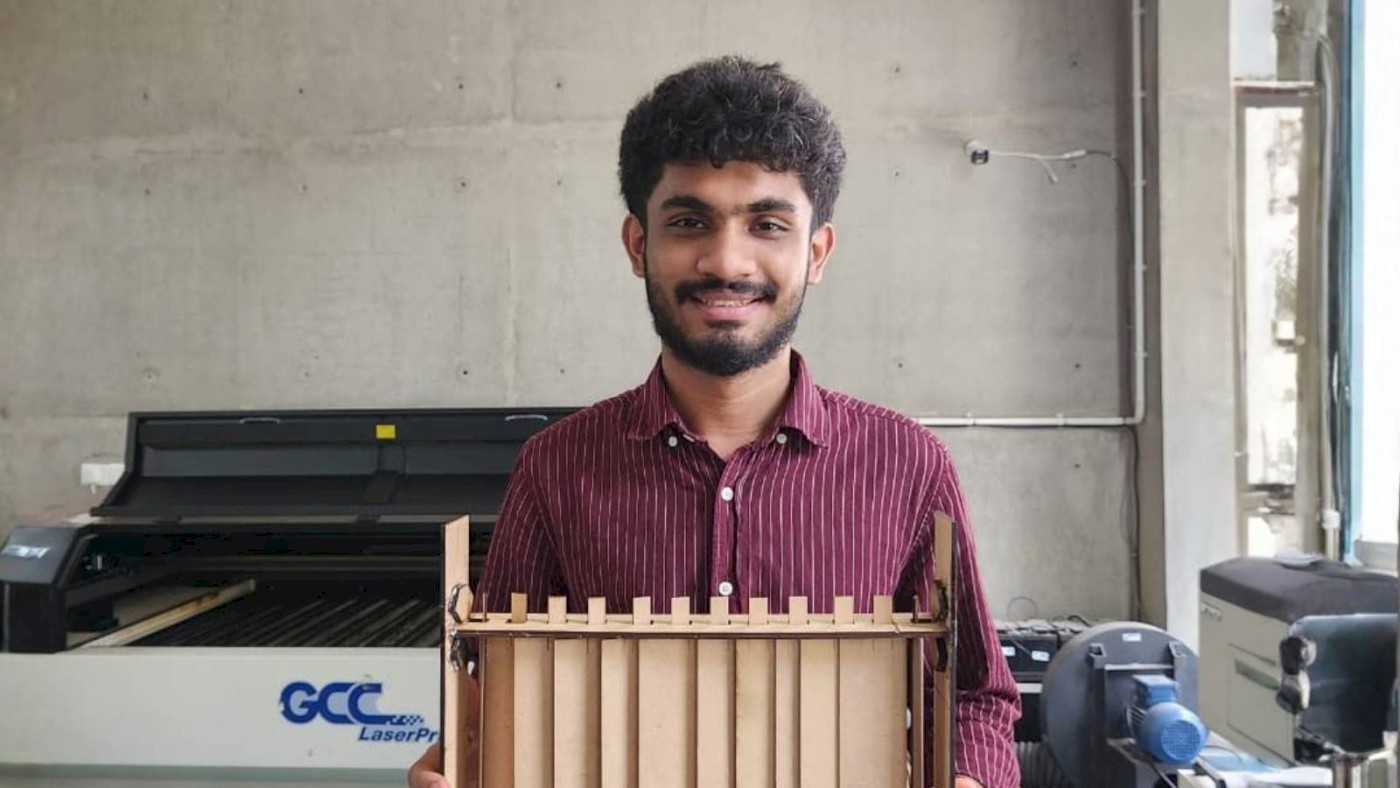
Traditionally observed cooling practices in Indian villages, along with contemporary architectural strategies, particularly the façade design of the School of Arts and Sciences Building at Ahmedabad University, served as the inspiration for CoolCampus, an innovative, low-cost passive cooling system designed by an Ahmedabad University student. This idea took shape during the Community-Driven Engineering for Climate Solutions Hackathon, hosted by IIT Gandhinagar in collaboration with University College London, where it won first place.
Dhairya Sanathara, a Computer Science and Engineering student, developed the project to improve thermal comfort in hostel rooms, addressing the persistent challenge of excessive indoor heat and the growing dependence on energy-intensive air conditioning. The project was the result of a strong interdisciplinary collaboration among students from multiple institutions, including Aditya Arora from IIT Gandhinagar and Dirgh Mehta from Pandit Deendayal Energy University. While Dhairya initiated the core idea and drove the concept forward, he also led design development, prototyping, and system integration, while managing execution timelines and coordinating stakeholder feedback.
Guided by the principles of climate-responsive design, the solution is both context-aware and environmentally responsible. It integrates adaptive shading, airflow control, and evaporative cooling to create a sustainable indoor environment that responds effectively to local climatic conditions.
The system relies on a terracotta-based honeycomb cooling module as its primary cooling mechanism. This structure is designed to maximise surface area, enabling efficient heat exchange. As hot air flows through the porous channels of the terracotta, it interacts with the moisture retained within the material. This interaction triggers evaporative cooling, reducing the air temperature before it enters the room. The honeycomb’s geometry also ensures even airflow distribution, enhancing overall cooling performance.
Complementing this mechanism are adjustable window flaps, constructed using MDF for the prototype stage. These flaps are carefully angled to block direct solar radiation while redirecting airflow into the room, achieving a balance between shading and ventilation. Together, these elements form a cohesive system that operates entirely on passive airflow principles and requires no electricity.
The prototype of CoolCampus was developed during a 48-hour hackathon, where it was designed with practicality in mind. The system is lightweight, scalable, and built using locally available materials, making it both affordable and accessible. The development process involved iterative on-site testing, during which the team continuously refined the design by adjusting flap angles, optimising airflow pathways, and modifying the honeycomb configuration.
CoolCampus highlights the potential of simple solutions in addressing complex environmental challenges. It exhibits that meaningful innovation can emerge from a deep understanding of local context, material properties, and user needs. As institutions seek sustainable alternatives to conventional cooling systems, solutions like CoolCampus offer a promising pathway toward more energy-efficient, climate-responsive built environments.