6 October 2025
Fellowship Award for Nanoplastics Research
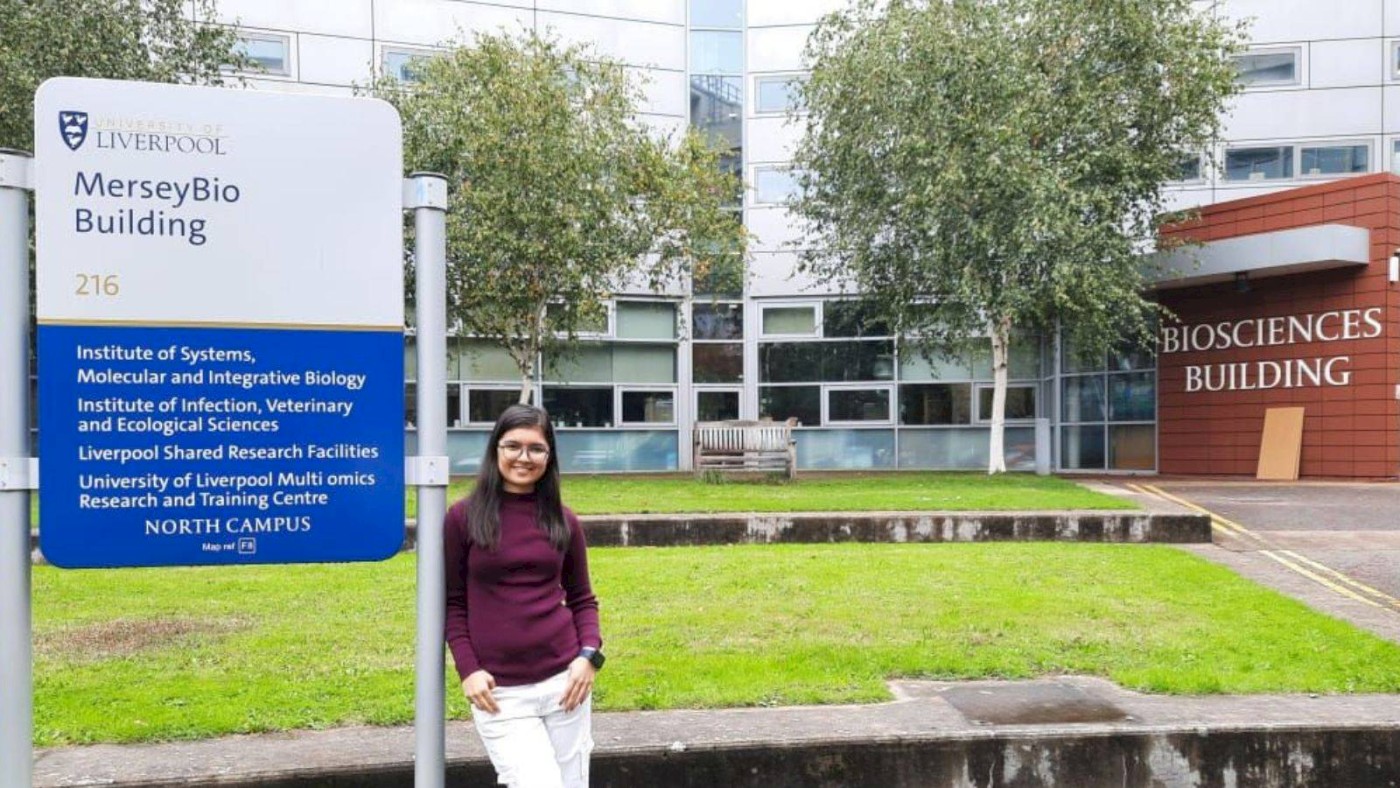
Plastic pollution, a pressing global environmental issue, is breaking down into invisible particles that threaten ecosystems and human health. As plastic waste degrades into microplastics (less than 5 mm) and nanoplastics (1–1000 nm), it can infiltrate food chains and disrupt biological systems. While scientists continue to study the biological impacts of nanoparticles, the specific risks associated with nanoplastics remain uncharted. This knowledge gap inspired Charvi Trivedi, a graduate of the Integrated MS programme (Class of 2024) at Ahmedabad University, to uncover the ecological and evolutionary consequences of nanoplastic pollution.
Charvi’s academic journey took a decisive turn when she began researching nanoplastic pollution. She has been awarded the ACCE+ DLA Fellowship (Adapting to the Challenges of a Changing Environment – Doctoral Landscape Award). This competitive fellowship is part of the ACCE Doctoral Training Partnership, a collaboration between the Universities of Liverpool, Sheffield, and York, as well as the UK Centre for Ecology and Hydrology (CEH) and the Natural History Museum (NHM). The programme supports interdisciplinary doctoral research focused on the biological aspects of environmental change.
As a doctoral researcher, Charvi will investigate nanoplastic pollution using Daphnia magna, a model organism in aquatic toxicology. Her research begins with synthesising nanoplastics and will explore toxicity and bioaccumulation, ending with field-based ecosystem analysis. At Ahmedabad University, Charvi specialised in environmental toxicology, conducting research on microplastic pollution in a zebrafish lab. Reflecting on her academic journey, she shared that her deep interest in biology began in school. It was in high school that she was first introduced to the world of pure sciences and research, a field that immediately drew her to its processes of inquiry and discovery.
"Conducting individual research projects made me realise how much I enjoy research. That led me to pursue the interdisciplinary Life Sciences programme at Ahmedabad University, where I began working on microplastic pollution. That experience solidified both my concern for the environment and my desire to apply research to address pressing ecological issues. It ultimately inspired me to pursue a PhD," shares Charvi.
Charvi largely attributes her success during the rigorous doctoral programme application process to her strong support system. "I am grateful to my thesis supervisor, Professor Ashutosh Kumar from Ahmedabad University's School of Arts and Sciences, for his guidance, encouragement, and practical advice. I am also thankful to Abdulkhalik Mansuri, my mentor in the lab, whose insights proved crucial in helping me present confidently during interviews." Furthermore, Charvi extended her gratitude to Professor Stewart Plaistow, her future doctoral programme supervisor, for his mentorship throughout the demanding fellowship selection process. Ultimately, she emphasised that none of this would have been possible without her family and friends' unwavering belief and support.
When asked what advice she would give to other students aspiring to pursue international research opportunities, Charvi conveyed this heartfelt message: "Always keep applying. Don't let self-doubt stop you, no matter how impossible something may seem. If you don't take that first step, you'll never know what could have been. Rejections are not failures but redirections. The right opportunities will find you. The key lies in staying persistent, patient, and resilient.