5 October 2026
BA (Hons) Students’ Study Challenging the Colonial Readings of Jayadeva’s Gīta Govinda Wins ICSSR Grant
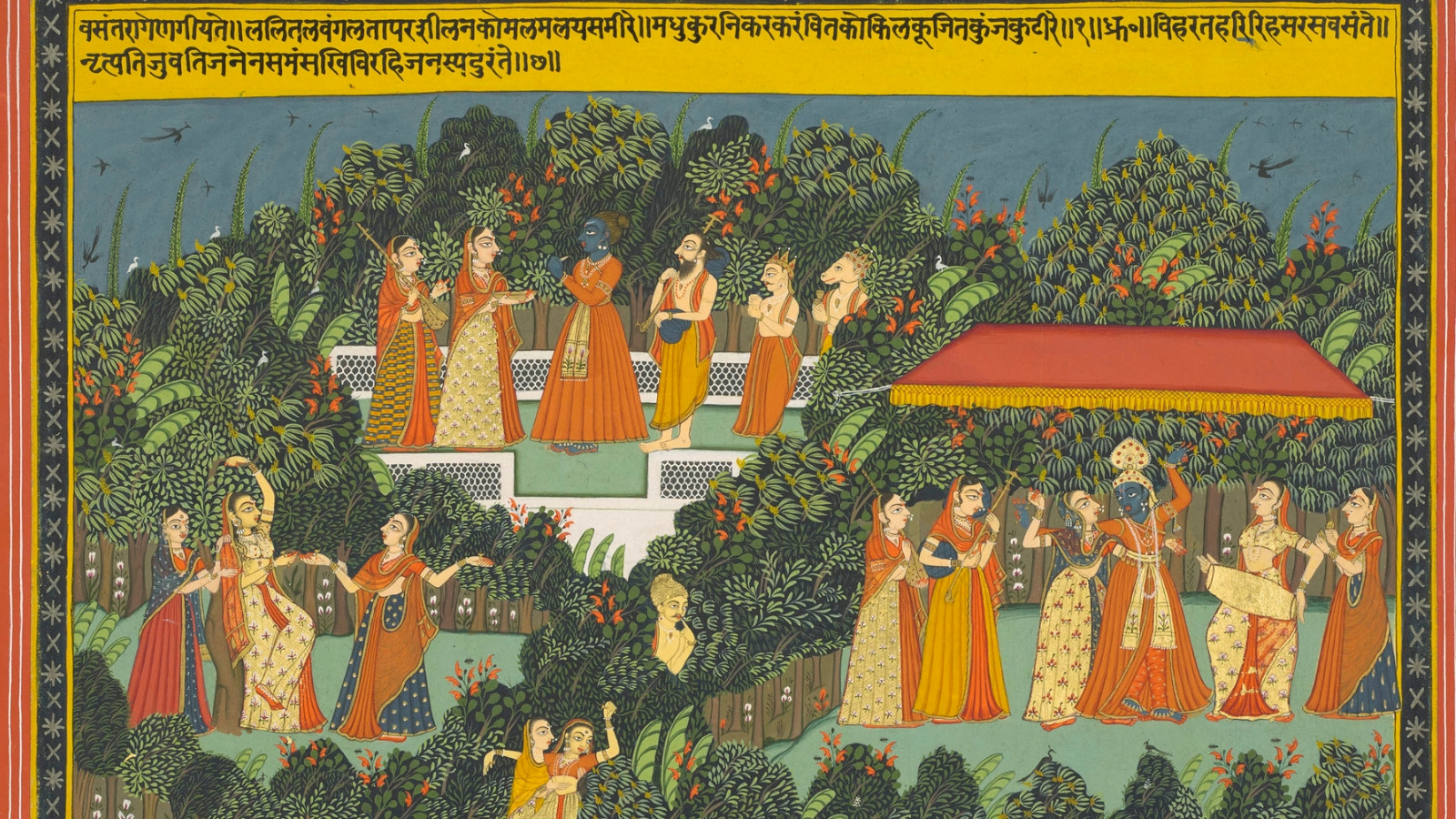
Colonial readings and translations of Indian literary texts have often allegorised or omitted key aspects of the original works. A case in point is Jayadeva’s 12th-century Sanskrit poem, the Gīta Govinda. Recent research traces how the text has been translated and interpreted across different periods and languages. It examines how colonial readings altered the poem’s meaning, and shows how Indian literary and aesthetic frameworks can restore its original cultural context.
This critical shift from colonial reduction to indigenous restoration forms the core of new research by Suhani Guleria and Soohani Kheria, BA (Hons) students majoring in Philosophy, History, and Languages. Their research focuses on the Gīta Govinda, a work that explores the love, separation, and reunion of Rādhā and Kṛṣṇa through the intertwined traditions of Śṛṅgāra and Bhakti.
Their project, A Study of the Evolution of Adaptations and Translations of Jayadeva’s Gīta Govinda and the Decolonisation of an Indian Literary Culture, traces how the text has been translated and interpreted from the colonial period to the present. The research examines major English translations, beginning with Sir William Jones’s 1792 rendering and extending to later translations by Edwin Arnold, George Keyt, Barbara Stoler Miller, and W. J. Johnson. It also studies the Hindi and Gujarati translations. Rather than treating these versions simply as linguistic equivalents, the researchers compare the choices translators made in rendering key passages. These include the text’s devotional invocations, expressions of separation and union, erotic imagery, Kṛṣṇa’s epithets, and accompanying paratexts.
This comparison brings questions of cultural interpretation into focus. The project examines how some colonial readings recast Gīta Govinda’s devotional and erotic dimensions through Western literary frameworks. One example is the omission of the final canto in Arnold’s translation in accordance with what he described as Western standards of propriety. Such interventions could separate the poem’s erotic and devotional dimensions rather than reading them through the Indian aesthetic framework of rasa.
To recover that context, the students are reading the translations alongside Sanskrit commentaries, including the Rasikapriyā and Rasamañjarī. Their research also involves manuscript and archival work at Ahmedabad’s L.D. Institute of Indology and B.J. Institute, where they are examining variant readings, colophons, and illustrations. The project extends beyond textual comparison to visual traditions, studying painting traditions from Basohli and Kangra, Mewar and Bundi, as well as Odisha’s paṭachitra and palm-leaf traditions, to understand how iconography, mood, season, and gesture can themselves function as forms of translation.
The project is an effort to reposition Gīta Govinda within Indian Knowledge Systems by examining it through its own literary, aesthetic, and devotional traditions. Additionally, student researchers will examine how interpretations have evolved across languages and periods. The study brings together multilingual textual analysis, Sanskrit commentaries, manuscript research, and visual traditions. In doing so, it seeks to recover Indian literary and aesthetic heritage while offering a methodology applicable to other classics.
The research earned the students the Indian Council of Social Science Research (ICSSR) Yuva Shodh Pratibha Scheme grant under the theme "Youth and Decolonisation." They are pursuing the study under the supervision of Professor Aditya Chaturvedi from the School of Arts and Sciences. Their work reflects Ahmedabad University’s commitment to enabling undergraduate students to conduct sustained, interdisciplinary research that engages with questions of knowledge, culture, and society.