2 July 2025
Micro-PTAL – A Solution to Simplify First/Last Mile Connectivity

Vadaj, a neighbourhood in Ahmedabad, is poised to become a key transport hub as it sits at the junction of major corridors. All three public transport modes—AMTS, BRTS, and Metrorail—are adequately available in this area, indicating a high level of public mobility and further potential for improved accessibility.
This raises an important question. Is the earlier employed city-wide PTAL (Public Transport Accessibility Level) mapping approach, which used large 1 square kilometre grids, the right way for neighbourhood-level planning?
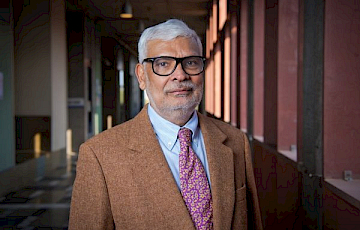
A study by Bhargav Adhvaryu, Professor at Ahmedabad University’s Amrut Mody School of Management, and Rohini Chatterjee, CEPT University (currently at the University of Alberta, Canada), indicate that the earlier approach used large grids. These grids were too broad and generalised to support the fine-grained decisions necessary for small-scale interventions in areas like Vadaj. The study also suggests that the challenge of limited first/last mile connectivity is not unique to Vadaj. A study by Professor Adhvaryu in 2019 found that 27 per cent of the urban poor in Ahmedabad do not use public transport because they can't easily access it.
This study, "Micro-public transport accessibility mapping to enhance local area planning (LAP) in Ahmedabad," presents an alternative system, Micro-PTAL, a detailed mapping approach using much smaller 50 square metre grids, compared to the traditional 1 sq km grids. Micro-PTAL maps provide a more detailed and accurate picture of public transport accessibility at the neighbourhood level. This helps planners make smarter decisions—like where to build footpaths, bike lanes, or improve bus stops—to better connect people to public transport, especially at the first and last mile of their journey.
Using Ahmedabad as a case study, the research maps accessibility in four diverse neighbourhoods: Vadaj and Vasna in the west and Nikol and Odhav in the east. These locations were selected based on five key parameters: availability of AMTS and BRTS services, land use diversity (residential, commercial, and industrial mix), high population density, high floorspace consumption (FSI), and greater potential for redevelopment.
The study identifies two types of interventions:
- Global interventions: Broad improvements like continuous footpaths, cycling paths, and better road design across the entire area. While these don't require PTAL maps for planning, their effectiveness can be evaluated using PTAL.
- Surgical interventions: More focused improvements, like creating new footpaths along building edges in areas with poor or unsafe pedestrian access. These offer shorter, more direct routes to public transport.
In both types, PTAL maps are critical for identifying where improvements are most needed and measuring how much accessibility improves after changes are made. The study especially highlights the value of micro-PTAL. For example, in Vadaj, the smaller 50 sq m grids reveal much more about how accessible different parts of the neighbourhood are. This detail is essential for making precise decisions, like where to install crossings or pathways to improve access to nearby metro or bus stations.
The study is essential as urban areas grow based on how easily people and goods can move. Most redevelopment and infrastructure planning happen locally, making detailed tools like micro-PTAL essential for effective decision-making.
The study also proves that without micro-PTAL maps, Local Area Plans (LAPs) may fall short, leading to inefficient spending and unequal access to transport. This research also supports broader goals like Sustainable Development Goal 11, encouraging public transport use, reducing emissions, and making cities more livable and inclusive.
This study was published in Elsevier's Case Studies on Transport Policy journal. This study was published in Elsevier's Case Studies on Transport Policy journal. It is well-known for its practical, application-oriented, case-based research, bridging the gap between academic research, practice, and policymaking, offering real-world insights into transport policy implementation across diverse global contexts. Its interdisciplinary nature encourages contributions from fields like urban planning, economics, and environmental science, fostering a holistic view of transport challenges. Moreover, the journal is inclusive of exploratory or context-specific research, making it accessible to both academics and practitioners involved in transport policy and planning. Despite its applied nature, the journal maintains a high standard of empirical and methodological rigour.