
Faculty Fellows
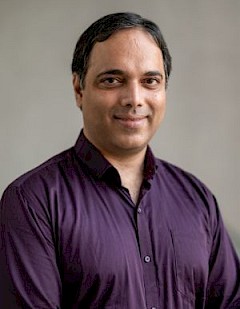
Research Interests: Modular Forms, Automorphic Forms And Representations, Quantum Computing.
Profile
Alok Shukla is an Assistant Professor in the Mathematical and Physical Sciences division of the School of Arts and Sciences at Ahmedabad University. He received a Bachelor of Engineering degree in Electrical and Electronics Engineering from Birla Institute of Technology, Ranchi, and a MA and PhD in Mathematics from the University of Oklahoma, USA. He was selected for several scholarship awards by the Department of Mathematics at Oklahoma during his PhD, including the John Clark Brixey Graduate Scholarship award in 2015, and the Richard V. Andree Memorial Scholarship awards for academic excellence in 2016 and 2017. After receiving his PhD in 2018, Professor Shukla joined the Department of Mathematics at the University of Manitoba, Canada, as a Postdoctoral Fellow.
Prior to pursuing his doctoral studies in Mathematics, Professor Shukla worked for HAL (Hindustan Aeronautical Limited) for several years, first on the Avionics system of MiG-27 fighter aircraft, and later in the final assembly section of ALH (Advanced Light Helicopter), Dhruv. He learned the basics of Aeronautical Engineering in a special one-semester programme at IIT, Madras in 2004. He has also worked as a software engineer for IBM and TCS, for about a year in each organisation. In addition to research in Mathematics, he enjoys teaching the subject to students. Professor Shukla has organised several maths-popularisation and community outreach events to spread the ‘Joy of Mathematics’ among young students.
Research
Professor Alok Shukla spans number theory and quantum computing, with a growing emphasis on fundamental quantum algorithm design guided by symmetry and spectral methods.
A central direction of his research is the development of resource-efficient quantum algorithmic primitives that remain practical on noisy quantum hardware. His work focuses on reducing circuit depth, qubit requirements, and error sensitivity in foundational quantum subroutines.
He developed a deterministic algorithm for preparing uniform superposition quantum states for arbitrary problem sizes, including cases where the number of basis states is not a power of two (A. Shukla, P. Vedula, Quantum Information Processing, 23, 38 (2024)). The construction achieves logarithmic gate complexity without ancillary qubits, providing an exponential improvement over previous deterministic methods.
The algorithm has been incorporated into major quantum software frameworks as the UniformSuperpositionGate:
Preparing a uniform superposition state is a fundamental subroutine in quantum computation and typically forms the first step in many important quantum algorithms, including Grover’s search.
Professor Shukla also introduced Adaptive Windowed Quantum Phase Estimation (AWQPE). Standard quantum phase estimation extracts all bits of an eigenvalue using a single long coherent circuit acting on many qubits, making it highly sensitive to noise and hardware limitations.
AWQPE replaces this with a sequence of short quantum circuits that estimate small blocks of phase bits independently. After each block, classical processing updates the next circuit. Because errors remain localized instead of propagating across the entire computation, the method substantially improves robustness and reduces the number of simultaneously active qubits.
- reduced qubit footprint
- improved robustness to decoherence
- selective repetition of uncertain bits
- parallel and distributed execution
The framework extends naturally to amplitude estimation and modular implementations of Shor-type algorithms.
In addition, Professor Shukla studies hybrid classical-quantum algorithms based on structured transforms. Using Walsh–Hadamard basis methods, he developed algorithms for nonlinear differential equations, signal processing, and image processing that improve computational complexity relative to classical transform approaches.
Number Theory and Combinatorics
Professor Shukla’s mathematical research focuses on automorphic forms and modular forms, particularly Siegel modular forms of degree two and their associated L-functions.
He developed a representation-theoretic construction of Klingen Eisenstein series of arbitrary level, extending classical constructions to paramodular and Siegel congruence subgroups. He also established pullback formulas relating Fourier coefficients of Siegel modular forms to special values of automorphic L-functions. His work includes an explicit formula for the co-dimension of cusp forms in spaces of Siegel modular forms, extending previous results to broader level structures.
In combinatorial number theory, he studies partitions and q-series identities inspired by Ramanujan. Using a tiling-based generating-function framework, he developed elementary combinatorial proofs of classical identities such as the Jacobi triple product and Rogers–Ramanujan identities and derived new families of q-series identities.
He has also investigated geometric configurations over finite fields using elliptic curves, constructing optimal configurations related to the classical Orchard problem.
Selected Research Contributions
- Logarithmic-depth uniform superposition quantum state preparation implemented in Cirq and Qiskit
- Adaptive Windowed Quantum Phase Estimation and modular amplitude estimation
- Hybrid classical-quantum algorithms for nonlinear ordinary differential equations
- Quantum signal and image processing based on Walsh–Hadamard representations
- Representation-theoretic construction of Klingen Eisenstein series of arbitrary level
- Pullback formulas and special value identities for Siegel modular forms
- Explicit co-dimension formula for degree-two Siegel modular forms
- Combinatorial proofs of q-series identities and partition results
- Finite-field geometric constructions related to the Orchard problem
Publication
- Towards Practical Quantum Phase Estimation: A Modular, Scalable, and Adaptive Approach (2026)
Authors: Alok Shukla, Prakash Vedula
Journal: (Accepted) To appear in Advanced Quantum Technologies .
Preprint: https://arxiv.org/pdf/2507.22460- Efficient quantum algorithm for weighted partial sums and numerical integration (2025)
Authors: Alok Shukla, Prakash Vedula
Journal: Advanced Quantum Technologies, Article e202500084 (July 2025). DOI: 10.1002/qute.202500084
Preprint: https://arxiv.org/pdf/2411.10986- Efficient Implementation of a Quantum Search Algorithm for Arbitrary N (2025)
Authors: Alok Shukla, Prakash Vedula
Journal: The European Physical Journal Plus, 140, 575 (2025). DOI: 10.1140/epjp/s13360-025-06518-3
Preprint: https://arxiv.org/abs/2406.13785- A quantum approach for optimal control (2025)
Authors: Hirmay Sandesara, Alok Shukla, Prakash Vedula
Journal: Quantum Information Processing, 24, 95 (2025). DOI: 10.1007/s11128-025-04710-z
Preprint: https://arxiv.org/abs/2407.02864- Hybrid classical-quantum image processing via polar Walsh basis functions (2024)
Authors: Mohit Rohida, Alok Shukla, Prakash Vedula
Journal: Quantum Machine Intelligence, 6, 72 (2024). DOI: 10.1007/s42484-024-00205-9
Preprint: https://arxiv.org/abs/2403.16044.pdf- An efficient quantum algorithm for preparation of uniform quantum superposition states (2024)
Authors: Alok Shukla, Prakash Vedula
Journal: Quantum Information Processing, 23, 38 (2024). DOI: 10.1007/s11128-024-04258-4
Preprint: https://arxiv.org/pdf/2306.11747.pdf- A quantum approach for digital signal processing (2023)
Authors: Alok Shukla, Prakash Vedula
Journal: The European Physical Journal Plus, 138(1121), DOI: 10.1140/epjp/s13360-023-04730-7
Preprint: https://arxiv.org/pdf/2309.06570.pdf- A generalization of Bernstein–Vazirani algorithm with multiple secret keys and a probabilistic oracle (2023)
Authors: Alok Shukla, Prakash Vedula
Journal: Quantum Information Processing, 22(244), DOI: 10.1007/s11128-023-03978-3
Preprint: https://arxiv.org/pdf/2301.10014- Tiling proofs of Jacobi triple product and Rogers-Ramanujan identities (2023)
Author: Alok Shukla
Journal: Journal of the Ramanujan Mathematical Society, 38.2 (2023): 157-176
Preprint: https://arxiv.org/pdf/2006.03878.pdf- A hybrid classical-quantum algorithm for the solution of nonlinear ordinary differential equations (2023)
Authors: Alok Shukla, Prakash Vedula
Journal: Applied Mathematics and Computation, 442, 127708, DOI: 10.1016/j.amc.2022.127708
Preprint: https://arxiv.org/pdf/2112.00602.pdf- A hybrid classical-quantum algorithm for digital image processing (2023)
Authors: Alok Shukla, Prakash Vedula
Journal: Quantum Information Processing, 22, 3 (2023), DOI: 10.1007/s11128-022-03755-8
Preprint: https://arxiv.org/pdf/2208.09714.pdf- 106.20 When do we have 1 + 1 = 11 and 2 + 2 = 5? (2022)
Authors: Padmanabhan, R., Alok Shukla
Journal: Mathematical Gazette, 106(566), 319-323, DOI: 10.1017/mag.2022.74
Preprint: https://arxiv.org/pdf/1906.02324.pdf- Pullback of Klingen Eisenstein series and certain critical L-values identities (2021)
Author: Alok Shukla
Journal: The Ramanujan Journal, 55(2), 471-495, DOI: 10.1007/s11139-019-00246-w
Preprint: https://arxiv.org/pdf/2006.05273- Orchards in elliptic curves over finite fields (2020)
Authors: R. Padmanabhan, Alok Shukla
Journal: Finite Fields and Their Applications, 68, 101756, DOI: 10.1016/j.ffa.2020.101756
Preprint: https://arxiv.org/pdf/2003.07172- Means compatible with semigroup laws (2019)
Authors: Ranganathan Padmanabhan, Alok Shukla
Journal: Quasigroups and Related Systems, 27(2),
Preprint: https://arxiv.org/pdf/1902.10809- On Klingen Eisenstein series with level in degree two (2019)
Authors: Ralf Schmidt, Alok Shukla
Journal: Journal of the Ramanujan Mathematical Society, 34(4)
Preprint: http://www2.math.ou.edu/~ashukla/OnKlingenEisensteinSeriesWithLevelInDegreeTwo.pdf- Trajectory optimization using quantum computing (2019)
Authors: Alok Shukla, Prakash Vedula
Journal: Journal of Global Optimization, 75(1), 199–225, DOI: 10.1007/s10898-019-00754-5
Preprint: https://arxiv.org/pdf/1901.04123- A Short Proof of Cayley's Tree Formula (2018)
Author: Alok Shukla
Journal: The American Mathematical Monthly, 125(1), DOI: 10.1080/00029890.2018.1392750
Preprint: https://arxiv.org/pdf/0908.2324- Codimensions of the spaces of cusp forms for Siegel congruence subgroups in degree two (2018)
Author: Alok Shukla
Journal: Pacific Journal of Mathematics, 293(1), DOI: 10.2140/pjm.2018.293.207- On Klingen Eisenstein series with levels (2018)
Author: Alok Shukla
PhD Dissertation: Department of Mathematics, University of Oklahoma, Norman, https://shareok.org/bitstream/handle/11244/299326/2018_Shukla_Alok_Dissertation.pdfPreprint:
- Quantum Detection of Sequency-Band Structure (2026)
Author: Alok Shukla and Prakash Vedula
Arxiv link: https://arxiv.org/abs/2602.08393- A Modular, Adaptive, and Scalable Quantum Factoring Algorithm (2025)
Author: Alok Shukla and Prakash Vedula
Arxiv link: https://arxiv.org/pdf/2509.05010- Modular Quantum Amplitude Estimation: A Scalable and Adaptive Framework (2025)
Author: Alok Shukla and Prakash Vedula
Arxiv link: https://arxiv.org/pdf/2508.05805- Generalized tensor transforms and their applications in classical and quantum computing (2025)
Author: Alok Shukla and Prakash Vedula
Arxiv link: https://arxiv.org/abs/2507.02420v2- Quantum algorithm for edge detection in digital grayscale images (2025)
Author: Mohit Rohida, Alok Shukla and Prakash Vedula
Arxiv link: https://arxiv.org/abs/2507.06642- On sequency-complete and sequency-ordered matrices (2024)
Author: Alok Shukla and Prakash Vedula
Arxiv link: https://arxiv.org/abs/2402.1100Expository and Educational Articles:
- On teaching mathematics to gifted students: some enrichment ideas and educational activities (2019)
Author: Alok Shukla
Arxiv link: https://arxiv.org/abs/1911.10726
Teaching
Winter 2026
- MAT248 - Applied Linear Algebra
Monsoon 2025
- MAT485 / MAT585 - Introduction to Quantum Computing
- MAT312 - Abstract Algebra
Winter 2025
- MAT248 - Applied Linear Algebra
Monsoon 2024
- CSC210 - Introduction to Data Structures and Algorithms
- MAT123 - Precalculus
Winter 2024
- FDP - Foundation Programme (ECC Module - I)
Monsoon 2023
- MAT256 - Differential Equations
- MAT485 / MAT585 - Introduction to Quantum Computing
- MAT775 - Lie Algebras and their applications in Quantum Physics
Winter 2023
- MAT248 - Applied Linear Algebra
- MAT334 - Introductory Real Analysis
Monsoon 2022
- MAT142 - Introductory Calculus
- MAT465 / MAT565 - Fourier Analysis and Its Applications
- PHY798 Research Project - II
Winter 2022
- MAT248 - Applied Linear Algebra
- MAT442 - Complex Analysis
- MAT485 / MAT585 - Introduction to Quantum Computing
Monsoon 2021
- MAT256 - Differential Equations
Winter 2021
- MAT246 - Introduction to Linear Algebra
- FDP - Foundation Programme (ECC Module - II)
Monsoon 2020
- MAT142 - Introductory Calculus