2 September 2026
Professor Minal Pathak Contributes to UNEP Report on Navigating Climate Overshoot
The focus of global climate policy is shifting from keeping global warming below 1.5°C, the point at which the Earth’s average temperature is 1.5°C higher than it was before industrialisation, to managing what happens if that limit is temporarily crossed. The aim is to keep this “overshoot” as small and short as possible through deep cuts in greenhouse gas emissions and the removal of carbon dioxide from the atmosphere.
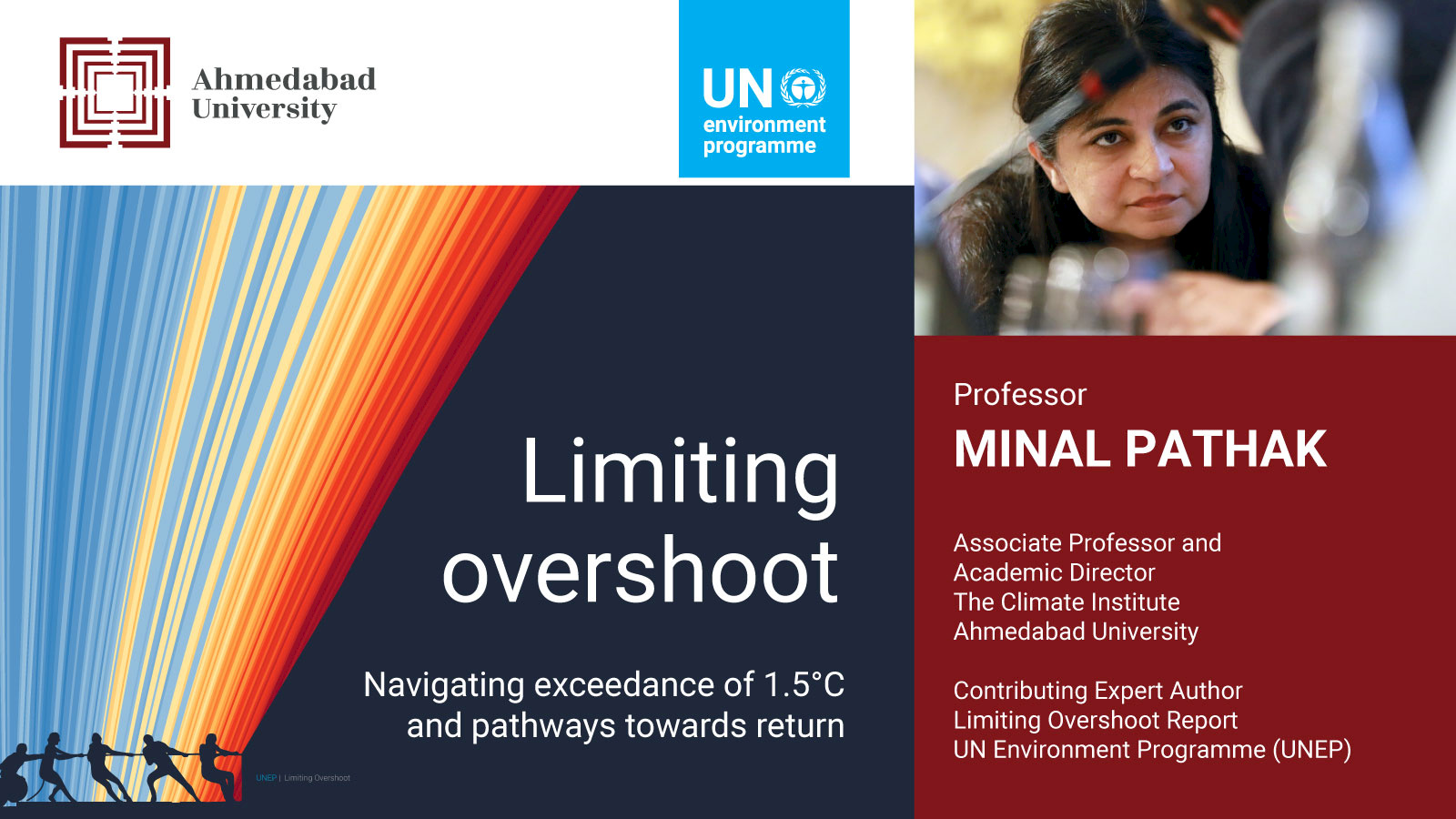
The United Nations Environment Programme (UNEP) has outlined this approach in its Limiting Overshoot: Navigating Exceedance report, which describes an “overshoot, peak and decline” pathway for a world facing a temporary breach of the 1.5°C goal. Professor Minal Pathak, Associate Professor and Academic Director at The Climate Institute, Ahmedabad University, served as a contributing expert author to the report.
The pathway requires countries to rapidly cut emissions, reach net-zero CO₂ emissions, and strengthen climate adaptation. If temperatures temporarily exceed 1.5°C, carbon removal could help lower global temperatures over time. UNEP also highlights renewable energy, ecosystem restoration, and nature-based cooling as key solutions.
Professor Pathak states, “This is the first time a UN report acknowledges that we are likely going to cross the warming level of 1.5°C—the objective now is to minimise the duration and magnitude of this temperature increase by the end of the century. This does not mean we resign and give up effort; in fact, much more effort will be needed on reducing emissions. For developing countries like India, this could be even more challenging to do alongside adapting to a warmer world and meeting our development needs. There are opportunities to do this, for example, in decarbonising the electricity or transport sector, and many of these can effectively align development and climate action.”
Read the complete report here: Limiting Overshoot: Navigating Exceedance