Saif Siddiqui who is a resident of Bhopal and student of Masters of Heritage Management led a walk in Bhopal on 30th December 2018. The walk started from Moti Masjid- the pearl mosque built by Sikander Jehan Begum. The walk explored the first palace of the first Begum of Bhopal, the Gauhar Mahal. The walk leader also mentioned about Allama Iqbal and his connection with Bhopal at the Iqbal Maidan which is named in honour of the poet. He also talked about urban natural heritage through 300-year-old Khirni Tree as a living cultural and natural heritage. The first walk led by him behalf of Sahapedia concluded with a discussion over tea and poha-jalebi on the heritage discourse shaping up in Bhopal at Raju Tea Stall.
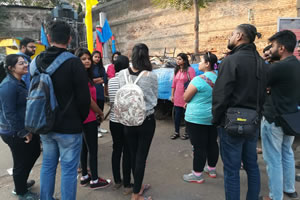
The heritage club ‘Sharitage’ along with the food club organised a heritage walk on 9th December 2018 in the old city followed by a traditional Gujarati breakfast at Chadravillas. The walk started at Sidi Sayyed masjid followed by the Bhadra Fort, Jama Masjid, Badshah no hajiro and Rani no hajiro. The event was attended by faculties from different universities who have/ had come to conduct ISP courses at Ahmedabad University.
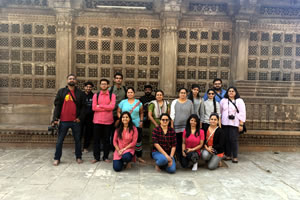
Walk on 2nd December 2018: Through this walk, Jyoti Shukla, Student, Master of Heritage Management explored completely forgotten structures and stories and discussed the heritage of this city that has gone unnoticed. The walk started at Panchkuva Darwaza, covering monuments like Amritvarshini Vav, Rani Masjid and tomb, French Haveli, and Rani Sipri Masjid, and traverse through the narrow lanes of the walled city.
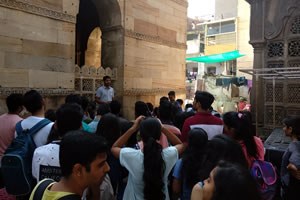
Walk on 2nd December 2018: Through this walk, Jyoti Shukla, Student, Master of Heritage Management explored completely forgotten structures and stories and discussed the heritage of this city that has gone unnoticed. The walk started at Panchkuva Darwaza, covering monuments like Amritvarshini Vav, Rani Masjid and tomb, French Haveli, and Rani Sipri Masjid, and traverse through the narrow lanes of the walled city.

Shalvi Suman, a first-year student of masters programme attended the second edition of the Great Rivers Forum (GRF) at Wuhan, China, Oct. 29-30, 2018. She showcased a short film on the impact of the Sabarmati riverfront project which was a part of a research internship with Living Waters Museum from January-June 2018.
Sukrit Sen, a first-year student of Masters in Heritage Management is selected to present his paper on ‘Sustainable Conservation of the Temples of Bali Dewangunj, Arambagh, West Bengal’ at the 2nd International Conference on Sindh Studies: Indus Valley Cultural Heritage – New perspectives and Challenges’ to be held on 19-21 November 2018 at the University of Sindh, Pakistan. He also took two sessions with the architecture students of Om Dayal School of Architecture and Amity University on 1st December and 6th December 2018 respectively. The topic was the role of intangible heritage in the architectural documentation of historic sites.
He also led a small meeting with the youngest members of few of the oldest living communities of Kolkata to discuss how the families could come together and play a role to save our city’s heritage both tangible and intangible. He led two walks on behalf of Khoj Museum, one on the food and monumental heritage of Ahmedabad on the 25th and 29th of December respectively. He took a session with the ISP students of Ahmedabad University on water and music on the 13th of December 2018.
Nikhil Parashar, a second-year student of Masters in Heritage Management is selected for ‘Film Preservation & Restoration Workshop India (FPRWI) 2018’ that will take place from 15-22 November 2018 at the Indian Council for Cultural Relations (ICCR), Kolkata. FPRWI 2018 is an initiative of Film Heritage Foundation (FHF) and the International Federation of Film Archives (FIAF).
Nikhil Parashar’s paper on Comparative study of “formal management system of ‘Desert National Park, India’ & traditional management system of ‘Bishnoi’ community” is selected for the presentation at International Biodiversity Congress organised by Wildlife Institute of India, Dehradun on 4 – 6th October 2018. The focal theme of the Congress is “Biodiversity for Ecological Civilization”. His paper explores the ‘Nature – Culture’ relationships and the possibility of incorporating informal community practices in the framing of a formal framework for the management of protected areas.

Shaoni Pramanick, second-year student, Centre for Heritage Management, will present her paper on ‘Jewish Food Museum’, selected for the Conference ‘Urban Jewish Heritage: Presence and Absence’. The conference is organised by Ironbridge International Institute for Cultural Heritage at Krakow, Poland on 3-7 September 2018.
Aanchal Mehta, Student, MMS-Heritage Management is selected by the US/ICOMOS International Exchange Program (IEP) Committee to participate in the 2018 programme at the National Center for Preservation Technology and Training (NCPTT) in Natchitoches, Louisiana, the USA as part of her practicum. She will be at NCPTT for the period of 3 months in summer 2018.
IEP is a prestigious and competitive programme, in which an average of 5 candidates per year are selected from applicants across the world.
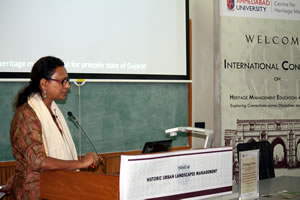
MASTERS’ THESIS PRESENTATION AT THE INTERNATIONAL CONFERENCE ON HERITAGE MANAGEMENT EDUCATION
The International Conference on Heritage Management and Educational Practices witnessed along with the presentations of the external participants, the presentations of the thesis work of the first graduating batch of the Masters in Management Studies. The presentations were classified under the different themes of the conference and the students had already excelled with additional corrections post their final presentations. Students’ thesis presentations also received special mention in the concluding plenary sessions. The conference gave them a platform to showcase their work in front of a larger international audience which could open further prospects to them in future.
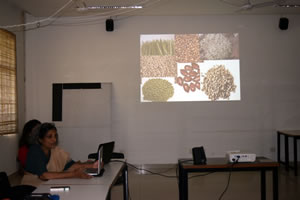
PRACTICUM EXPERIENCE PRESENTATIONS BY MASTERS’ STUDENTS
The Masters programme on Heritage Management requires each of its students to pursue a 10-12 weeks long compulsory practicum during the summer break between their first year and second year .This is an important part of the two years learning process. Masters 2016-18 cohort group pursued their practicum at organisations working in diverse areas related to heritage.
Aayushi Maheshwari, pursued her Practicum with UNESCO, New Delhi and was stationed at Darjeeling Himalayan Railways site office. She contributed to the preparation of Comprehensive Conservation Management Plan and also reflected the existing gap between different stakeholders through consultations and mapping.
Bansari Ladia, assisted Centre for Environment Education for the designing Heritage Walk for of one of the areas in Old City of Ahmedabad. Her reflections came in the form of bridging a gap between cultural and natural elements through reinterpreting the narratives.
Gourav Mandloi, with his interest to work with the Craft sector, did his practicum with Banglanatak.com in Kolkata. He contributed to the organisation by collecting narratives about different crafts from the rural areas of Bengal. He aims to take ahead his learning from this experience into his thesis on understanding the value chain associated with the crafts sector in India.
Kavin Shah, critically examined the area of Marketing in Heritage. He was associated with The House of MG, Ahmedabad and understood the organisation structure through his practicum.
Renu Mittal, whose interests lies in Nature and indigenous knowledge systems did her practicum with Satvik, Kutch. She spent most of her time on the field with the farmers who are following the traditional ways of farming in Kutch district. She is also helping the organisation in conceptualizing a Seed and Soil Museum.
Richa Pandey, worked with National Center for Preservation Training and Technology (NCPTT), Natchitoches, the USA which is part of National Parks Service, United States. She helped the organisation in formulating a Restore Purpose website which aims to document the restoration, infill and regeneration projects from around the world.
Shaoni Pramanick, interested in Natural Heritage worked with Wildlife Institute of India. Throughout her internship, she aimed to understand the Nature-Culture relationship and contributed to the organisation through the preparation of various preliminary reports for the Cultural Landscape sites in India.
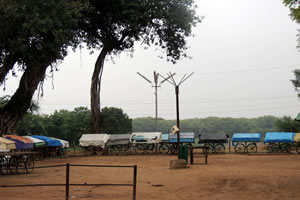
WORKSHOP AND COURSE PROJECTS LOOKING AT MIRZAPUR AREA WITHIN THE WORLD HERITAGE OF AHMEDABAD OLD CITY
As part of the first semester, the students studied heritage proportions of Mirzapur and Shahpur in the Old city of Ahmedabad. They selected a few buildings to apply what they have learned in various classes over the last semester. Along with individual projects, they have documented a) tangible aspects of selected buildings in terms of their structure, material, construction techniques, condition and various significances and b) intangible aspects of their surrounding areas in terms of the lives of the people, their traditions, occupations and practices. Through these project students put into practice what they have learned so that it aids them in the task of managing heritage.
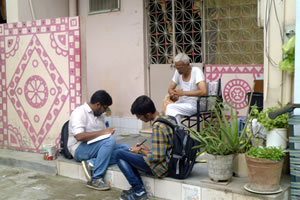
MITHAKALI VILLAGE AND HALISA VILLAGE-SITES FOR HERITAGE MANAGEMENT WORKSHOP COURSES
Each semester in the first year has a workshop course that requires students to delve into a real-life scenario to understand, identify, document heritage resources in a community, and analyse management challenges. The one in the second semester requires them to come up with strategies for Heritage Management that they are required to share with the community. The 2016 batch were given Mithakali village in Ahmedabad in the first-semester workshop, and the Halisa village near Gandhinagar in their second semester as the cases to work on. The students made a presentation about their findings and recommendations at a community meeting in Halisa.

STUDENT INITIATED ENTREPRENEURSHIP PRACTICE
As part of a course on Entrepreneurship through Practice, the final year students along with MBA students studied the modus operandi of the traditional markets and community-based businesses that flourished in the walled city of Ahmedabad. The skills and knowledge gained herewith, in the group of two, they had to come up with a unique business idea and sell the manufactured product in two markets, Bhadra Fort and C.G. road, respectively. They came up with ‘Tohfa’ and ‘Chamki’- two brands and made their products within a given budget of Rs. 5,000 for each. They managed to sell their products in markets for one whole day and earning more than 100 percent profit. Over this course of experience, the lessons and knowledge shared in the class and site visits helped students in executing ‘Tohfa’ and ‘Chamki’.