15 April 2026
Professor Subhabrata Moitra Awarded ANRF Grant for Building Better Asthma Care in India
Every year, thousands of asthma patients in India are discharged from hospitals, only to return within weeks. The issue isn't just treatment. It's what happens after.
Asthma affects an estimated 42 million people in India. Nearly 25 per cent require hospitalisation or emergency care annually due to acute exacerbations, and close to 40 per cent are readmitted within 30 days of discharge. These are not isolated clinical failures; they point to a deeper structural gap in how asthma is managed beyond the hospital.
"There is currently no structured asthma care plan in India," says Professor Subhabrata Moitra of the Bagchi School of Public Health at Ahmedabad University. Without a clear post-discharge framework, patients often leave hospitals without the tools or knowledge needed to manage their condition. The result is poor symptom control, declining quality of life, and a cycle of repeated emergency visits that places strain on both families and the healthcare system.
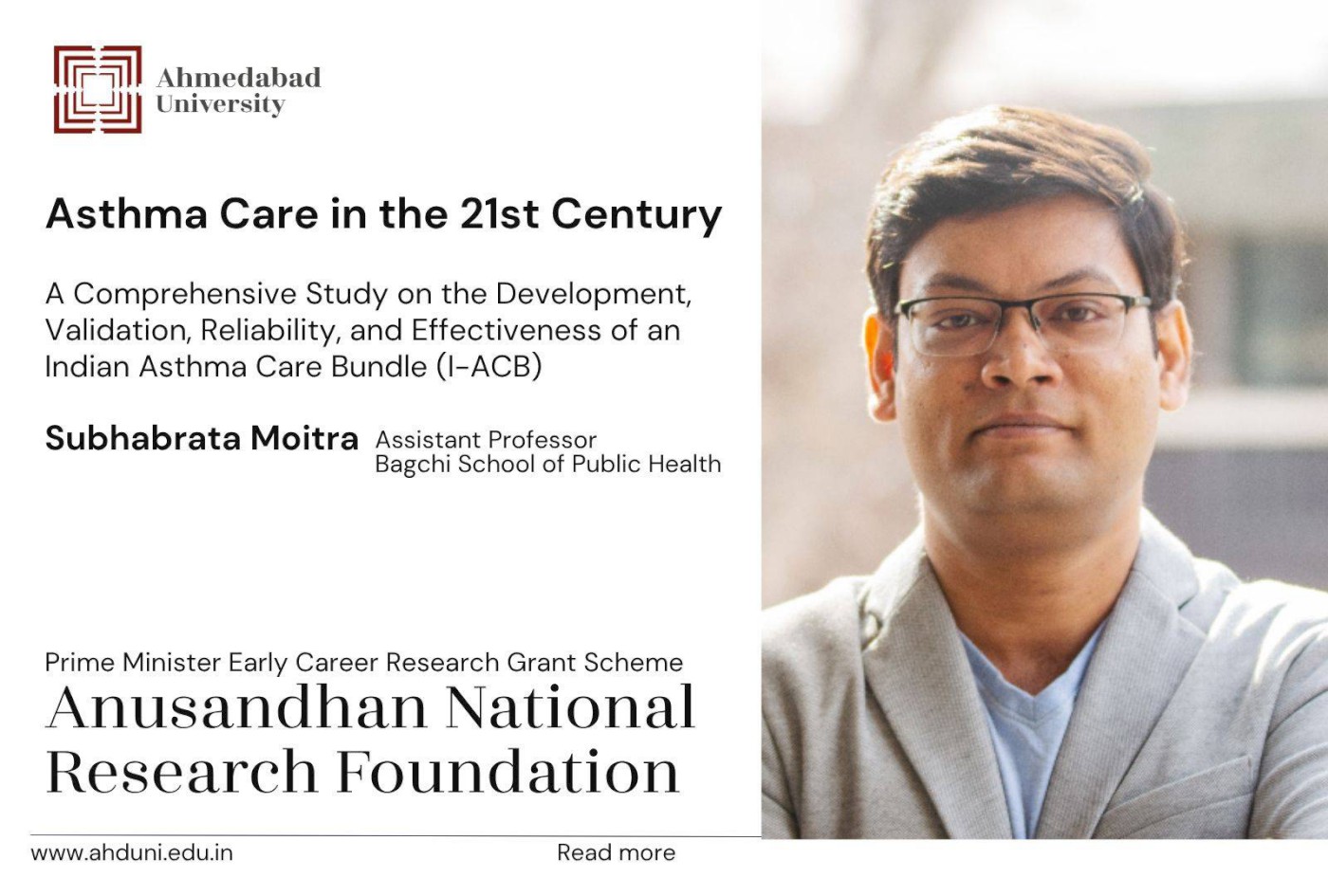
Professor Moitra has been awarded a grant from the Anusandhan National Research Foundation under the Prime Minister Early Career Research Grant Scheme to address this gap. His project proposes the development and validation of the Indian Asthma Care Bundle (I-ACB) a structured, evidence-based plan designed to support patients at the point of discharge. Before leaving the hospital, patients and caregivers are equipped with practical guidance on identifying triggers, adopting preventive strategies, and building routines for long-term care. The aim is that treatment should not stop at discharge but extend into everyday life in a way that patients can realistically follow.
The implications of the same go beyond individual patient. Fewer readmissions mean less pressure on already stretched hospitals and emergency departments. For patients, it reduces the financial and emotional cost of repeated medical crises. Better symptom control also changes daily life in ways that are harder to measure but just as important, enabling people to work, attend school, and participate more fully in everyday activities. At a broader level, it can help shift asthma care from reactive treatment to sustained management.
Asthma does not present the same way across India. Environmental exposure, living conditions, genetics, and access to care all shape how the disease develops and how patients respond to treatment. The next phase of the project will test the care bundle across different regions and populations which will evaluate its performance across varied demographic, geographical, phenotypic, genotypic, and endotypic profiles. The goal is not just effectiveness but adaptability: an approach that works across contexts rather than in a single setting.
Funding from the ANRF is central to enabling research of this scale and ambition supporting the kind of rigorous, large-scale study that developing homegrown healthcare solutions demands, rather than relying on models imported from very different health systems. The project also benefits from Ahmedabad University's active encouragement of interdisciplinary collaboration, drawing on perspectives from public health, clinical science, and beyond to approach chronic disease management in more integrated ways.
The research looks at how asthma is treated not as a series of acute episodes, but as a condition that requires continuous, structured care. If successful, the Indian Asthma Care Bundle could reduce the revolving door of hospital admissions and offer a more stable path for patients managing the disease. More broadly, it could serve as a model for how India approaches chronic conditions by focusing not just on treatment, but on what happens after.