17 December 2025
How can Randomness Explain the Coordinated Behaviour in Beetle Swarms?
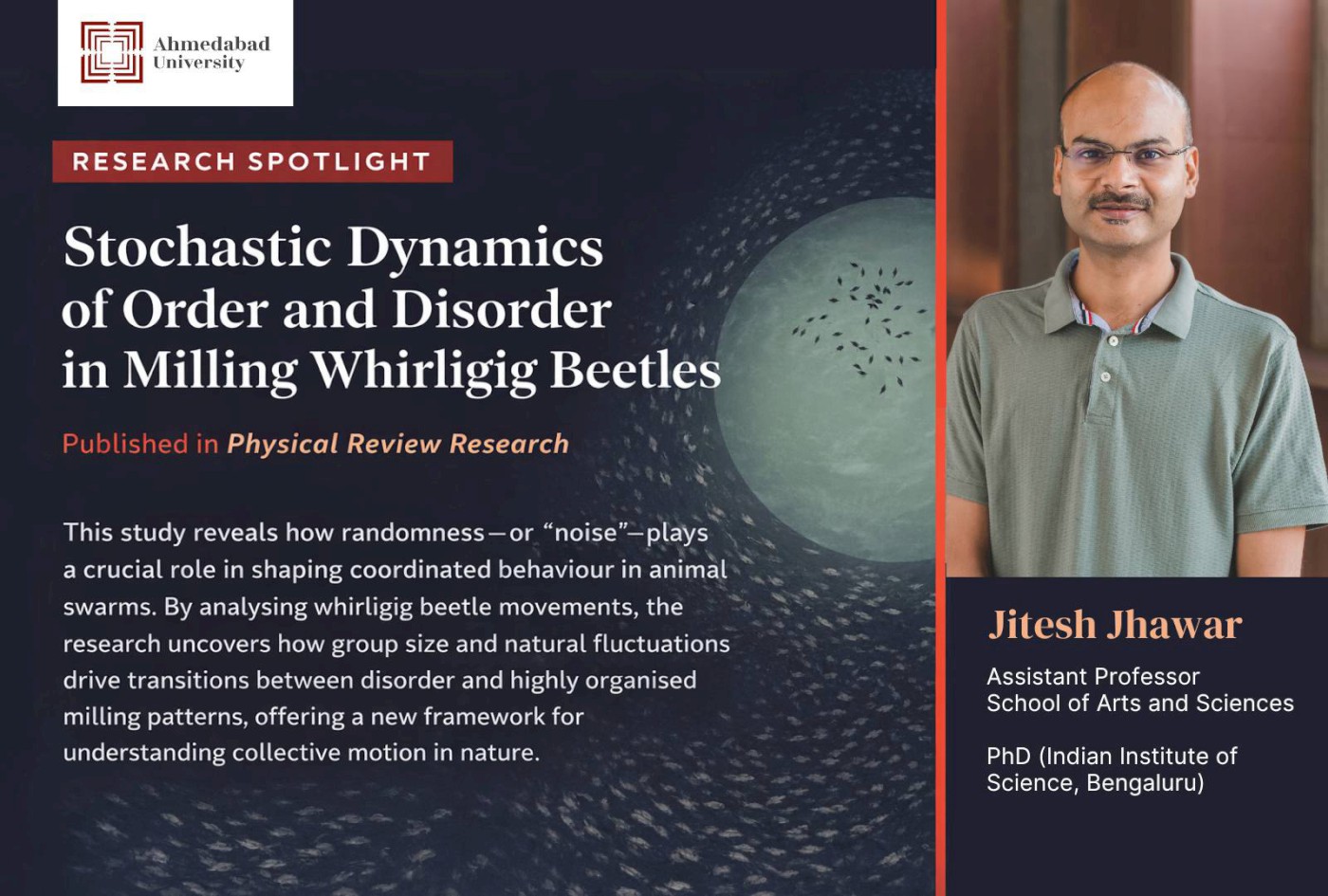
Noise is often treated as interference, but what if it is the key to understanding how collective behaviour emerges in animal swarms? This question drove Professor Jitesh Jhawar from Ahmedabad University’s School of Arts and Sciences, along with researchers from IISc and NCBS, to study whirligig beetles, whose dramatic circular “milling” formations make for an apt example of collective motion. Instead of ignoring fluctuations in their movement, Professor Jhawar used these natural variations to uncover the fundamental rules that govern how swarms organise, transition between states, and change direction.
Collective behaviours, whether in fish schools, bird flocks, or insect swarms, appear smooth and perfectly coordinated. Yet beneath this order lies a randomness, the “noise” that reveals how animals move and respond to one another. Professor Jhawar’s study, “Stochastic Dynamics of Order and Disorder in Milling Whirligig Beetles,” shows that group size plays a decisive role in shaping swarm behaviour: small groups behave differently from large ones even when individuals follow identical rules.
Intrinsic randomness also drives spontaneous switches in milling direction, causing swarms to shift from clockwise to counterclockwise rotation and vice versa. The research further uncovered that short-range alignment and long-range attraction among beetles are sufficient to reproduce the observed transitions and complex dynamics.
These findings emerged from detailed tracking of groups of 50–200 whirligig beetles as they moved between disordered swarming and coordinated milling. Using a data-driven discovery method, the researchers extracted the stochastic differential equations underlying these transitions. By analysing natural fluctuations in the beetles’ motion, they uncovered the mathematical rules that determine when milling begins, how a swarm stabilises, and why and when its direction reverses. A simple agent-based model constructed from these rules successfully replicated beetles behaviours, thereby validating the study’s conclusions.
Most existing models of collective behaviour rely on simplifying assumptions that undermine fluctuations. Instead, this study indicates that noise is not an obstacle, but rather a source of information. By embracing randomness, the research reveals the hidden structure that drives some of nature’s captivating group behaviours.
The implications of the study, was recently published in the journal Physical Review Research, are immense. This work reframes randomness not as noise to be eliminated but as a tool for uncovering the mechanisms that generate collective behaviour. It offers a framework for understanding transitions between states in a system composed of interacting agents. It also opens new possibilities for analysing group decision-making and coordination in animal populations.