30 January 2026
Classical Algorithms and Quantum Insights Converge to Fix Image Noise

Digital imaging systems often fail to render light as a perfect point. Because of diffraction, a single dot of light frequently spreads into a central disk encircled by faint rings, creating what is known as an Airy pattern. These 'structured distortions' are a common challenge in high-precision imaging. By obscuring fine details and reducing clarity, this patterned noise poses a significant hurdle for accurate scientific and engineering analysis.
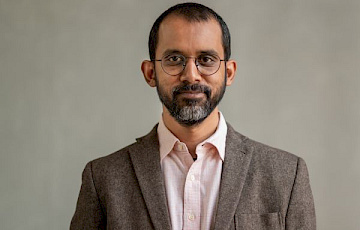
To address this challenge, doctoral student Mohit Rohida's research introduces a hybrid classical–quantum method for image processing. The approach builds on earlier work in hybrid classical–quantum Walsh–Hadamard transforms and achieves lower computational complexity compared to standard classical methods. This allows images to be analysed in ways that align more naturally with circular and angular noise patterns.
Specifically, the method develops an algorithm to remove circular banding noise, including airy pattern noise and azimuthal banding noise. While circular noise resembles rings, azimuthal noise appears as "spokes" on a wheel or wedges of a pie.
Most digital images are represented on a Cartesian grid made up of square pixels. However, when image noise follows circular patterns, analysing it within this square framework becomes ineffective. Converting a Cartesian grid into a polar (circular) representation can introduce mathematical challenges, such as pixel overlap or gaps in the image.
To address this, the research employs two polar image representations based on uniform area and uniform radial measures. To maintain accuracy during the transformation between Cartesian and polar coordinates, the study introduces smoothing and interpolation techniques that resolve issues arising from digital image discretisation. By working in a polar framework, the approach effectively removes both radial distortions that spread outward from the centre and angular distortions that circulate it.
The proposed framework is expected to improve both the efficiency and accuracy of image noise removal, with potential applications in scientific imaging, engineering analysis, and future quantum-enabled image processing systems.
The work is detailed in the article Hybrid Classical–Quantum Image Processing via Polar Walsh Basis Functions, published in Quantum Machine Intelligence. This research was presented by Mohit Rohida at the Applied Quantum Methods for Computational Science and Engineering (AQMCSE) conference held at RWTH Aachen, Germany, with participation supported by an International Travel Grant under the International Travel Scheme (ITS) from the Anusandhan National Research Foundation (ANRF). The work was carried out in collaboration with Professor Alok Shukla (Ahmedabad University) and Professor Prakash Vedula (University of Oklahoma).