Wednesday
07
October 2026
2:30 - 4:00 PM IST
Location
Room 300, School of Arts and Sciences
Central Campus
Share
What Eigenvectors and Eigenvalues Reveal About Graphs: Distance and Resistance Laplacians
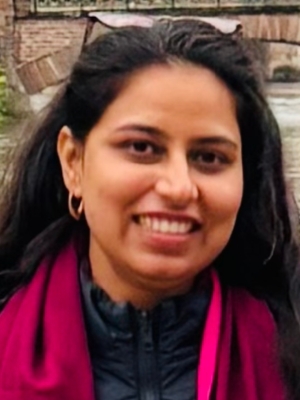
Gargi Lather
Postdoctoral Fellow
Chennai Mathematical Institute
Speaker
What can the signs of an eigenvector tell us about a graph? Can eigenvalues identify a particular class of graphs? I will explore these questions by comparing the ordinary graph Laplacian with two related matrices built from shortest-path distances and effective resistances.
Fiedler’s theorem says that the vertices corresponding to the nonnegative entries of an eigenvector for algebraic connectivity induce a connected subgraph, as do those corresponding to its nonpositive entries. This offers a useful perspective on dividing a network using eigenvectors. I will discuss a corresponding theorem for the resistance Laplacian, where the relevant eigenvector belongs to the largest eigenvalue. On unweighted trees, effective resistance equals path distance, so the result also applies to the distance Laplacian.
I will then turn to eigenvalues. A classical theorem characterises threshold graphs through a relationship between Laplacian eigenvalues and vertex degrees. An analogous characterisation holds for the distance Laplacian. For the resistance Laplacian, the corresponding formula fails for some threshold graphs but holds precisely for complete split graphs within the connected threshold class.
The talk will use examples throughout and assume no prior knowledge of spectral graph theory.
Speaker
Gargi Lather
Gargi Lather is a Postdoctoral Fellow at the Chennai Mathematical Institute. Her research spans algebraic combinatorics and spectral graph theory, with a particular interest in distance and resistance Laplacians. Her recent work explores graph partitioning and applications of spectral methods to data clustering. Before joining CMI, she was an Institute Postdoctoral Fellow at IIT Madras. She received her PhD in Mathematics from IISER Mohali, where she studied combinatorial and homological invariants of skeleton ideals of graphs.