Tuesday
28
April 2026
2:30 - 4:00 PM IST
Location
Room 202, School of Arts and Sciences
Central Campus
Share
Unveiling Hot Stars in Extreme Environments: A UVIT view of the Magellanic Bridge
Arts and Sciences Research Seminar Series
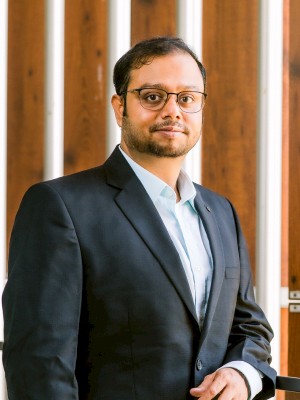
Samyaday Choudhury
Assistant Professor
School of Arts and Sciences
Speaker
Why do massive stars form in environments where they seemingly should not? I will highlight some key results from our recent ultraviolet (UV) studies of star clusters in a unique region of the Magellanic Clouds, based on observations from one of a kind Indian space observatory, AstroSat. The Magellanic Clouds, a pair of satellite dwarf galaxies of the Milky Way, provide physical and chemical conditions very different from our Galaxy, and closely resemble those of early galaxies. They host massive stars (more than 10 times the Sun’s mass) formed in young (10 to 100 million years) star clusters. The UV regime is crucial for studying such hot stars (surface temperature more than 15,000 K). Our studies utilise a small-aperture UV telescope (UVIT) onboard AstroSat observatory, which has a unique ability to conduct stellar-scale to galactic-scale studies, thanks to its high angular resolution and large field of view. By combining this data with other observations and comparing them with theoretical models, we identify and estimate the properties of young clusters and hot stars in the Magellanic Bridge – a bridge of stars and gas between the Magellanic Clouds. These studies are crucial for investigating the origin of UV-bright/massive stars in a harsh environment and deciphering the recent interaction history between the Magellanic Clouds.
Speaker
Samyaday Choudhury
Professor Samyaday Choudhury works on problems concerning stellar evolution, star formation and galaxy evolution by carrying out observational studies of star clusters and dwarf galaxies in the nearby Universe using multi-wavelength data and big-data in astronomy. He leads the Astronomy & Astrophysics Group and coordinates the IUCAA Centre for Astronomy Research and Development at Ahmedabad University. He earned his PhD degree from the Indian Institute of Science (Bengaluru). Prior to joining Ahmedabad University Professor Choudhury spent his postdoctoral years at the Space Telescope Science Institute (Maryland, USA), Macquarie University (Sydney, Australia) and Yonsei University Observatory (Seoul, South Korea).