Inclusive Net-Zero Transport in Cities of Gujarat
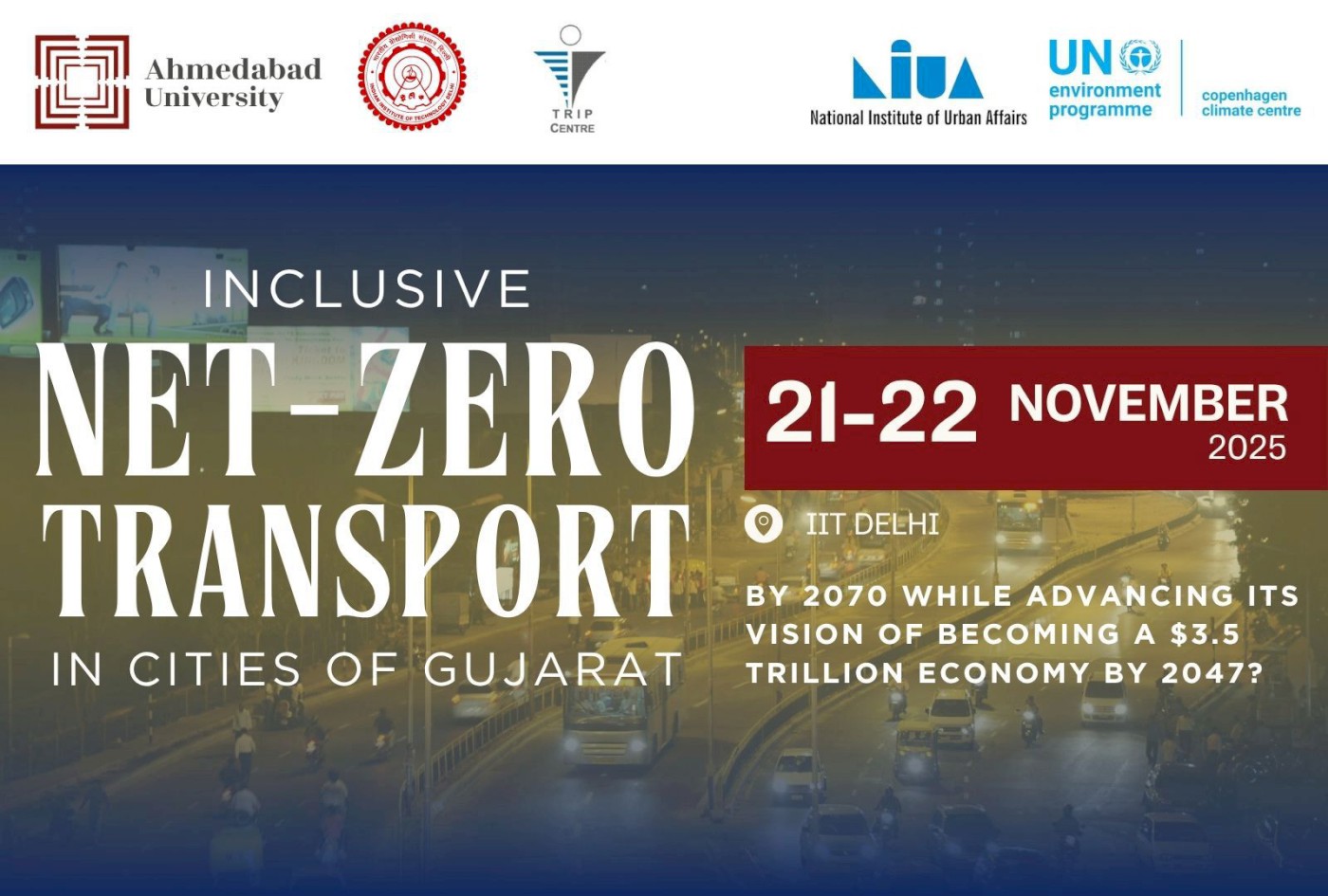
The project ‘Inclusive Net-Zero Transport in Cities of Gujarat’ emphasises an inclusive approach for achieving net-zero emissions within the transport sector. The project is a collaborative effort among Ahmedabad University, the Indian Institute of Technology (IIT) Delhi, and the UNEP Climate Centre Copenhagen (UNEP-CCC). The project is funded and supported by UNEP-CCC.
The project objectives include developing a detailed approach and methodology, studying the existing transport scenario, and proposing a scenario-based net-zero plan for the case city of Rajkot. Cities in the developing world need to improve upon the avoid-shift-improve strategies due to the limited capacities and archaic urban transport planning practices on one hand, and a significant population experiencing low mobility due to poor transport provisioning and lack of affordability. The project’s objective is to increase capacity and awareness among cities for net-zero transport planning and support these with roadmaps that will help cities reduce motorisation and improve coverage of zero-emission vehicles and zero-emission transit.
The project outlines three scenarios for 2030, 2040, and 2050: Business as Usual (BAU), a Technology Scenario for Net-Zero Emissions, and an Inclusive Net-Zero Emissions Scenario. The 2050 scenario is expected to link with the ‘Viksit Gujarat 2047’ vision, whereas India’s commitment is to achieve net-zero by 2070.
The key outputs of the project include-
- Defined net-zero transport for the Indian context
- Proposed indicators for a net-zero transport approach in the Indian context
- Created linkages between the net-zero approach and the Avoid-Shift-Retain (ASI) framework
- Assess the effectiveness of alternate pathways for net-zero transport at the city level while aligning it with ‘Viksit Gujarat 2047’
- Developed methods (spatial tools and worksheet-based methods) for studying the impacts of alternate pathways on emissions.
The key strategies identified for achieving inclusive net-zero include retaining the existing land use planning and opting for a better land use mix, promoting the usage of non-motorised transport and improving the infrastructure for public transport to encourage the modal shift from private vehicles to public transportation, for example, improving the public bus services. Technological improvements related to alternative fuels and vehicle designs, and related infrastructure and circular economy through scrappage policy and waste management monitoring are also part of the identified strategies.