Thursday
25
June 2026
4:00 - 5:30 PM
Location
Room 113, School of Arts and Sciences
Central Campus
Share
Calling Site Preference Helps Minimise Acoustic Interference Among Sympatric Bush Frogs
Faculty Lecture Series

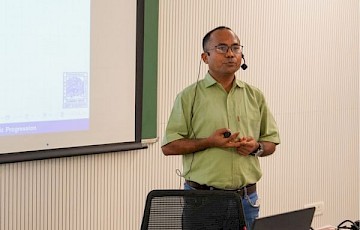
Shomen Mukherjee
Associate Professor
School of Arts and Sciences
Speaker
Among sympatric species, the degree of signal overlap strongly influences intraspecific communication. Signal interference presents the classic cocktail party problem, hence pose challenges for coexisting species as it can hinder the detection, recognition, and localisation of conspecifics. To overcome this challenge, sympatric species are expected to partition their acoustic space to minimise masking interference. We studied sympatric and closely related endemic frogs in coffee plantations of the Western Ghats, India. Acoustic communication during the breeding season is integral to these frogs, making them an ideal system to investigate possible strategies adopted by a community to minimise masking interference. Using calling site height and acoustics data, we show that the frog assemblage partition in multidimensional trait axes, such as call frequency and space. These results also reveal a novel coexistence strategy, where frogs with similar acoustic parameters partition more in their space use. Our findings broadly suggest that competition for acoustic space can drive signal and space-use partitioning and that vertical call site selection can enhance the minimisation of masking interference. This is among the few studies that test spatial stratification in conjunction with spectral stratification among coexisting species, and to the best of our knowledge, the first on amphibians.
Speaker
Shomen Mukherjee
Professor Shomen Mukherjee has been working in the field of Ecology for over two decades, focusing on questions related to species interactions and mechanisms of coexistence. He has been using evolutionary game theory to understand predators’ and competitors’ direct and indirect effects in shaping ecological communities. He has also studied how predatory stress affects the reproductive life-history traits of prey animals.
More recently, he has been using a community ecology approach to understand the ecology of disease. In particular, his research focuses on understanding how changes in ecological community structure affect the population dynamics and behaviour of vectors and their competitors. He has also been trying to understand how mosquitoes and the perceived risk of a vector-borne disease affect human behaviour, particularly in the context of social equity.
Before joining Ahmedabad University, Shomen was part of the core faculty group that conceptualised, developed, and executed the BS and BS (Honours) Biology degree programme at Azim Premji University, Bengaluru.
Shomen holds an MS degree in Wildlife Biology from the Wildlife Institute of India, and a doctorate from Ben-Gurion University, Israel. He has extensive research experience from working in different countries across the globe. He has taught both elective and core courses in Biology programmes in South Africa and India.