Wednesday
01
April 2026
2:30 - 4:00 PM IST
Location
Room 300, School of Arts and Sciences
Central Campus
Share
Arborescences and Shortest Path Trees when Colours Matter
Arts and Sciences Research Seminar Series
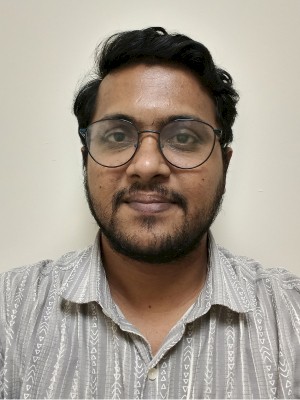
Sreejith K P
Institute Post-Doctoral Fellow
Department of Computer Science
IIT Madras
Speaker
Given an edge-colored (directed or undirected) graph, our objective is to find a specific type of subgraph, like a spanning tree, an arborescence, a singlesource shortest path tree, a perfect matching, etc., with constraints on the number of edges of each colour. Some of these problems, like colour-constrained spanning tree, have elegant solutions, and some of them, like colour-constrained perfect matching, are longstanding open questions.
In this talk, we study colour-constrained arborescences and shortest path trees. Computing a colour-constrained shortest path tree (CC-SPT) on weighted digraphs turns out to be NP-hard in general but polynomial-time solvable when all cycles have positive weight. This polynomial-time solvability is due to the fact that the solution space is essentially the set of all colour-constrained arborescences (CCARB) of a directed acyclic subgraph of the original graph. While finding CC-ARB of digraphs is NP-hard in general, we give an efficient algorithm when the input digraph is acyclic. Our algorithm generalises to the problem of finding a CC-SPT with the minimum total weight. Both our algorithms use a single-source shortest path algorithm and a (minimum cost) maximum flow algorithm as subroutines. By using the algorithm by van den Brand et al. (FOCS 2023) for these subroutines, our algorithms achieve near-linear running time when the edge weights are integral and polynomially-bounded in the size of the graph. Our approach can also be adapted to find the largest common independent set of two generalised partition matroids in near-linear time.
Speaker
Sreejith K P
Sreejith K P is an Institute Post-Doctoral Fellow in the Department of Computer Science at IIT Madras. He works on graph theory and graph algorithms, particularly perfect matchings, total colouring, colour-constrained subgraphs, and geometric intersection graphs. He did his PhD from IIT Palakkad under the supervision of Professor Deepak Rajendraprasad on the topic "Graphs and Posets as Intersection Patterns of Line Segments" and MTech from IIT Guwahati.