Monday
13
October 2025
4:00 - 5:30 PM IST
Location
Room 004, School of Arts and Sciences
Central Campus
Share
A Bird’s-Eye View of 21st-Century Astronomy
Arts and Sciences Lecture Series
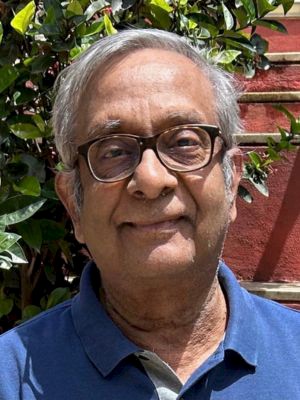
Rajaram Nityananda
Professor
ICTS Bangalore
Speaker
The exploration of the universe is exploding. The channel of communication extends over the entire electromagnetic spectrum from long radio waves to high-energy gamma rays. Astronomers now welcome new messengers, such as neutrinos and gravitational waves. The sources range from planets around the nearest star to the whole universe at a time when it was a thousand times smaller than it is now. Underlying this explosion is the technology of large telescopes and space missions, as well as the increasing power of recording and processing the data. Every branch of physics is pushed to its limits and makes full use of contemporary computational power. What has remained the same, over a century, is a tradition of international co-operation which, I would claim, makes astronomy unique among scientific pursuits. We have only one sky!
Speaker
Rajaram Nityananda
Rajaram Nityananda studied physics at Vivekananda College and IIT Madras, and completed his PhD under Professor S. Ramaseshan at the National Aeronautical Laboratory, Bangalore, in 1975. He joined the Raman Research Institute the same year, where he worked for nearly 25 years. From 2000 to 2010, he served as Director of the National Centre for Radio Astrophysics (NCRA–TIFR). This was followed by academic stints at TIFR Hyderabad, IISER Pune, and Azim Premji University (2014–2021). He is currently affiliated with the International Centre for Theoretical Sciences (ICTS), Bangalore. He is a Fellow of all three Indian science academies and has served as editor of Pramana, Journal of Astrophysics and Astronomy, and Resonance. He has a deep interest in teaching basic physics and in communicating physics and astronomy to a general audience.